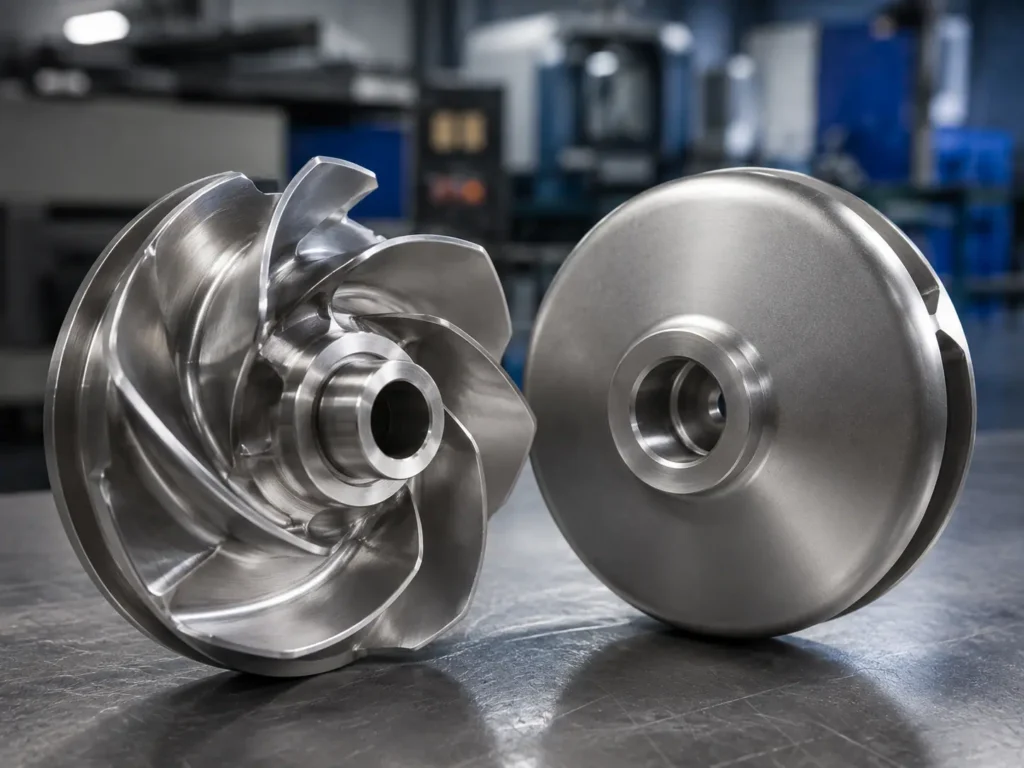
Impeller blade angle and pump performance are linked, but a larger outlet angle does not automatically improve the pump. Under simplified assumptions, increasing a backward-curved outlet angle can increase theoretical energy transfer; actual head, efficiency and shaft power still depend on flow losses and the complete hydraulic arrangement. Before accepting an angle change, confirm its measurement convention, the inlet and outlet geometry, operating range and validated performance evidence, not just one angle value.
First establish which angle is being compared
An impeller does not have one universal blade angle. The inlet angle, outlet angle and wrap angle describe different features. A quotation that says “improved blade angle” without identifying the feature and reference direction is not yet a technical proposal you can approve.
KSB’s vane explanation relates the blade shape to inlet and outlet velocity triangles. A useful design review therefore starts by locating the angle on the released geometry, rather than judging the curvature in a photograph.
| Angle or term | What it describes | What to confirm in a comparison |
|---|---|---|
| Blade inlet angle | Local blade orientation at the leading edge | Section, radius or span position, rotation and incoming-flow basis |
| Blade outlet angle | Local blade orientation at the trailing edge | Tangent/radial reference, section and whether the value is a metal angle or flow angle |
| Blade wrap angle | Angular extent of the blade around the impeller axis between defined inlet and outlet locations | Projection and endpoints; do not substitute it for outlet angle |
| Flow angle | Direction of a velocity vector under the stated velocity-triangle convention | Absolute or relative velocity, operating point and calculation assumptions |
The distinction between blade metal angle and fluid flow angle matters. Finite blades and real flow do not guarantee that the outlet velocity follows the metal exactly. KSB’s separate velocity-triangle reference also distinguishes absolute and relative flow angles. Do not exchange these terms in a drawing note.
A larger number can describe the same geometry
As a simple geometric illustration, an acute angle of 30 degrees measured from a tangent has a complementary angle of 60 degrees from the perpendicular radial reference in the same plane. Those two labels can describe the same line orientation. This is not a suggested pump design angle.
For curved or twisted blades, also identify the local tangent to the blade and the section where it is evaluated. An angle measured at the hub need not represent the entire blade span. Ask for an annotated section showing the reference, viewing side and rotation before comparing numbers from different suppliers.
Why a larger outlet angle can raise theoretical head
For a simplified radial outlet velocity triangle, take the blade angle from the backward tangential direction. With outlet peripheral speed and meridional flow velocity held fixed, increasing a backward-curved angle toward a radial orientation reduces the backward component of relative velocity. The idealized circumferential component of absolute outlet velocity then increases, raising theoretical energy transfer under a no-inlet-swirl assumption.
That explanation is conditional. It does not mean every physical redesign holds the other quantities fixed, or that the extra theoretical transfer appears as useful discharge head. Changing the blade profile also changes the passage through which the liquid moves.
In their low-specific-speed multistage pump study, Peng and colleagues examine outlet angle together with head, efficiency, shaft power and internal flow. The work illustrates why a hydraulic review must consider power demand and losses alongside head. Its findings apply to the studied configurations, not a universal angle prescription for unrelated pumps.
For procurement, the key question is: what was held constant, and what actually changed? Request the comparison basis before treating “larger outlet angle” as evidence of an improvement.
Why actual efficiency or head might not improve
An ideal triangle does not describe all losses in the impeller, diffuser or volute. Changes in flow guidance, separation and outlet conditions affect the resulting pump curve. Even when a calculation predicts higher energy transfer, the complete pump still needs evaluation.
There is direct evidence against a blanket rule. Ding and colleagues’ study of a high-specific-speed centrifugal pump reports decreasing measured head and efficiency as outlet angle increased across its tested designs. That is a model-specific result, not a recommendation to reduce every impeller’s angle. It demonstrates why the direction of a measured change cannot be assumed from the angle number alone.
Head, efficiency and shaft power are also different acceptance questions. A candidate that produces more head can still require unacceptable input power. A favorable efficiency result at one point does not demonstrate acceptable performance across the intended operating range.
Our recommendation is to compare the released baseline and proposed design on the same stated basis. Look for flow-head, efficiency and shaft-power curves, the speed and diameter used, liquid properties, and the required operating envelope. Identify simulation results as predictions and test results as measurements. Do not present one as the other.
Inlet angle is a different part of the decision
The inlet angle concerns how the incoming liquid approaches the blade leading edge. Matching the incoming relative flow to the blade is a different problem from controlling energy transfer at the outlet. An outlet-angle change does not automatically resolve an inlet mismatch.
A useful review identifies the inlet geometry, flow and speed conditions, and any inlet swirl assumed in the analysis. If suction performance is part of the project, request the appropriate suction-performance assessment instead of inferring a cavitation margin from a larger or smaller angle.
For a design operating over several duties, ask which condition the inlet geometry was designed around and how the remaining range was evaluated. A single design-point illustration cannot establish the entire operating envelope. The hydraulic owner should define acceptable evidence and limits before a revised component is released.
Compare the proposed change, not just two angle values
Use the following questions when evaluating a design revision or a supplier’s alternative. They are review prompts, not acceptance thresholds.
| Proposal or claim | Evidence to request | Reason to hold approval |
|---|---|---|
| Larger outlet angle gives better performance | Same-basis head, efficiency and power curves across the intended duties | Only theoretical head or one favorable operating point is supplied |
| The angle change solves suction problems | Inlet geometry, suction conditions and relevant validated assessment | No evidence connecting the proposal to the reported problem |
| Only the outlet angle has changed | Model comparison identifying every changed surface and dimension | Outlet width, blade length, thickness or passage geometry also changed without review |
| The part fits, so it is equivalent | Released hydraulic geometry and component/assembly acceptance criteria | Bore and diameter conformity are offered as proof of hydraulic equivalence |
| The new shape is easier to cast or finish | Manufacturing deviation with engineering disposition and revised inspection plan | Process convenience is treated as permission to alter hydraulic geometry |
An OEM comparing clean-water hydraulics might use this review to examine curve changes at constant speed. A process-equipment project also needs the specified liquid and service conditions in the comparison. A repeat-order buyer needs confirmation that manufacturing has preserved the approved design, not a new “optimized” angle introduced without authorization.
The wider pump impeller design review covers duty, materials, fit and other geometry variables. This article stays focused on interpreting angle changes and the evidence needed to approve them.
Preserve the approved angle through manufacturing
A blade angle is part of a three-dimensional surface, not an isolated number that the workshop can adjust independently. The released model should connect it to the leading and trailing edges, passage width, blade thickness and surrounding shrouds.
Matson reviews custom pump impeller manufacturing against drawings, samples and confirmed specifications. A manufacturing review should identify how the approved geometry will be produced and checked. It should not silently turn an RFQ into a hydraulic redesign project.
Before production, resolve:
- The governing drawing and model revision, including which file controls disputed geometry.
- Angle definitions, section locations, reference directions and rotation/viewing convention.
- The controlled blade profile and inspection method, not just a front outline.
- Permitted finishing and material-removal regions around hydraulic surfaces.
- How inaccessible passages and repeated blades will be checked under the agreed plan.
- Which departures require engineering approval and whether revalidation is required.
No generic angular tolerance is offered here. The design owner must specify the required acceptance criteria. A report confirming bore size and outside diameter does not establish the blade profile, and a balance report does not verify the hydraulic geometry.
For broader component anatomy, the impeller vanes guide addresses construction, wear and inspection access. Keep those checks linked to the angle definition without replacing them with a single measurement.
What to send with an angle-related RFQ
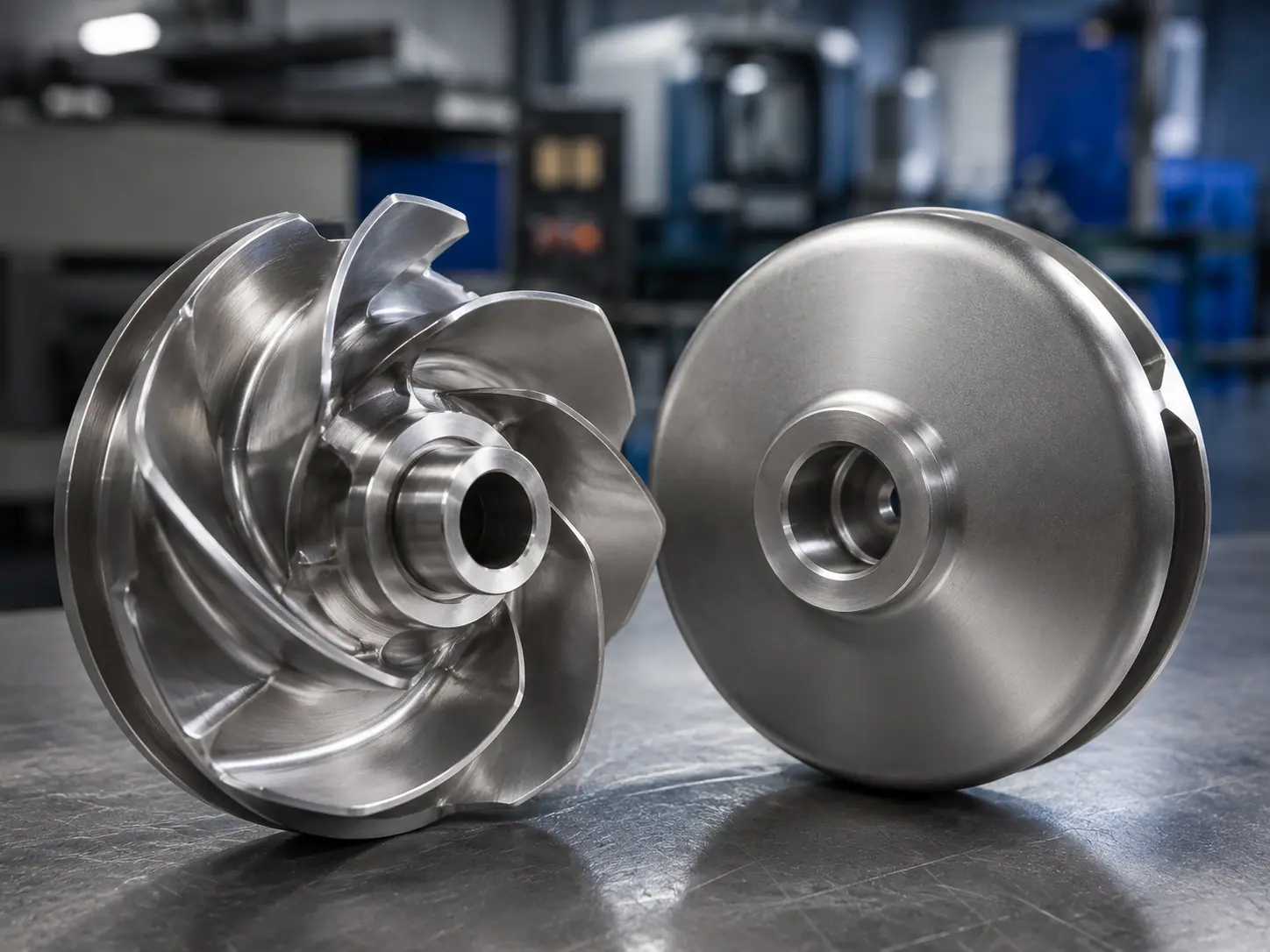
Send the approved drawing and 3D model, material grade and condition, quantity, component interfaces and inspection requirements. Add an annotated angle section and the curve or engineering reference that identifies the hydraulic design. State whether you want repeat manufacture of the released part or review of a proposed revision.
If a sample is the only reference, describe whether it is new, worn, repaired or previously modified. Trailing-edge loss and earlier grinding can distort the measured local angle. A supplier should not convert uncertain sample geometry into a new nominal design without a disposition from the responsible owner.
Define the supply boundary in the quotation. Matson’s manufacturing capabilities support component process and inspection review within the agreed scope. Hydraulic optimization, operating-limit approval and complete-pump performance validation should remain explicitly assigned rather than implied by a component quotation.
Questions to settle before changing the design
Does increasing the impeller outlet blade angle always increase pump head?
No. A simplified velocity-triangle comparison can predict higher theoretical energy transfer under fixed assumptions, but a physical redesign also affects the internal flow and losses. Actual pump head must be evaluated for the complete hydraulic arrangement. Ask for the baseline and proposed curves at the same speed, diameter and liquid condition. Do not approve a change from an angle value or theoretical-head calculation alone.
What is the difference between inlet angle, outlet angle and wrap angle?
Inlet and outlet angles describe local blade orientation at the leading and trailing edges under specified reference conventions. Wrap angle describes the angular extent around the axis between defined blade locations. They are not interchangeable. The drawing should identify the section, reference direction and viewing side for each value. A statement that the blade angle changed is incomplete until the actual geometric feature is identified.
Can two suppliers report different angles for the same blade?
Yes, if they use different reference directions, sections or definitions. An acute angle measured from a tangent differs from its complementary radial-reference angle even when the line orientation is unchanged. A three-dimensional blade also requires a defined span or section location. Request an annotated comparison before concluding that the parts differ. Keep blade metal angle separate from calculated relative or absolute fluid flow angle.
Can a larger outlet angle improve efficiency without changing motor requirements?
That cannot be assumed. Efficiency and shaft power need their own comparison across the intended operating range, alongside head and flow. A result at one duty does not demonstrate acceptable loading at every other duty. Request validated performance evidence and have the equipment owner assess drive requirements and operating limits. Do not infer unchanged motor suitability merely because the outside diameter and bore remain the same.
Can a manufacturer change the angle to simplify casting or machining?
Only through an approved engineering change when the modification affects the released hydraulic geometry. The proposal should identify changed surfaces, the reason, inspection consequences and any required performance validation. A process benefit is not permission to substitute a different blade profile. For repeat production, the approved drawing and model remain the manufacturing basis until the responsible owner releases a revision or a documented deviation.
Is a photograph or worn sample enough to define the original blade angle?
Usually not by itself. Perspective, hidden passages, three-dimensional curvature and service damage can obscure the original geometry. A worn trailing edge can also give a misleading local angle. Use the released drawing, model or an approved reconstruction basis wherever available. If uncertainty remains, identify it before quotation and release. Copying a measurable feature does not establish that it represents the original approved hydraulic design.
Final Thoughts
A larger outlet blade angle is a design change, not a performance guarantee. Confirm the angle definition, compare head, efficiency and power on a consistent basis, and preserve the released geometry through manufacturing and inspection. Matson can review custom impeller production against confirmed drawings and specifications. Keep hydraulic selection and validation with the responsible equipment engineer so that a manufacturing quotation does not imply an unapproved redesign.
Send your approved model, annotated angle section, material grade, quantity and inspection requirements through Matson’s RFQ contact page for a manufacturing review.