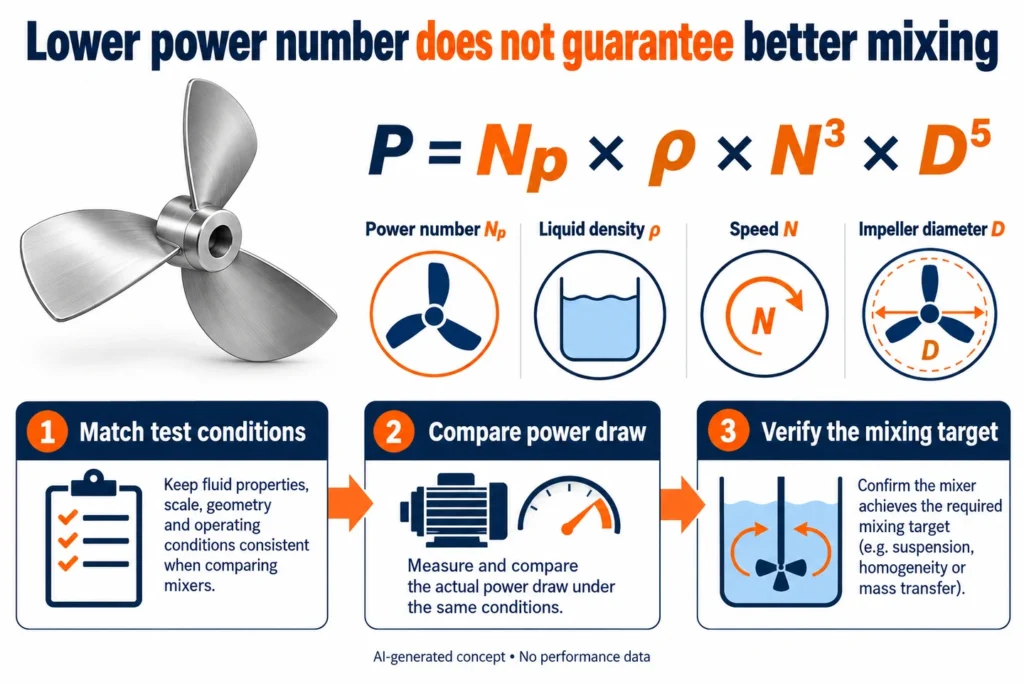
A lower mixer impeller power number is not automatically better. It indicates lower absorbed power only when density, rotational speed, impeller diameter and the applicable operating conditions are comparable. It does not prove faster blending, adequate solids suspension or acceptable product quality. Before choosing a low-power-number design, define the mixing result you need, confirm the coefficient’s test conditions and check the complete operating envelope—not just one number on a quotation.
What is mixer impeller power number?
Power number, commonly written as Np or Po and also called the Newton number, is a dimensionless coefficient used to relate impeller power to liquid density, rotational speed and diameter. It describes power consumption for a defined geometry and condition. It is not an efficiency percentage, a motor size or a manufacturing tolerance.
Using consistent SI units, the power relationship is also presented in Milton Roy’s industrial mixing fundamentals:
Np = P / (ρ × N³ × D⁵)
Rearranging:
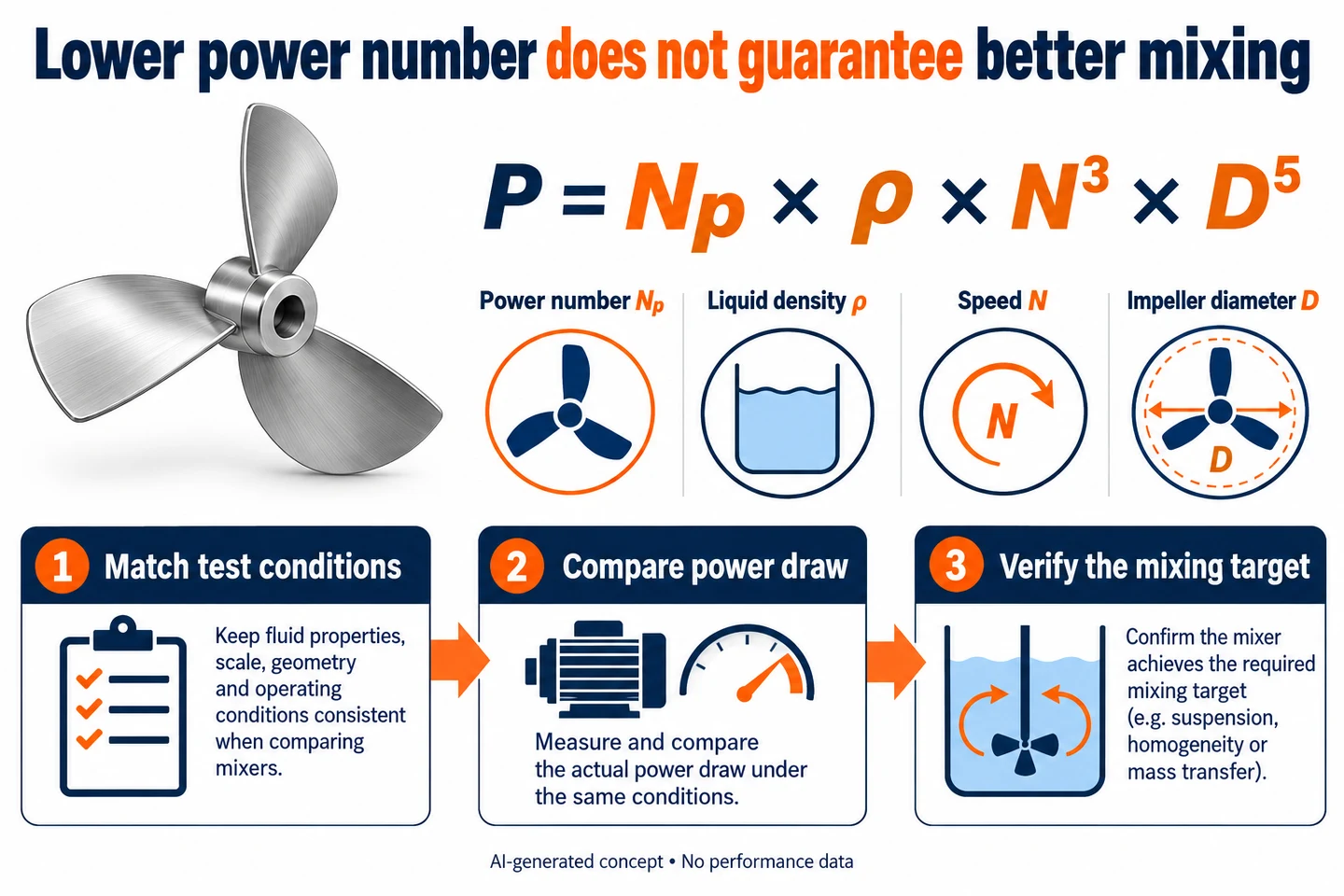
P = Np × ρ × N³ × D⁵
Here, P is the power transferred through the impeller to the liquid under the stated measurement convention. N is rotational speed in revolutions per second, not rpm. D is impeller diameter in metres, and ρ is density in kilograms per cubic metre. The calculated P is in watts.
A quoted coefficient needs a source: a manufacturer correlation, a documented test or an approved engineering model. A blade-family name alone is insufficient. The ProQuip explanation of mixing impeller power identifies geometry, size, speed and fluid properties as important inputs and cautions that power number also depends on the installed conditions. Its published equation uses a different input convention; do not combine symbols from different formulas without checking units.
| Input | SI basis used here | Before using it |
|---|---|---|
| Np: power number | Dimensionless | Confirm geometry, flow regime and test arrangement. |
| P: absorbed power | W | Identify where power is measured and how mechanical losses are handled. |
| ρ: liquid density | kg/m³ | Use density at the specified process condition. |
| N: rotational speed | Revolutions per second | Divide rpm by 60 before substitution. |
| D: impeller diameter | m | Use the approved finished diameter, not tank diameter. |
The units provide a useful check: kg/m³ multiplied by 1/s³ and m⁵ gives kg·m²/s³, which is a watt. If your calculation uses millimetres or rpm without conversion, the result is not the SI power described above.
A worked example: lower Np, lower power—but what mixing result?
Consider a hypothetical single-impeller comparison with density 1,000 kg/m³, speed 120 rpm and diameter 0.40 m. Assume the applicable coefficients are Np = 0.5 for Design A and Np = 1.0 for Design B. These are invented calculation inputs, not measured values for Matson products or recommended coefficients for a blade family.
Convert speed first: 120 / 60 = 2 revolutions per second.
- Design A: P = 0.5 × 1,000 × 2³ × 0.40⁵ = 40.96 W.
- Design B: P = 1.0 × 1,000 × 2³ × 0.40⁵ = 81.92 W.
At those matched inputs, Design A absorbs half the power. The calculation establishes that relationship and nothing more. It does not establish equal circulation, equal blend time or equal suspension quality. It also does not select a motor, gearbox or shaft.
Now consider a change in diameter. If Design A instead uses a 0.50 m impeller at the same speed and density, with Np assumed unchanged and still applicable, its calculated power becomes 125 W. The lower coefficient no longer means lower absolute power than the original Design B.
That is the practical trap: a quotation can advertise a lower power number while also changing diameter, speed or the required operating point. Ask for the complete inputs and the process result at those inputs. Do not compare the coefficients as if all other variables had stayed fixed.
When is a lower power number useful?
It is useful when it helps meet a defined process target with acceptable power demand and equipment requirements. The target must come first. Examples include a specified blend endpoint, a required suspension condition or a product-quality criterion under a defined batch cycle.
| Comparison situation | What lower Np tells you | What you still need to establish |
|---|---|---|
| Same density, speed, diameter and applicable conditions | Lower calculated absorbed power | Whether both designs meet the process target |
| Different diameters or speeds | No stand-alone ranking of absolute power | Calculate each operating point using applicable coefficients. |
| Same successful batch endpoint | One input to an energy comparison | Actual input energy over the full cycle and equivalent product quality |
| Solids suspension duty | Does not establish the suspension result | Specified solids distribution or suspension criterion at required conditions |
| Dispersion or shear-sensitive processing | Does not describe local shear by itself | Required dispersion outcome or acceptable product damage |
| Different test arrangements or flow regimes | Coefficients are not directly interchangeable | Matched basis or an approved correction/model |
| Repeat manufacture of an accepted design | Context for the approved hydraulic design | Controlled geometry, interfaces and component acceptance evidence |
The distinction between a coefficient and a process objective is important. ProQuip’s process-objective comparison guide discusses evaluating mixers against their intended task. The manufacturer’s point of view here is simple: do not authorize a geometry substitution until the responsible process owner has accepted the resulting design basis.
Lower instantaneous power is not necessarily lower batch energy
Energy depends on power over time. If one design takes longer to reach the same accepted endpoint, a lower power draw may not reduce energy per successful batch. Where power varies during processing, use the relevant power history rather than multiplying a convenient single reading by the whole batch duration.
Also identify the comparison boundary. Absorbed impeller power and electrical energy at the motor supply are not the same measurement. A purchasing comparison should specify whether it concerns fluid-side power, shaft power, electrical input or the complete production cycle. Otherwise, the claimed saving can move simply because the measurement location changed.
Why operating conditions change the interpretation
Reynolds number and viscosity
For a Newtonian liquid, a common impeller Reynolds-number definition is Re = ρND² / μ, where μ is dynamic viscosity in Pa·s. Reynolds number helps identify the flow-regime basis of a power correlation. It is not the pump-specific-speed parameter or the vessel’s rotational speed.
In a sufficiently turbulent regime for a specified arrangement, a power-number curve can approach a roughly constant value. That does not make the value universal. In laminar or transitional conditions, its relationship with Reynolds number matters. Request the applicable correlation or curve and its validity range instead of borrowing a constant from an unrelated design.
For a non-Newtonian product, do not insert one arbitrary viscosity into a Newtonian calculation and treat the result as validated. The responsible process engineer should establish the rheological model, relevant apparent-viscosity basis and correlation. If viscosity changes during a batch, review the limiting stages as well as the starting liquid.
Tank arrangement and baffling
Identify tank diameter, liquid height, bottom shape, baffles, impeller position and relevant internals. A coefficient measured in one arrangement may not represent another. A lower reading following a change in baffling is not automatically an improvement in useful mixing.
The LIGHTNIN Guide to Fluid Mixing includes a power-number/Reynolds-number determination exercise using a defined test vessel and impellers. That is the useful principle for RFQ review: the coefficient needs a stated experimental or correlation basis. This article does not reproduce its proprietary curves or assign those values to custom Matson components.
Multiple impellers and gas introduction
Do not assume that a single-impeller coefficient can be multiplied by the number of stages without considering interaction and spacing. Ask whether the reported power is per impeller or for the complete installed assembly. Record the count, positions and the normalization convention used for the quoted coefficient.
Likewise, identify whether the measurement is gassed or ungassed. Gas introduction can change the operating condition and the relevant power basis. EKATO’s technical-service documentation lists gassed/ungassed power numbers alongside mixing time, mass transfer and other test outputs. These are separate pieces of evidence, not interchangeable guarantees.
What should you compare instead of Np alone?
Use a small set of process acceptance requirements, not a longer list of unexplained coefficients. Each requirement should identify the measurement method and the condition at which the result must be achieved.
For liquid blending, define the endpoint, sampling locations and permitted time. For suspension, state whether the requirement is avoidance of persistent settled solids or a specified distribution throughout the vessel. For dispersion, identify the quality measurement that represents success. For sensitive materials, specify the damage or property change that is unacceptable.
These examples are acceptance questions, not process recommendations. A particular product may require additional controls, and the equipment/process owner must decide which test is suitable. EKATO’s discussion of mixing tasks likewise starts with the actual task rather than choosing equipment by one numerical descriptor.
Power number versus pumping number
Power number describes normalized power consumption. Pumping or flow number describes a normalized flow quantity under its defined convention. Neither alone establishes whole-tank mixing performance. If a proposal includes both, request the definition and measurement plane for the flow value and the conditions shared with the power data.
Do not convert a claimed impeller pumping rate into a guaranteed vessel turnover or blend time without the supporting model. Short-circuiting, circulation patterns and the installed arrangement can affect the connection between local discharge and the process result. For procurement, the acceptance test is more useful than an unsupported claim that the impeller “moves more liquid.”
Hydrofoil versus pitched-blade turbine comparisons
It is reasonable to investigate different impeller families, but the word “hydrofoil” does not provide a complete coefficient or a universal performance ranking. Use the exact geometry, operating point and evidence from the proposed design. Our hydrofoil impeller guide covers that component family; it does not replace the required application-specific correlation.
If your shortlist is specifically between these two families, the pitched-blade turbine versus hydrofoil comparison addresses their broader application and manufacturing differences. This power-number article focuses on how to judge the numerical evidence, not which family wins every duty.
From process data to a manufacturable impeller
“Supply a low-Np impeller” is not a controlled manufacturing instruction. The supplier needs the approved shape and interfaces. If an existing design has accepted process performance, the quotation should identify what geometry must be retained and which changes require approval.
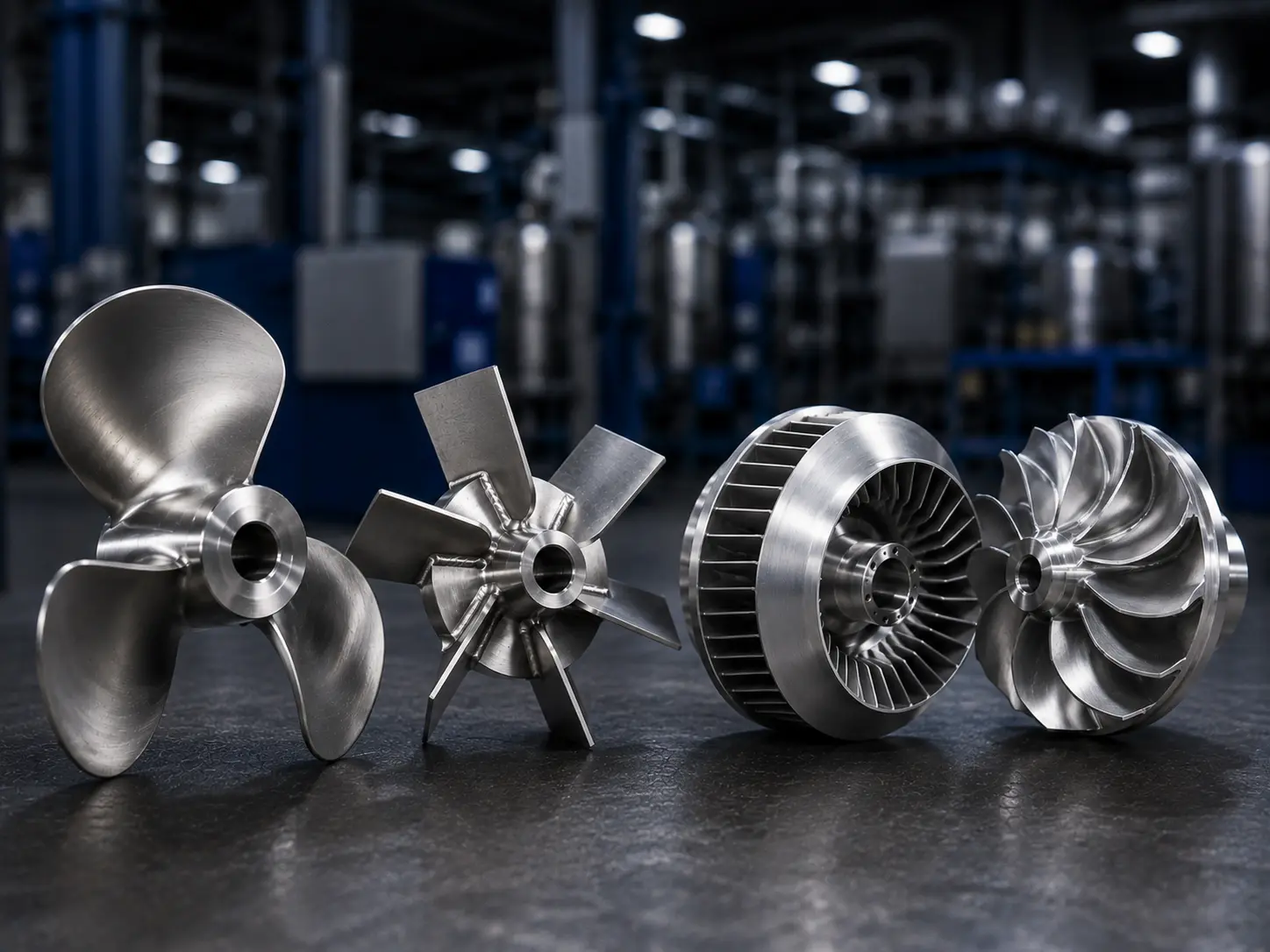
Control the finished diameter, blade count, blade profile, pitch or orientation, relevant curvature, thickness and hub relationship as required by the drawing. Also define the bore, shaft connection, seating faces and any assembly constraints. A photograph does not resolve those features with the same authority as an approved drawing.
Preserve approved geometry across repeat orders
Identify the drawing revision and approved reference before production. If a casting route, weld detail, blade finishing operation or hub arrangement changes, evaluate the affected drawing requirements. Do not silently replace a controlled blade profile with a visually similar shape because both are described using the same general impeller name.
This is where component manufacturing contributes: repeatable geometry, documented interfaces, agreed material and inspection records. It is not a substitute for process validation. A dimensional report confirms the measured requirements within its scope; it does not certify Np or mixing performance unless the order includes an appropriate, explicitly agreed test.
Keep motor and torque decisions separate
Do not select the drive from the worked power example above. The complete equipment review must cover the specified operating envelope and relevant mechanical conditions. Motor nameplate rating is not proof of absorbed impeller power. Drive and shaft approval remain with the responsible equipment organization.
If torque and rotational speed are used to determine shaft power, specify the measurement location, calibration and treatment of losses. A no-load correction should follow an approved method, not an assumed fixed percentage. The purpose is to keep the reported power tied to an intelligible boundary.
RFQ checklist for a power-number-sensitive project
| RFQ item | Information to provide | Approval responsibility |
|---|---|---|
| Process objective | Accepted endpoint, measurement method and operating envelope | Process/equipment owner |
| Power-number evidence | Value or curve, source, geometry, test conditions and applicability | Process/equipment owner |
| Fluid and vessel context | Density, rheology, temperature, liquid level, baffling, stage positions and gas condition | Process/equipment owner |
| Controlled part definition | Drawing/3D data, revision, blade geometry, hub and mounting interfaces | Design owner approves; manufacturer reviews production scope. |
| Material and finish | Exact grade, specifications, surface requirements and permitted processes | Buyer/design owner approves; manufacturer confirms route. |
| Component acceptance | Dimensional controls, traceability and balancing requirements where specified | Agreed buyer/supplier inspection plan |
| Process validation | Required tests, conditions, acceptance limits and who performs them | Explicitly assigned before order release |
| Commercial scope | Quantity, sample/pilot/batch needs, documentation and delivery expectations | Buyer and supplier |
For a sample-based order, record wear, deformation and prior repair. Distinguish a sample used to explain the part from an approved manufacturing master. If the original performance depends on uncertain geometry, establish an approval stage before reconstruction rather than asking the supplier to infer the original coefficient.
How Matson supports suitable custom projects
Matson manufactures custom mixer and agitator impellers from controlled project requirements. Suitable discussions include approved blade geometry, material, shaft interface, manufacturing route, surface finish and the inspection documents needed for OEM supply.
Share the process context to explain why the geometry matters, but separate the component order from complete-mixer performance approval. Matson’s manufacturing capabilities support casting, machining and quality discussions within the confirmed project scope. Do not interpret that scope as a promise to supply a proprietary low-Np design, conduct a mixing trial or guarantee a blend time.
Frequently asked questions
Is a lower mixer impeller power number always more energy efficient?
No. At matching density, speed, diameter and applicable conditions, a lower coefficient means lower absorbed power. Energy efficiency also requires a defined successful process result. Compare energy over the full accepted batch or operating cycle, including relevant losses and time. A lower instantaneous power reading is not an energy saving if the required mixing outcome is not achieved.
Should I put rpm directly into the power-number formula?
Not into the SI formula used here. Convert rpm to revolutions per second by dividing by sixty, use diameter in metres and density in kilograms per cubic metre, and calculate power in watts. Other published equations can use different units and conversion factors. Confirm the complete convention before comparing calculated results or adopting a supplier’s quoted coefficient.
Can motor nameplate power be used to calculate measured Np?
Not as a substitute for measured absorbed power. Nameplate power is a motor rating, not the actual power transferred to the liquid at a particular condition. Establish the measurement location, instrument method and treatment of mechanical losses. If the available data only show electrical input, ask the responsible engineer how that input relates to the required power boundary.
Can I use one turbulent power number for every viscosity?
No. Confirm the Reynolds-number range and conditions for which the coefficient applies. A turbulent plateau value should not be extended automatically into transitional or laminar operation. Non-Newtonian products require an appropriate rheological basis and correlation. For a batch whose properties change, assess the relevant stages rather than choosing one convenient viscosity from the initial liquid.
Does a low power number prove low shear?
No. Power number does not describe the local shear distribution or establish how a sensitive product responds. Identify the acceptable product-quality outcome and the conditions used to evaluate it. If the task requires dispersion, also define the desired result. The appropriate process test is more informative than assuming that a smaller global power coefficient guarantees gentler treatment.
Can I multiply a single-impeller coefficient by the stage count?
Do not assume that calculation is valid without reviewing spacing, interaction and the correlation basis. Clarify whether the reported coefficient describes one impeller or the installed assembly, and which diameter and speed define it. Use the approved multi-impeller model or test evidence. A list of separate blade coefficients does not independently establish the complete mixer’s absorbed power.
Will copying an accepted impeller’s dimensions guarantee its Np?
A controlled drawing supports repeatable manufacture, but dimensional acceptance alone does not certify a hydrodynamic coefficient. Confirm the relevant geometry, installed conditions and any required performance-validation method. If the order requires measured Np, assign the test scope and acceptance criteria explicitly. Do not treat a material certificate, balancing report or successful shaft fit as equivalent performance evidence.
What should I send Matson if low power consumption matters?
Send the approved drawing or model, material specification, quantity, mounting details and inspection requirements. Include the process context and any approved power-number data with its conditions. Identify which features are performance-critical and who authorizes changes. Matson can review the custom component scope; the responsible mixer or process organization should retain ownership of system selection and mixing-performance approval.
Final Thoughts
Choose a power-number basis you can explain, then test the proposed design against the mixing result that matters. Keep units, geometry, operating conditions and measurement boundaries consistent before comparing power demand. For custom production, translate the approved design into controlled drawings and an inspection plan. Matson can review that component package, while process validation remains a separately assigned requirement rather than an implied benefit of a lower coefficient.
Preparing a new or repeat OEM order? Send Matson your impeller drawing and RFQ package with material, quantity, mounting requirements and required inspection records. Flag any proposed geometry change or missing performance basis before quotation.