Impeller material verification is the documented confirmation that a manufactured impeller matches the material grade required by the approved drawing or purchase specification. It can combine supplier certificates, heat or batch traceability, positive material identification, laboratory chemistry, mechanical test records, hardness checks, and controlled part marking.
No single document or test proves every material property. A certificate connects the part to declared production data only when traceability is maintained. Portable alloy identification can support grade screening but may not verify every element, heat treatment, mechanical property, microstructure, or service condition. The buyer should define the required evidence before quotation.
Matson can review material-verification requirements for suitable custom pump, fan, blower, mixer, agitator, compressor, and industrial impeller projects. Final grade selection and acceptance should remain controlled by the buyer’s drawing, material standard, operating environment, and engineering owner.
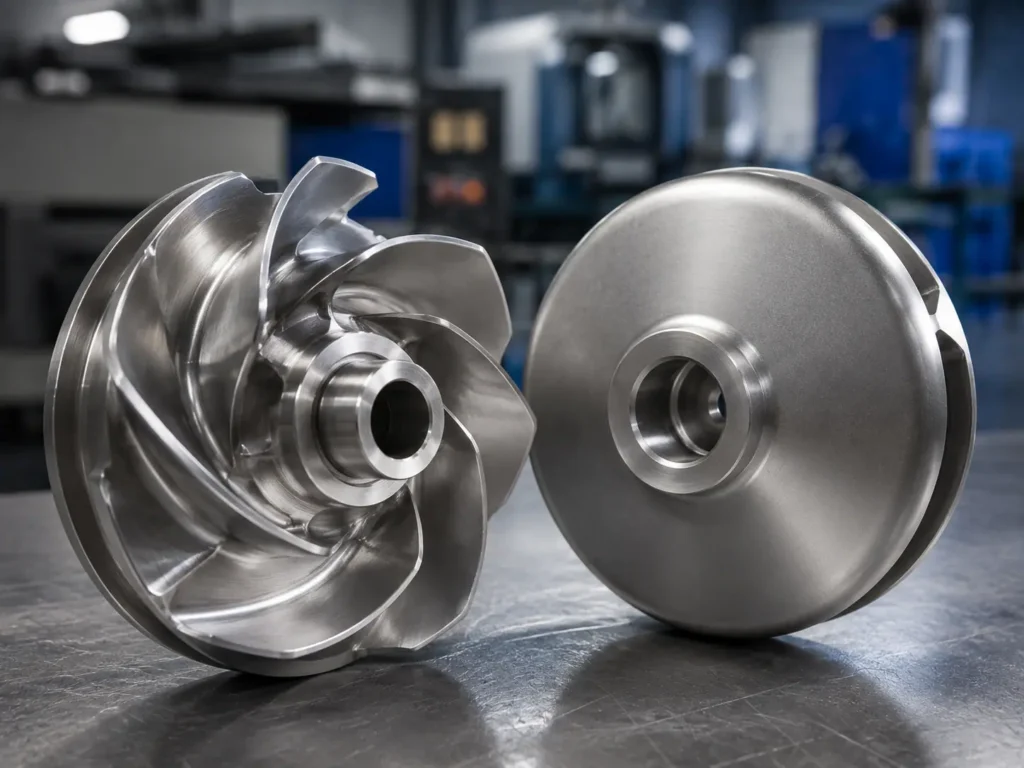
[Image placeholder: Add a real factory quality-control image showing a marked metal impeller beside its material certificate, heat or batch number, handheld alloy analyzer, and traceability label. Alt text: “Impeller material verification with certificate PMI and heat traceability”]
Material Selection and Material Verification Are Different
Material selection asks which grade fits the liquid, gas, temperature, solids, corrosion, abrasion, strength, weight, manufacturing route, and expected service life. Material verification asks whether the delivered impeller is actually linked to the grade that was approved.
The buyer should complete selection before production. The supplier then needs an acceptance plan that identifies the exact grade, governing specification, permitted equivalents, certificate type, traceability level, required testing, sampling, and marking.
The pump impeller material selection guide explains how stainless steel, duplex stainless, bronze, carbon steel, alloy steel, and wear-resistant materials should be reviewed against industrial pump service.
Build a Verification Package, Not One Checkbox
Different evidence answers different questions. Buyers should choose the package that matches project risk rather than adding vague notes such as “material report required.”
| Verification item | What it can support | Important limitation |
|---|---|---|
| Material certificate or mill/test report | Declared grade, heat or batch, chemistry, mechanical properties, heat treatment, and standard references when included | Useful only when the document is authentic, complete, and traceably linked to the impeller material |
| Heat or batch traceability | Connection between incoming material, casting batch, process records, test results, and finished part | A heat number stamped on a part is not enough if records do not show how identity was preserved |
| Positive material identification | Rapid alloy chemistry screening or confirmation using an agreed instrument and method | Method capability varies; it may not identify every element, condition, or property needed to distinguish grades |
| Laboratory chemical analysis | More complete chemistry verification using an agreed sample and test method | Sampling can be destructive and the tested location must represent the actual part or batch |
| Hardness testing | Support for material condition, heat treatment, wear alloy, or batch consistency where specified | Hardness alone does not prove exact alloy grade, chemistry, toughness, or corrosion resistance |
| Mechanical testing | Tensile, impact, or other specified properties from qualified samples or test coupons | A coupon must be produced and linked according to the applicable specification; it is not automatically identical to every local impeller section |
| Marking and receiving records | Part number, grade, heat, batch, serial, PO, and shipment linkage | Marking proves identity control only when it matches the underlying manufacturing and inspection records |
The right package may be a certificate plus traceability for a routine project, or it may add part-level identification, chemistry, hardness, and first-article records for a more critical OEM program.
Specify the Exact Grade and Standard
Broad names such as stainless steel, bronze, alloy steel, aluminum, or high-chrome material are not production specifications. Different grades within the same family can vary in chemistry, heat treatment, corrosion resistance, wear behavior, strength, casting response, machining, and cost.
The RFQ should state:
- Exact material designation
- Governing standard and edition if controlled by the buyer
- Casting, wrought, fabricated, or other product form
- Required condition or heat treatment
- Permitted equivalent grades, if any
- Chemistry and mechanical-property acceptance
- Certificate and test requirements
- Traceability and marking scope
Do not approve an “equivalent” based only on a supplier’s trade name. Compare the actual specification, chemistry, condition, properties, corrosion or abrasion context, manufacturing route, and buyer approval requirements.
Traceability Must Survive Every Process Step
Material identity can be lost when raw material is cut, melted, cast, heat-treated, rough-machined, sent for surface treatment, mixed with other batches, or returned from an external process.
A controlled route can link:
- Purchase order and approved material specification
- Incoming material or melt record
- Heat, lot, or batch identification
- Casting, fabrication, or machining traveler
- Heat-treatment and surface-treatment records where required
- Inspection and test results
- Finished-part marking
- Packing list and shipment documents
If a permanent mark will be removed during machining, the process needs an approved transfer method. If marking is prohibited on a balance-critical, sealing, fatigue-sensitive, polished, or visible surface, the drawing should identify a permitted location or alternative identification method.
Matson’s impeller manufacturing capabilities include suitable casting, CNC machining, surface treatment, dimensional inspection, dynamic balancing, material documentation, and export packing based on project requirements.
Understand What PMI Can and Cannot Prove
Positive material identification is useful when a buyer wants additional evidence that an alloy family or chemistry matches the expected grade. It can help screen incoming stock, check a casting, investigate a mixed-material risk, or verify selected finished parts.
However, PMI must be specified carefully:
- Instrument and method capability should fit the required elements
- Surface preparation may be needed to remove coating, scale, contamination, or oxidation
- Test location should represent the base material without damaging a critical surface
- Calibration or reference checks should follow the agreed procedure
- Result format should include part identity and test location
- Sampling should state whether it covers one part, each heat, each batch, or every part
Some grades cannot be reliably separated by a limited chemistry screen alone. Material condition, heat treatment, carbon level, microstructure, mechanical properties, or other characteristics may require a different or additional method. The buyer should not use the word “PMI” as a substitute for a complete acceptance requirement.
Coatings and Surface Treatments Can Mislead a Test
Paint, plating, thermal spray, oxide, scale, passivation residues, contamination, and surface buildup can interfere with direct base-material readings or visual identification. Test planning should identify whether verification occurs before or after coating.
For a coated impeller, the supplier may need to:
- Verify the substrate before coating
- Preserve a traceable uncoated witness area
- Use an approved local coating-removal and repair method
- Test a linked coupon when the specification permits
- Record both substrate and coating identities separately
A coating certificate does not prove the impeller substrate grade. Likewise, a substrate certificate does not prove coating preparation, thickness, cure, adhesion, or repair acceptance.
Certificates Need a Part-to-Record Link
A certificate should be reviewed for more than the material name at the top. Useful fields can include:
- Supplier or producer identity
- Certificate number and date
- Buyer PO and material specification
- Heat, lot, or batch number
- Product form and quantity
- Chemical results and limits where required
- Mechanical properties and limits where required
- Heat-treatment condition where applicable
- Test standard and result units
- Authorized review or approval
The finished impeller, packing list, and inspection report should carry enough identity to connect back to the certificate. Sending a generic certificate from the correct material family but an unrelated batch does not create traceability.
The custom impeller manufacturing documents checklist covers drawing control, material certificates, dimensional reports, balancing records, surface-treatment documents, photos, and packing evidence for OEM buyers.
Cast and Fabricated Impellers Need Different Attention
For a cast impeller, material verification may connect the melt, heat, casting batch, test coupon, heat treatment, rough casting, and finished part. The buyer should define whether testing represents each heat, batch, first article, or selected finished pieces.
For a fabricated impeller, the hub, blades, backplate, shroud, reinforcement, fasteners, and filler material can come from different sources or heats. The drawing should define which components require certificates and how their identity is recorded before assembly.
For a machined-from-solid impeller, the raw billet, bar, plate, or forging certificate should remain linked through cutting and machining. A leftover stock piece without controlled identity should not be accepted only because its appearance matches the specified alloy.
Sample-Based Projects Need Material Identification Early
Old impellers often arrive without a reliable material record. Color, magnet response, weight, corrosion pattern, sparks, or machining behavior can provide clues, but they are not a complete grade specification.
A worn sample may also contain:
- Repair welds with different filler chemistry
- Sleeves, inserts, balance weights, or fasteners of another alloy
- Coating, plating, or buildup
- Corrosion products and embedded process material
- Surface contamination from service
- Local material loss that changes hardness readings
Testing should target clean, representative base material and record the location. If destructive sampling is required, the buyer should approve where material can be removed. Once the likely grade is identified, the engineering owner still needs to confirm whether it remains suitable for the actual operating environment.
Material Verification Is Part of First-Article Approval
The first article should establish the material-control baseline for repeat production. The approval package can include the drawing revision, material requirement, certificate, heat or batch identity, test results, dimensional inspection, runout, balancing, surface treatment, deviations, and final disposition.
If the first article uses an alternative grade, temporary material, unapproved certificate, or incomplete traceability, the limitation must be recorded. A fit-check prototype made from substitute material should not silently become the approved production standard.
The custom impeller first article inspection guide explains how material, dimensions, runout, balance, documents, deviations, and reapproval triggers should be controlled before repeat orders.
Repeat Batches Need Consistent Sampling
The buyer should decide whether material verification applies to:
- Every incoming heat or batch
- Every casting melt
- First article only
- One or more pieces from each production batch
- Every finished impeller
- Selected high-risk components in a fabricated assembly
- Receiving inspection after shipment
More testing is not automatically better if identity control is weak. A strong plan combines traceability, risk-based sampling, suitable test methods, clear acceptance criteria, nonconformance handling, and retained records.
Any change in grade, producer, material source, product form, heat treatment, casting route, or verification method should follow the buyer’s change-control rules. Repeat orders should not rely on an old certificate when the source or batch has changed.
What to Do When Results Do Not Match
An out-of-specification or unexpected result should trigger controlled review, not immediate relabeling or undocumented retesting.
Record:
- Part, heat, batch, and certificate identity
- Test method, instrument, operator, and location
- Surface condition and preparation
- Actual result and required limit
- Retest or laboratory-confirmation plan
- Segregation of affected material and finished parts
- Root-cause and traceability review
- Buyer disposition and corrective action
If the first reading may be affected by coating, contamination, calibration, access, or method limitation, a qualified retest can be appropriate. The reason and result should be documented. Material should not be released until the agreed acceptance process is complete.
Impeller Material Verification RFQ Checklist
Send the following before quotation:
- Controlled drawing and exact material designation
- Governing material and product-form specification
- Required heat treatment or condition
- Permitted equivalent grades and approval process
- Certificate type and required reported values
- Heat, lot, batch, or part-level traceability
- PMI, chemistry, hardness, mechanical, or microstructure tests where required
- Test method, location, frequency, and acceptance limits
- Coating or surface-treatment sequence and substrate-verification stage
- Marking content, method, and permitted location
- First-article and repeat-batch sampling
- Nonconformance, retest, segregation, and buyer-disposition process
- Record retention and report format
- Sample condition and destructive-test permission where applicable
- Quantity, annual volume, packing, and shipment-identification needs
This information lets the supplier evaluate material sourcing, batch segregation, testing access, certificate flow, part marking, subcontracted processes, reporting, and cost before production begins.
Common Questions Buyers Ask
What is impeller material verification?
It is the documented confirmation that an impeller matches the material grade required by the approved drawing or purchase specification.
Is a material certificate enough to verify an impeller?
It can be sufficient for some projects when authentic records and traceability link the certificate to the finished part. Higher-risk projects may also require PMI, laboratory chemistry, hardness, mechanical testing, or part-level marking.
Can PMI identify every impeller alloy grade?
Not always. Capability depends on the instrument, method, elements that distinguish the grades, surface condition, and required material properties. Additional testing may be needed.
How should material be verified on a coated impeller?
Verify the substrate before coating or use an approved witness area, linked coupon, or local removal-and-repair method. The test plan should avoid confusing coating chemistry with base material.
Can Matson provide impeller material verification records?
For suitable projects, Matson can prepare agreed certificates, traceability, identification, and verification records when the grade, method, sampling, acceptance, and report scope are confirmed before quotation.
Need an impeller material verification plan reviewed for custom manufacturing? Send Matson the drawing, material grade, standard, certificate scope, traceability level, test method, sampling, coating condition, quantity, and report requirements through the custom impeller quote page.