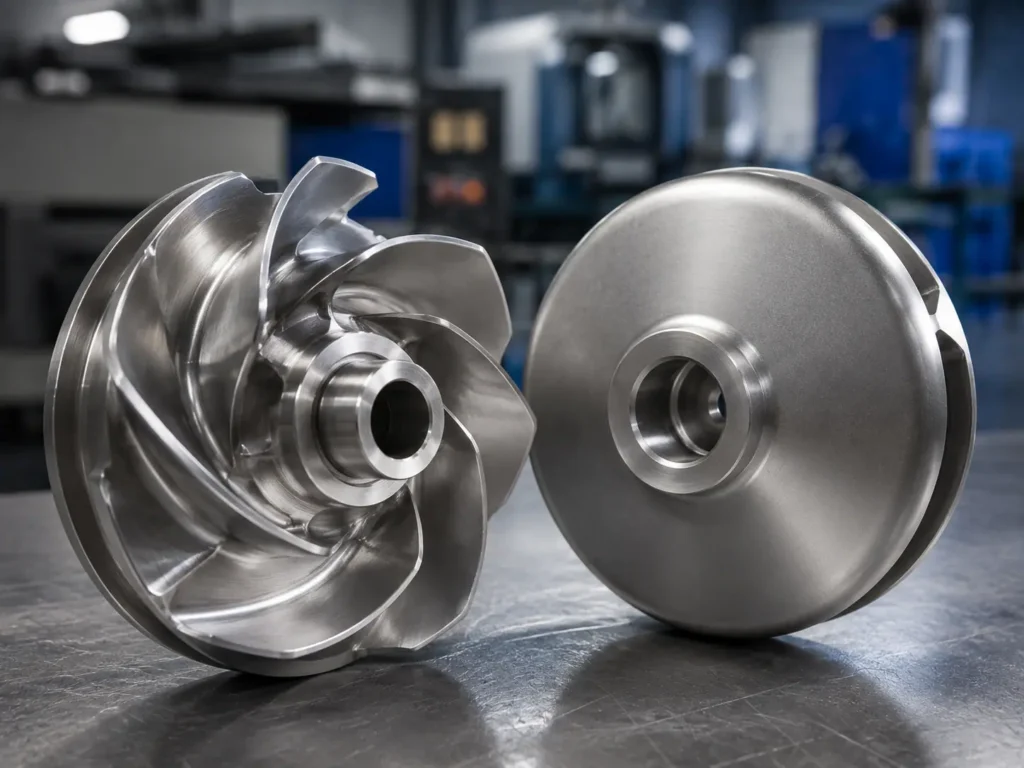
Custom impeller prototype manufacturing is the controlled production of one or a small number of impellers to verify geometry, fit, material, manufacturing route, inspection, balancing, and documentation before a larger OEM batch. A useful prototype is built around a written approval plan; it is not simply a low-quantity production order.
The buyer should state what the prototype must prove. A fit-check sample, process-representative casting, functional equipment trial part, first article, and pilot batch have different purposes. The drawing revision, material, machining condition, surface finish, balance requirement, inspection scope, and approval decision should be agreed before manufacturing begins.
Matson can review suitable prototype and pilot-run projects for custom pump, fan, blower, mixer, agitator, compressor, and other industrial impellers from drawings, 3D models, physical samples, and project specifications. Final hydraulic, aerodynamic, mixing-process, and equipment-performance approval remains with the OEM or engineering owner.
[Image placeholder: Add a real factory image showing one custom impeller prototype beside its controlled drawing, inspection report, material record, and a small approved pilot batch. Alt text: “Custom impeller prototype manufacturing with drawing inspection and pilot batch”]
A Prototype Needs a Defined Question
“Make one sample first” sounds cautious, but it does not define success. The prototype plan should identify the risk being reduced.
Typical questions include:
- Does the bore, hub, keyway, mounting face, or flange fit the mating assembly?
- Does the impeller clear the casing, inlet cone, wear plate, tank, or nearby hardware?
- Can the proposed casting, fabrication, or CNC route reproduce the geometry?
- Can the selected material be processed and documented as required?
- Are critical vane, shroud, blade, and passage features measurable?
- Can runout and dynamic-balancing requirements be achieved in the specified condition?
- Does the buyer need an equipment trial before releasing the pilot batch?
The prototype should be designed to answer the highest-risk questions first. It is wasteful to apply a complete cosmetic finish to a fit-check sample if the bore and axial position have not yet been approved.
Matson’s custom industrial impeller manufacturing work covers drawing-based, sample-based, prototype, pilot-run, and repeat OEM projects when material, tolerance, inspection, and quantity requirements are defined.
Prototype, First Article, and Pilot Batch Are Different
These terms are often used as if they mean the same thing. They should be separated in the purchase order and approval record.
| Stage | Main purpose | What must be clear |
|---|---|---|
| Concept or geometry sample | Review overall shape, access, envelope, or a manufacturing idea | Which material, finish, dimensions, and functions are intentionally non-production |
| Fit-check prototype | Verify shaft, hub, face, flange, casing, clearance, or assembly interfaces | Functional datums, mating parts, critical dimensions, and whether the part is safe for rotation or only static fitting |
| Process-representative prototype | Test the planned casting, machining, fabrication, finishing, and inspection route | Which production tooling, material, processes, and documents must match the intended batch |
| First article | Formally verify the first manufactured part against the controlled production definition | Ballooned drawing, material, full or agreed inspection scope, deviations, and approval status |
| Pilot batch | Confirm repeatability, throughput, inspection sampling, packing, and batch control in small quantity | Approved baseline, batch quantity, acceptance plan, process changes, and release conditions for production |
A prototype can become the first article only if it was produced and inspected under the agreed production conditions. A hand-finished development part should not silently become the master for repeat production.
Freeze the Input Before Cutting Metal
Prototype work moves quickly only when the input is controlled. The minimum package usually includes:
- 2D drawing and revision
- 3D model and revision where geometry requires it
- Units, general tolerances, datums, and critical characteristics
- Exact material grade or approved alternatives
- Intended manufacturing route or permission for supplier review
- Mating shaft, sleeve, key, nut, flange, casing, wear ring, or interface dimensions
- Operating speed and balance requirement
- Surface treatment, polishing, passivation, coating, or painting notes
- Inspection report and certificate requirements
- Prototype quantity and the decision expected after review
When 2D and 3D data conflict, the buyer should issue a written clarification. A prototype should not be used to discover which file the supplier guessed was correct.
Choose a Route That Matches the Prototype Goal
The fastest prototype route is not always the best route for production learning.
Direct CNC machining from billet or plate can avoid casting tooling and may suit a low quantity, simpler geometry, or an early fit-check. However, a billet-machined prototype does not prove that a later casting will fill, solidify, clean, machine, and balance in the same way.
Casting plus CNC finish machining may better represent the intended production route, but tooling, pattern preparation, casting variation, and process lead time must be included. Fabrication can fit selected fan, blower, mixer, and custom structures, while weld sequence and distortion need control.
The buyer should ask two questions:
- What is the lowest-risk way to answer the current prototype question?
- Which process must be represented before production approval?
Matson’s impeller manufacturing capabilities include suitable casting, CNC machining, surface treatment, dimensional inspection, dynamic balancing, documentation, and export packing based on project requirements.
Prototype Material Should Not Be Changed Casually
A substitute material can be acceptable for a dimensional mock-up, but the limitation must be written into the prototype plan. Material changes can affect casting shrinkage, machining behavior, weight, stiffness, corrosion, abrasion, surface treatment, weld procedure, heat treatment, and balancing.
If the prototype is intended for equipment testing, use of an alternative grade requires approval from the equipment owner. A part that fits the shaft is not automatically suitable for liquid, temperature, solids, chemical, marine, mining, HVAC, or process service.
For a process-representative prototype or first article, the material grade, certificate type, heat or batch traceability, and any permitted equivalence should match the production requirement unless the buyer authorizes a deviation.
Drawing-Based and Sample-Based Prototypes Need Different Controls
A controlled drawing gives nominal geometry and tolerances, but it may still contain missing notes or conflicts with the mating assembly. A physical sample provides real geometry, yet it may be worn, corroded, bent, repaired, trimmed, sleeved, or missing original balance corrections.
For sample-based prototypes, record:
- Which features appear reliable
- Which surfaces are worn or damaged
- Which dimensions come from the mating equipment
- Which geometry has been reconstructed
- Which deviations require buyer approval
- Whether the sample represents the last accepted design or only a failed service part
Do not add a uniform offset to a worn sample and call it a restored design. Bore wear, vane erosion, reduced OD, rubbed faces, old welds, and coating buildup require feature-specific decisions.
Fit Approval Comes Before Performance Claims
An impeller prototype can be dimensionally correct and still fail to deliver the required pump curve, airflow, pressure, mixing result, efficiency, noise, or service life. Manufacturing inspection and equipment-performance validation are separate responsibilities.
Matson can review whether a prototype matches the supplied drawing, material, machining, surface, runout, balance, and document requirements. The pump OEM, fan designer, mixer engineer, compressor owner, or equipment manufacturer should define the operating test, instrumentation, acceptance limits, and safety controls.
Useful equipment feedback is specific. Instead of “performance not good,” record the tested assembly, speed, flow or airflow condition, pressure or head, power, vibration, noise, temperature, clearances, rotation direction, and observed contact or wear. The engineering owner can then decide whether the issue comes from the impeller definition, assembly, operating point, or another system component.
Inspect the Prototype Against Its Purpose
A fit-check part may need intensive inspection of the bore, hub height, mounting face, flange, keyway, OD, width, and clearance surfaces. A process-representative prototype may add material traceability, complete profile checks, surface treatment, runout, balancing, and production documents.
The inspection plan should identify:
- Controlled drawing and model revision
- Ballooned characteristics or marked critical dimensions
- Datum and mounting setup
- Measurement method and report format
- As-cast, rough-machined, and finished inspection stages
- Surface finish and coating condition
- Runout and balancing condition
- Approved deviations and reinspection
- Final disposition: approved, conditionally approved, revise and remake, or rejected
The custom impeller first article inspection checklist explains how material, dimensions, runout, balance, documents, deviations, and reapproval triggers should be recorded for OEM approval.
Balance the Correct Configuration
Prototype balancing needs the same configuration definitions expected for the final product. Buyers should state whether the impeller is balanced alone, on a specified arbor, with a key convention, with a sleeve or hub component, or as a larger rotor assembly.
Balancing before final machining, coating, polishing, weld correction, or assembly can produce a result that no longer represents the delivered part. The prototype plan should define the final balance stage, acceptance requirement, correction zones, prohibited removal areas, and report needs.
A fit-only mock-up that will never rotate may not need production balancing. That limitation should be clearly marked so the part is not accidentally installed for operation.
Prototype Feedback Must Become Controlled Data
The prototype itself is not enough. Buyer feedback should produce an updated drawing, model, inspection plan, approved deviation, or written acceptance record.
Avoid instructions such as:
- Make the bore a little tighter
- Grind this edge slightly
- Use the same correction as the sample
- Move the hub about two millimeters
- Polish it more next time
Those comments are understandable during development but unreliable for repeat manufacturing. Convert them into dimensions, tolerances, datums, surface requirements, material notes, process instructions, or marked drawing revisions.
If an equipment test requires a geometry change, identify whether the existing prototype will be reworked or a new revision will be made. Record which test result belongs to which physical part and drawing revision.
Move From Prototype to Pilot Batch Carefully
Approval of one part does not prove stable batch production. Before a pilot run, confirm:
- Approved drawing, model, and prototype status
- Tooling, pattern, fixture, gauge, and CNC program revisions
- Material grade and certificate requirements
- Process sequence and subcontracted operations if any
- Critical dimensions and sampling plan
- Surface treatment and visual standard
- Balance requirement and correction method
- Part marking and traceability
- Packaging method and protection of machined surfaces
- Change-control and nonconformance process
The pilot batch should test repeatability, not reopen every design decision. Any approved change should be incorporated before the batch starts.
For projects moving into recurring supply, Matson’s OEM impeller repeat-order checklist covers drawing control, material consistency, inspection, balancing, packing, lead time, and batch documentation.
Why Prototype Unit Price Is Often Higher
Prototype cost includes work that is spread across more parts in production: drawing review, process planning, programming, tooling, fixtures, gauges, casting setup, inspection reports, balancing setup, communication, and approval records.
The buyer should compare total development risk rather than only prototype unit price. A cheap part with unclear material, uncontrolled dimensions, no report, and a non-repeatable process may create more cost before production begins.
Ask the supplier to separate one-time and repeat costs where practical:
- Pattern, mold, fixture, gauge, or programming cost
- Prototype part cost
- Inspection and document cost
- Balance or special-process cost
- Pilot-batch price
- Expected production price at stated quantities
The price should also state what happens if the drawing changes after tooling or machining begins.
Custom Impeller Prototype RFQ Checklist
Send the following before quotation:
- Prototype purpose and approval question
- Controlled 2D drawing and 3D model with revision
- Physical sample and condition notes where applicable
- Impeller type, application, and mating equipment interfaces
- Exact material grade and permitted alternatives
- Prototype quantity, pilot quantity, and expected annual volume
- Production-intended manufacturing route or supplier-review permission
- Critical dimensions, datums, tolerances, and surface finish
- Operating speed, runout, and dynamic-balancing requirements
- Material, dimensional, surface-treatment, and balance documents
- Equipment-test owner, test conditions, and feedback format
- Prototype approval states and deviation process
- Tooling, drawing, model, program, and sample ownership requirements
- Target schedule, shipping destination, and packing needs
- Conditions for release to pilot or repeat production
This information helps the supplier quote a controlled development step rather than an undefined one-piece order.
Common Questions Buyers Ask
What is custom impeller prototype manufacturing?
It is the controlled manufacture of one or a small number of custom impellers to verify specified geometry, fit, material, process, inspection, balance, and documentation before larger OEM production.
Is an impeller prototype the same as a first article?
Not automatically. A prototype can explore geometry or fit using non-production conditions. A first article formally verifies a part made to the controlled production definition and agreed inspection scope.
Should a prototype use the final production material?
Use the final material when the prototype must represent casting, machining, weight, balance, surface treatment, or equipment service. A substitute may suit a dimensional mock-up only when its limitation is documented and approved.
Can Matson manufacture an impeller prototype from a worn sample?
For suitable projects, Matson can review worn samples with photos, mating dimensions, material information, and buyer-approved reconstruction decisions. Damaged features should not automatically become production geometry.
What happens after the prototype is approved?
Update and freeze the approved drawing, model, process, inspection plan, material, balance condition, deviations, marking, and packing requirements before releasing a pilot batch or repeat order.
Need a custom impeller prototype manufacturing project reviewed? Send Matson the prototype goal, drawing, model, sample photos, material, critical dimensions, intended production route, quantity, inspection, balance, and approval requirements through the custom impeller quote page.