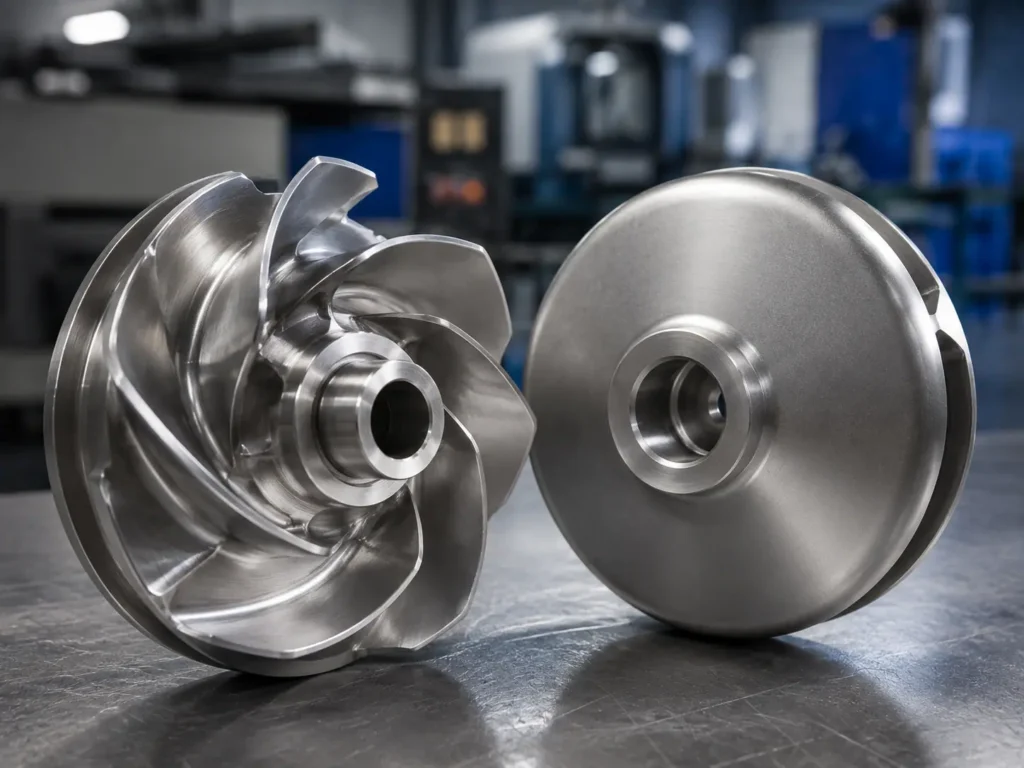
OEM buyers should request the documents that prove the custom impeller was made to the approved drawing, material, inspection requirement, balance requirement, and shipment condition. For most custom pump, fan, blower, mixer, agitator, compressor, and industrial equipment impellers, the practical document set includes the approved drawing or revision, material certificate, dimensional inspection report, dynamic balancing report when required, process or surface-treatment notes, pre-shipment photos, and packing documents.
Short answer: do not ask for “all certificates” in a vague way. Tell the manufacturer which documents are needed before quotation, because material testing, dimensional checks, balancing, photos, and packing records must be planned before production and shipment.
Matson supports custom industrial impeller projects from drawings, 3D files, samples, and buyer specifications. The document package should match the project risk: a one-piece sample review may need fewer records than a repeat OEM batch, but the critical material, fit, balance, and inspection requirements should still be clear.
[Image placeholder: Add a real factory image showing an impeller inspection setup with drawing printout, calipers, material certificate, balance report, and packed finished impeller. Alt text: “Custom impeller manufacturing documents including drawing inspection certificate and balancing report”]
The Core Document Set Buyers Should Request
For a custom impeller project, documents are not paperwork after the job. They are part of manufacturing control.
The buyer should first decide which documents are mandatory for internal approval, import, customer acceptance, equipment warranty, or repeat orders. Then the manufacturer can quote the project with the right inspection time, testing route, report format, and packing method.
| Document | Why buyers request it | What to confirm before production |
|---|---|---|
| Approved drawing and revision | Defines the geometry, tolerances, material, surface finish, and inspection points. | Revision number, missing dimensions, datum points, critical surfaces, and approval status. |
| Material certificate | Shows the material grade used for casting, machining, or fabrication. | Grade, standard, chemical composition, heat treatment, mechanical data if required, and certificate format. |
| Dimensional inspection report | Confirms critical fit dimensions before shipment. | OD, bore, hub height, keyway, mounting face, wear surfaces, vane features, and tolerance points. |
| Dynamic balancing report | Supports rotating stability for speed-sensitive equipment. | Balance grade, correction plane, speed or operating context, report requirement, and acceptance rule. |
| Surface treatment or coating record | Confirms passivation, polishing, coating, painting, or other finishing work. | Required finish, masking areas, coating thickness, passivation need, and inspection method. |
| Pre-shipment photos | Help the buyer check visible condition, marking, packing, and key surfaces before dispatch. | Photo angles, marked dimensions, nameplate or label, packing condition, and quantity. |
| Packing and export documents | Reduce logistics confusion and import delays. | Packing list, invoice, crate marking, gross weight, HS code if needed, and destination requirements. |
Drawing and Revision Records
The approved drawing is the first document to control. If the drawing is old, incomplete, or different from the physical sample, the buyer should resolve that gap before production.
For custom impellers, the drawing should define more than outside diameter. It should control the bore, hub height, mounting face, keyway, shaft fit, wear-ring or sealing surfaces, vane geometry, rotation direction, surface finish, material grade, tolerance notes, and balance requirement. If a 3D model is used, keep the 2D drawing or inspection note as the control document for tolerances and acceptance.
This is especially important for repeat orders. A buyer may approve a first sample, then reorder six months later. Without a stable drawing revision and inspection record, the second batch can drift even if the visible impeller shape looks similar.
For projects that start from a sample instead of a drawing, Matson’s guide to custom impeller from drawing or sample explains why worn areas, broken vane edges, enlarged bores, and old welds should not be copied blindly.
Material Certificates
A material certificate matters when the impeller works in corrosion, abrasion, heat, seawater, chemical liquid, slurry, wastewater, or food/process equipment. It also matters when the buyer has an OEM specification, end-user approval process, or import documentation requirement.
For stainless steel, duplex stainless, bronze, brass, carbon steel, alloy steel, aluminum, heat-resistant steel, or high-chrome wear alloys, the buyer should state the exact grade and standard if one is required. “Stainless steel” is not enough. “Bronze” is not enough. “Same as old part” is not enough unless the old part has a reliable material test or certificate.
Ask what the certificate will show. Some projects only need chemical composition. Others need heat treatment, mechanical properties, hardness, or a standard-specific report. If the buyer needs a third-party inspection or special test, that should be stated before the quote.
Matson’s impeller manufacturing route can include material documentation, casting, CNC machining, surface treatment, dimensional inspection, dynamic balancing, and export packing when the requirement is defined.
Dimensional Inspection Reports
The dimensional report should focus on the surfaces that decide fit, clearance, and rotation. A long report full of easy dimensions is less useful than a shorter report that checks the right features.
For pump impellers, important points often include bore size, keyway, hub height, mounting face, outside diameter, wear surfaces, shroud areas, vane outlet width, eye diameter, and clearance-related surfaces. For fan and blower impellers, hub fit, blade spacing, runout, diameter, width, inlet fit, weld condition, and balance-related areas may matter. For mixer and agitator impellers, shaft connection, blade angle, blade flatness, runout, surface finish, and weld condition may be more important.
The buyer should mark critical dimensions on the drawing. If a dimension is only approximate, say so. If a surface must assemble with another part, provide the mating dimension or equipment-side requirement.
Balancing Reports
Not every impeller needs the same balancing requirement, but rotating parts should never treat balance as an afterthought.
Buyers should request a dynamic balancing report when the impeller is large, heavy, fast, vibration-sensitive, used in a fan or blower, or installed in equipment where bearing life and noise matter. The report request should say whether the buyer needs a specific balance grade, correction plane, residual unbalance data, or only production confirmation.
Standards such as ISO 21940 are often used as balancing context, but the right grade still depends on the impeller type, operating speed, diameter, mass, assembly condition, and equipment requirement. A manufacturer should not guess one universal grade for every pump, fan, blower, or mixer impeller.
For deeper background, Matson’s article on pump impeller balancing explains why balance grade, speed, diameter, and report requirements should be discussed before production.
Surface Treatment, Photos, and Packing Records
Surface treatment records are useful when the impeller needs passivation, electropolishing, coating, painting, polishing, or corrosion protection. The buyer should confirm which surfaces need treatment and which areas must be masked. A coated bore, for example, may create fit problems if the drawing did not allow for coating thickness.
Pre-shipment photos are simple but valuable. They help confirm visible geometry, machined surfaces, marking, quantity, and packing condition before the parts leave the factory. Photos are not a replacement for inspection data, but they catch obvious communication problems early.
Packing documents matter more than many buyers expect. Custom impellers can have thin vane edges, machined bores, coated surfaces, balanced areas, and heavy rotating geometry. Ask for export packing suitable for the weight, geometry, surface condition, and shipment route.
How Document Needs Change by Order Type
A prototype, replacement sample, and repeat OEM batch do not need the same document package.
| Order type | Document priority | Buyer note |
|---|---|---|
| Early feasibility quote | Drawing, sample photos, material target, quantity, and application context. | Do not demand final certificates before the process route is selected. |
| Prototype or first sample | Approved drawing, material certificate if required, dimensional report, photos, and balance confirmation if needed. | Use this stage to define the acceptance standard for future batches. |
| Sample reproduction | Sample condition photos, marked worn areas, critical dimensions, material confirmation, and inspection record. | Separate original design intent from visible wear or repair marks. |
| Repeat OEM batch | Drawing revision, material certificate, dimensional report, balancing report, packing record, and batch traceability. | Document consistency matters more than one-time problem solving. |
| Distributor or export order | Packing list, invoice, product photos, certificates required by end customer, and shipment markings. | Confirm documents before shipment rather than after the buyer’s customer asks. |
For recurring supply, Matson’s OEM impeller manufacturer page is the better commercial path. Buyers should send expected batch quantity, annual demand, document requirements, inspection points, packing requirement, and approval process.
Common Mistakes When Asking for Documents
The first mistake is asking for documents too late. If the buyer requests a balancing report after the impeller has already shipped, the manufacturer may not be able to recreate the test condition or report format.
The second mistake is asking for documents that do not match the risk. A low-speed rough prototype may not need the same package as a high-speed blower impeller or a corrosion-resistant chemical pump impeller.
The third mistake is using vague language. “Need certificate” could mean material certificate, dimensional report, balancing report, coating confirmation, third-party inspection, or export certificate. Write the exact document name in the RFQ.
The fourth mistake is ignoring repeat orders. If this impeller will be purchased again, document control should include drawing revision, approved sample status, inspection points, and packaging notes from the first batch.
Common Questions Buyers Ask
What documents should I request from a custom impeller manufacturer?
Request the approved drawing or revision, material certificate, dimensional inspection report, dynamic balancing report when required, surface treatment record if relevant, pre-shipment photos, and packing or export documents.
Do I always need a material certificate for custom impellers?
Not always, but it is recommended when material grade affects corrosion, abrasion, heat resistance, OEM approval, import documentation, or repeat supply. State the required material standard before quotation.
When should I request a balancing report?
Request a balancing report when the impeller is large, fast, heavy, vibration-sensitive, or used in equipment where bearing life, noise, or stability matters. Provide speed, diameter, mass, and any required balance grade.
Is a dimensional inspection report enough for OEM approval?
It may be enough for some simple projects, but OEM approval often also needs material confirmation, drawing revision control, sample approval, balance data, photos, packing notes, and batch consistency records.
What should I send to Matson before asking for certificates and reports?
Send the drawing, 3D file or sample photos, material grade, critical dimensions, application condition, speed, quantity, balance requirement, inspection points, and required document names through the custom impeller quote page.