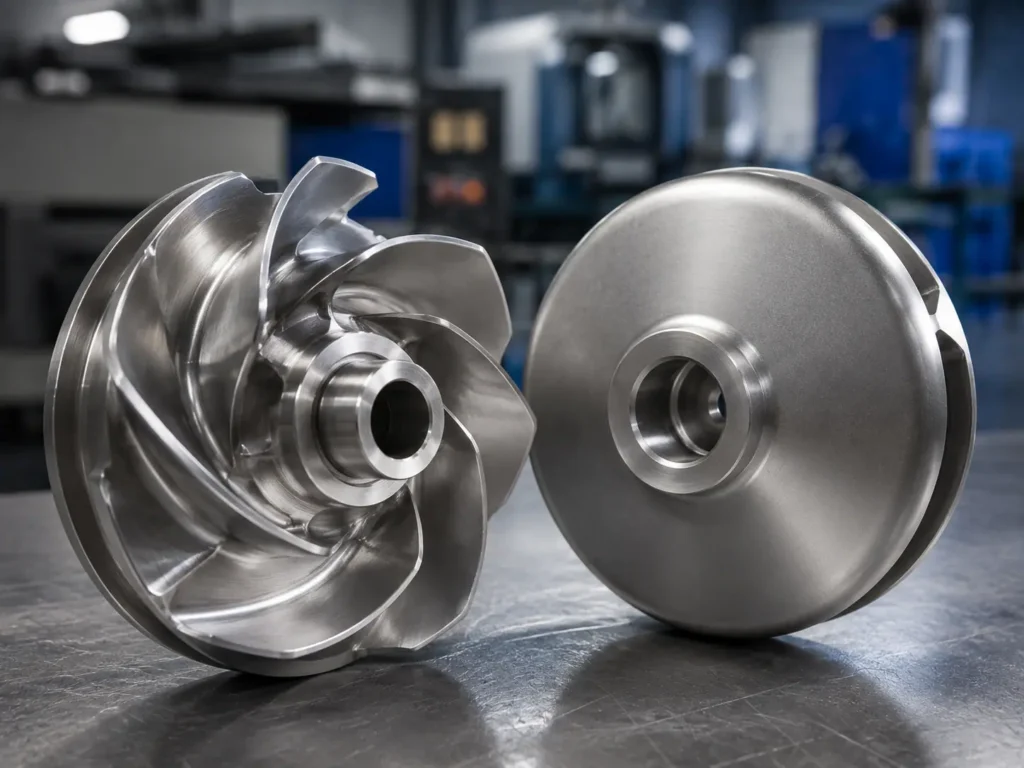
Paddle impeller is a mixer and agitator impeller with flat or slightly pitched blades mounted to a hub or shaft. In industrial tanks, buyers usually consider it for simple blending, low-to-moderate speed agitation, light suspension, heat-transfer support, or viscous materials where the blade geometry, shaft connection, clearance, material, and welding quality matter as much as the name of the impeller type.
For Matson, a paddle impeller is not a hand-held mixing paddle or a retail replacement part. It is a custom industrial agitator component manufactured from a drawing, 3D file, or confirmed sample for process equipment, OEM mixer assemblies, and non-standard tank systems. If the project already has a mixer design, Matson can review the manufacturing details around the paddle blades, hub, bore, welds, material, surface finish, runout, and balancing requirement.
What Is a Paddle Impeller?
A paddle impeller uses broad blades to push material through a tank. The blades may be flat, angled, pitched, curved, or built into a custom frame. Compared with hydrofoil or propeller-style impellers, paddle impellers are usually simpler in geometry and easier to inspect visually. That does not make them automatically easy to manufacture.
The practical question is not just “is it a paddle impeller?” A buyer also needs to confirm whether it is a flat paddle impeller, a pitched paddle impeller, a multi-blade paddle, an anchor-paddle hybrid, or a custom agitator blade assembly. Those details change the fabrication route, welding sequence, shaft load, finished dimensions, and inspection method.
For the full range of custom mixer and agitator impeller categories, see Matson’s mixer impeller manufacturer page. The rest of this guide stays on what actually trips up paddle impeller production.
Where Paddle Impellers Fit
Paddle impellers are often chosen when the process does not require a highly shaped hydrofoil blade or a close-clearance helical ribbon. They can be useful in tanks where the goal is bulk movement, blending, gentle agitation, or keeping material reasonably uniform.
They are also common in custom equipment where the mixer layout has already been defined by the OEM. In that situation, the manufacturer is not trying to redesign the process. The job is to produce the paddle impeller accurately, with the correct material, shaft fit, blade angle, weld quality, surface condition, and documentation.
| Paddle impeller type | Typical use context | Manufacturing point to check |
|---|---|---|
| Flat paddle impeller | Simple blending, low-speed agitation, basic tank movement. | Blade flatness, blade-to-hub angle, weld distortion, and shaft fit. |
| Pitched paddle impeller | More directional movement than a flat paddle, sometimes used when axial movement is needed. | Pitch direction, blade angle, repeatability between blades, and rotation direction. |
| Multi-blade paddle impeller | Larger tanks, wider swept area, or custom process equipment. | Blade spacing, symmetry, runout, and balance risk. |
| Anchor-paddle hybrid | Viscous materials, wall-area movement, or special tank geometry. | Tank clearance, bottom clearance, frame roundness, and weld sequence. |
| Custom paddle assembly | OEM equipment where the impeller is part of a special machine. | Drawing control, critical interfaces, material certificate, and inspection report. |
Paddle Impeller vs Anchor and Helical Ribbon Impeller
A paddle impeller is sometimes grouped with anchor and helical ribbon impellers because all three can appear in mixing tanks. They should not be treated as the same part.
An anchor impeller usually follows the tank wall more closely and is often used for higher-viscosity movement near the vessel wall. A helical ribbon impeller uses a spiral ribbon path to move viscous material upward or downward through the tank. A paddle impeller is usually simpler and more open, with flat or pitched blades attached to a hub or shaft.
This difference matters when requesting a quote. If a buyer sends only “paddle impeller” without drawings, a supplier may not know whether to price a simple blade-and-hub part, a wide agitator frame, or a close-clearance tank component. If the application is high viscosity or near-wall movement, the buyer may also need to review Matson’s anchor impeller and helical ribbon impeller articles before locking the part name.
Blade Geometry Buyers Should Confirm
The blade form is the first thing to clarify. Flat paddle blades are not the same as pitched paddle blades. A 30-degree blade angle is not the same as a 45-degree blade angle. A blade welded slightly out of angle can create uneven movement, additional shaft load, or vibration at operating speed.
For a new RFQ, the drawing should show:
- outside diameter or swept diameter
- blade width, height, thickness, and count
- blade pitch or angle, if any
- hub diameter, hub height, bore, keyway, set screw, or shaft connection
- distance from blade edge to tank wall or bottom, if the clearance is critical
- rotation direction and viewing side
- weld size, weld location, and surface finish requirement
If the buyer is replacing a worn sample, photos help but are not enough. Worn blade edges may be thinner than the original. A bent blade may hide the true pitch. A corroded hub may make the bore look larger than it should be. For sample-based work, Matson should confirm critical dimensions before manufacturing, especially the bore, hub length, blade angle, and mounting features.
Material and Surface Finish
Paddle impellers may be made from stainless steel, carbon steel, alloy steel, duplex stainless, or other materials specified by the buyer. The right grade depends on the liquid, solids, pH, chloride level, temperature, cleaning method, and whether the impeller needs polishing, passivation, coating, or another surface treatment.
In chemical and wastewater tanks, corrosion and deposits can be more important than the impeller type itself. A simple flat paddle in the wrong material can fail earlier than a more complex design in a suitable alloy. For chemical processing context, buyers can also review Matson’s chemical processing impeller application page.
Surface finish is easy to underestimate. A rough weld area may trap residue. Poor weld cleanup may become a corrosion starting point. Over-polishing a blade edge may change dimensions if the part is small or thin. For food, chemical, and clean-process applications, the buyer should specify the required finish instead of using a vague phrase like “smooth surface.”
Fabrication, Welding, and Machining Checks
Many paddle impellers are fabricated from plate, bar, hub, and shaft components. That sounds straightforward until the part is large, thin, or asymmetric. Welding heat can pull blades out of angle. A hub can distort before final machining. Long paddle arms can introduce runout. If several blades are welded around one hub, symmetry becomes part of the quality problem.
Matson’s impeller manufacturing capability is most relevant when a paddle impeller needs controlled fabrication, CNC machining of the bore or hub, surface treatment, inspection, and balancing data.
Key manufacturing checks include:
- confirm whether the hub should be machined before or after welding
- control blade position with fixtures during welding
- check blade angle after welding, not only before welding
- machine the bore, keyway, mounting face, or flange surfaces to drawing
- inspect runout if the shaft connection or swept diameter is critical
- review whether dynamic balancing is needed for the diameter and operating speed
Not every paddle impeller needs dynamic balancing. A small low-speed paddle may only need dimensional inspection. A larger paddle assembly, faster rotating part, or asymmetric design may need balancing or at least a runout check. The drawing or buyer specification should decide this, not guesswork.
Paddle Impeller RFQ Checklist
The fastest way to get a useful quote is to send enough information for the manufacturer to understand both geometry and service conditions. A short message with only “paddle impeller, stainless steel, quote price” usually leads to more questions.
| RFQ item | Why it matters | What to send |
|---|---|---|
| Drawing or 3D file | Prevents confusion between flat paddle, pitched paddle, anchor-paddle, and custom assemblies. | PDF, DWG, DXF, STEP, STP, IGS, or a clear sketch with dimensions. |
| Sample photos | Helps identify welds, blade condition, hub type, and wear pattern. | Front, back, side, hub close-up, shaft connection, and worn areas. |
| Critical dimensions | Fit problems often come from bore, hub, blade angle, or overall diameter errors. | OD, blade width, blade thickness, bore, keyway, hub height, shaft size, and clearances. |
| Material and media | Corrosion, abrasion, temperature, and cleaning can change the material route. | Material grade, liquid, solids, pH, chloride, temperature, and cleaning method. |
| Speed and balance need | Large or faster paddle impellers can create vibration if mass distribution is uneven. | RPM, diameter, acceptable runout, balancing grade, and whether a report is required. |
| Quantity and use case | Prototype, repair replacement, and OEM batch production have different cost structures. | Quantity, annual demand, sample approval need, and export packing requirements. |
Common Questions We Actually Get
Is a paddle impeller the same as an anchor impeller?
No. A paddle impeller usually has open flat or pitched blades, while an anchor impeller often follows the tank wall more closely. Some custom designs combine both ideas, but the drawing should define the actual geometry.
Can Matson manufacture a paddle impeller from a sample?
Yes, if the sample can be measured and the buyer confirms critical dimensions. A worn or bent sample should be treated carefully because it may not show the original blade angle, bore size, or clearance.
Should a paddle impeller be dynamically balanced?
It depends on diameter, speed, geometry, shaft connection, and buyer requirement. Small low-speed paddle impellers may not need balancing, while larger or faster assemblies may need runout control or dynamic balancing.
What material is best for a paddle impeller?
There is no universal best material. Stainless steel is common for corrosion resistance, carbon steel may fit some general-duty equipment, and duplex stainless or other alloys may be needed for harsher chemical conditions. The material should match the media and drawing requirement.
Is paddle impeller design Matson’s responsibility?
Matson can support manufacturing review, material discussion, machining, inspection, and drawing-based production. Final process-mixing design, motor sizing, and tank performance should stay with the mixer OEM, process engineer, or equipment owner.
Manufacturing Summary
A paddle impeller is worth writing into a drawing carefully because the simple name hides several manufacturing variables. Blade angle, hub fit, weld distortion, material, surface finish, runout, and balancing can all affect whether the part installs and runs correctly.
Matson manufactures custom paddle impellers and related agitator components from drawings, 3D files, and confirmed samples. For a useful quote, send the drawing or sample photos, dimensions, material grade, quantity, operating speed, surface finish, and any inspection or balancing requirement through the custom impeller RFQ page.