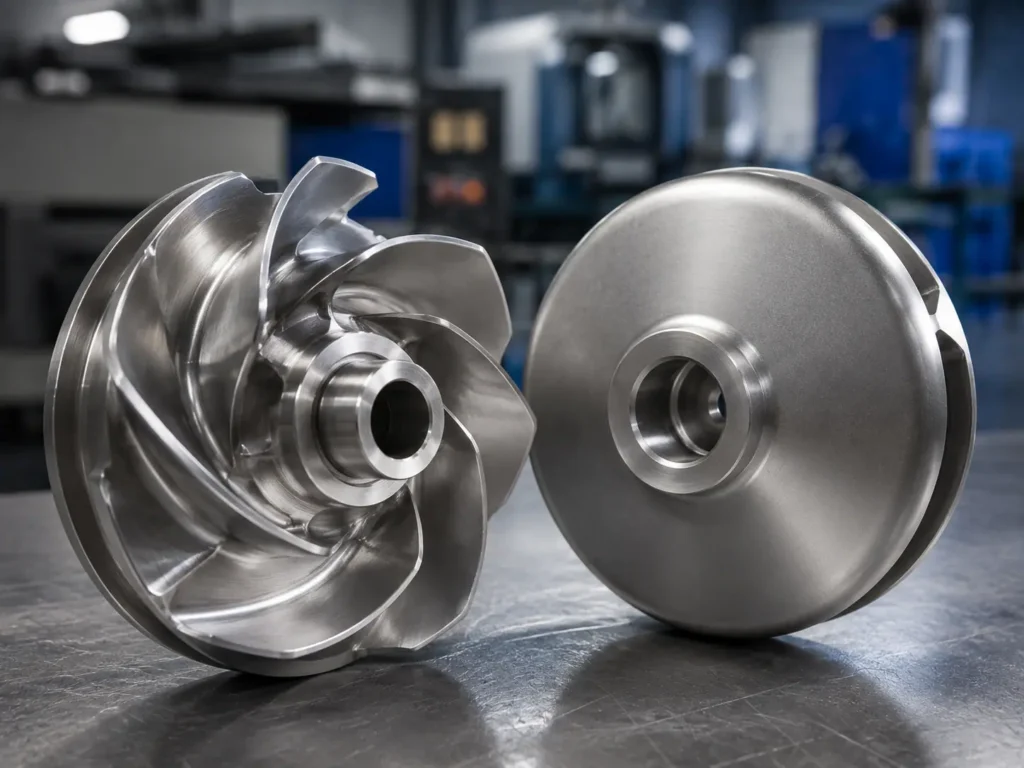
Short answer: a hydrofoil impeller is an axial-flow mixing impeller used when a tank needs strong circulation with lower power draw and gentler shear than many older turbine designs. For custom manufacturing, the important question is not only “hydrofoil or not.” Buyers should confirm blade width, blade angle, diameter, hub and shaft connection, material, surface finish, operating speed, runout or balance needs, and whether the part is a generic hydrofoil design or a proprietary brand/model component.
Matson manufactures custom mixer impellers, agitator impellers, pump impellers, fan impellers, and other industrial impellers from drawings, 3D files, samples, and specifications. This article focuses on hydrofoil impeller manufacturing checks, not process-mixing design promises.
What a Hydrofoil Impeller Actually Solves
A hydrofoil impeller is normally selected to move a large volume of liquid in an axial direction. In plain language, it tries to push flow up or down through the tank instead of throwing most of the liquid sideways.
That matters in process tanks where the job is bulk circulation, blending, suspension support, heat transfer, or low-shear movement. It can be useful in chemical processing, wastewater treatment, fermentation-related equipment, coatings, and other industrial mixing systems.
But the impeller alone does not guarantee the process result. Tank diameter, liquid level, viscosity, baffles, shaft location, speed, solids, and process goal all matter. Matson can manufacture the hardware when the geometry and material are defined; the mixer OEM or process engineer should confirm the mixing performance, scale-up, and final duty.
Hydrofoil vs Pitched-Blade Turbine vs Radial Flow Impeller
Many buyers compare hydrofoil impellers with pitched-blade turbines because both can create axial flow. They are not the same manufacturing problem.
| Impeller type | Typical flow behavior | Where buyers often use it | Manufacturing check |
|---|---|---|---|
| Hydrofoil impeller | Axial circulation with wide, airfoil-like blades. | Blending, circulation, lower-shear mixing, selected suspension duties. | Blade profile, pitch direction, blade width, hub fit, weld quality, runout, and surface finish are important. |
| Pitched-blade turbine | Axial and radial components, depending on blade angle and installation. | General mixing, solids suspension, process tanks, chemical service. | Blade angle, blade count, hub connection, weld distortion, and balance should be checked. |
| Radial flow impeller | More sideward flow from the center toward the tank wall. | Dispersion, gas-liquid contact, shear-oriented mixing, turbine-style equipment. | Flat blade geometry, disc or hub structure, welds, blade thickness, and balance are central. |
For a deeper radial-flow hardware discussion, see Matson’s radial flow impeller article. For a broader axial-flow explanation across pumps and mixers, see the axial flow impeller guide.
Why the Search Data Needs a Careful Angle
The hydrofoil impeller keyword has commercial value, but the surrounding search terms are mixed. Some people are looking for general hydrofoil mixing knowledge. Some are looking for power number, flow pattern, and solid suspension comparisons. Some are looking for specific brand or model terms.
That last group needs care.
If a buyer needs a proprietary replacement part, the safest RFQ is not “make this brand model.” The practical manufacturing route is to send a valid drawing, a sample that can be measured, material requirement, dimensions, and ownership/approval from the equipment owner. Matson should not be positioned as a retail brand-parts seller. The better fit is industrial custom manufacturing from confirmed geometry.
The Details That Decide Whether the Part Can Be Made Well
Hydrofoil blades look simple in photos. They are not simple when the part has to mount correctly, run smoothly, and survive the process environment.
| RFQ item | Why it matters | What to send |
|---|---|---|
| Blade geometry | Hydrofoil performance depends on blade width, profile, pitch, and leading/trailing edge shape. | 2D drawing, 3D model, blade count, blade width, pitch angle, and photos from top, side, and underside. |
| Rotation and pumping direction | A blade installed for the wrong direction can push flow the wrong way or overload the mixer. | Rotation direction viewed from motor side, up-pumping or down-pumping requirement, and shaft orientation. |
| Diameter and tank clearance | Diameter affects swept area, tank fit, blade-tip clearance, and load. | Impeller OD, tank diameter if available, liquid level, bottom clearance, and baffle information if relevant. |
| Hub and shaft connection | A wrong bore, keyway, clamp, or flange can make a good blade useless. | Bore size, shaft size, keyway, set screw, taper, clamp hub, flange, bolt pattern, hub length, and tolerance. |
| Material and finish | Chemicals, chloride, abrasion, cleaning, and contamination risk change the material route. | 304, 316L, duplex stainless, carbon steel, coating, polishing, passivation, or buyer-specified grade. |
| Speed, runout, and balancing | Wide blades and welded hubs can create vibration if geometry or mass is uneven. | Operating rpm, shaft length, balance grade if required, runout tolerance, and report requirement. |
A weak RFQ often says only “hydrofoil impeller, stainless steel, quote 20 pcs.” That is not enough. Stainless steel does not define the grade. “Hydrofoil” does not define the blade. Quantity does not define the hub. The quote may look fast, but it will not be reliable.
Material Choice Is Not Just Stainless or Not
Most hydrofoil mixing impellers are discussed in stainless steel because process tanks often involve water, chemicals, food-adjacent processing, cleaning, or corrosion risk. Still, “stainless” is too vague for production.
304 may be enough for mild water or general industrial mixing. 316L is often considered when chloride, cleaning chemistry, or corrosion risk is higher. Duplex stainless may enter the discussion for tougher corrosion conditions. Carbon steel or coated steel can appear in some non-corrosive duties, especially where cost and large size matter.
The right answer comes from the working liquid, temperature, pH, chloride, solids, cleaning method, contamination limit, and certificate requirement. If the project involves chemicals, Matson’s chemical processing impeller page is the better application reference.
Manufacturing Route: Fabricated, Cast, or Machined
A hydrofoil impeller may be fabricated from plate and hub components, cast and machined, or produced through a mixed route. The route depends on size, blade shape, quantity, material, tolerance, and surface finish.
Fabrication can make sense for many mixer impellers, especially when blades, hub, and shaft connection can be welded and finished cleanly. The risk is distortion: a wide blade can move during welding or finishing. The RFQ should say whether visual weld cleanup, polishing, passivation, or dimensional inspection is required.
Casting may be useful when the geometry is more integrated or the batch size justifies tooling. Even then, critical surfaces usually need machining. Hub bore, mounting face, keyway, bolt pattern, and shaft-fit surfaces should not be left to casting alone.
For more process detail, Matson’s impeller manufacturing page covers casting, CNC machining, surface treatment, dynamic balancing, and inspection.
What Buyers Should Not Guess
There are a few items that should be confirmed before a hydrofoil impeller order, even if the old part looks obvious.
Do not guess the rotation direction. Photos can mislead if the viewing side is unclear.
Do not guess the blade angle from one photo. A side photo, top photo, and dimensioned drawing are much safer.
Do not assume a worn sample still has the original OD. Blade edges may be bent, trimmed, corroded, or worn.
Do not copy a brand/model term into an RFQ and assume that is enough. A model name may help identify equipment context, but manufacturing still needs geometry, material, and approval.
Do not treat power number or flow number from an online reference as a manufacturing specification. Those values belong to process engineering and scale-up. For production, the manufacturer needs the drawing-controlled geometry and acceptance criteria.
A Better RFQ Checklist
For a custom hydrofoil impeller quote, send:
- Drawing, STEP file, or measured sample photos
- Impeller diameter, blade count, blade width, and blade pitch
- Rotation direction and up-pumping or down-pumping requirement
- Hub style, bore, keyway, flange, clamp, set screws, and shaft size
- Material grade and certificate requirement
- Surface finish, polishing, passivation, coating, or weld-cleanup requirement
- Operating speed and balance or runout requirement
- Process liquid, solids, temperature, corrosion risk, and cleaning method
- Quantity, first-batch plan, and repeat-order expectation
If the part is for a broader tank mixer assembly, the tank agitator impeller article gives a wider checklist for shaft connection, material, surface finish, and process environment.
Common Questions Buyers Ask
What is a hydrofoil impeller?
A hydrofoil impeller is a mixing impeller with wide, angled, airfoil-like blades that usually create axial flow for tank circulation, blending, and lower-shear mixing duties.
Is a hydrofoil impeller the same as a pitched-blade turbine?
No. Both can create axial flow, but a hydrofoil impeller normally uses a wider, more profiled blade shape. A pitched-blade turbine is usually simpler in blade form. Manufacturing checks are different, especially around blade profile and weld distortion.
Can Matson manufacture hydrofoil impellers from samples?
Yes, when the sample can be measured and the buyer can confirm material, dimensions, shaft connection, rotation direction, surface finish, and acceptance requirements. If the sample is worn or bent, original dimensions should be confirmed where possible.
Can Matson replace a branded hydrofoil impeller?
Matson is not a retail brand-parts seller. For industrial custom projects, Matson can review drawings, samples, and specifications supplied by the buyer. The buyer should confirm ownership, approval, and equipment responsibility before asking for manufacturing.
What information matters most for a hydrofoil impeller quote?
The most important items are drawing or sample data, blade geometry, diameter, rotation direction, hub and shaft connection, material grade, surface finish, operating speed, runout or balancing requirement, quantity, and application environment.
Talk to Matson
Need a custom hydrofoil impeller for a mixer, agitator, or process tank? Send Matson your drawing, 3D file, sample photos, material grade, shaft connection details, surface finish, operating speed, quantity, and inspection requirement through the contact page. We can review the manufacturing route, material, machining, welding, surface treatment, inspection, and documentation before quoting.