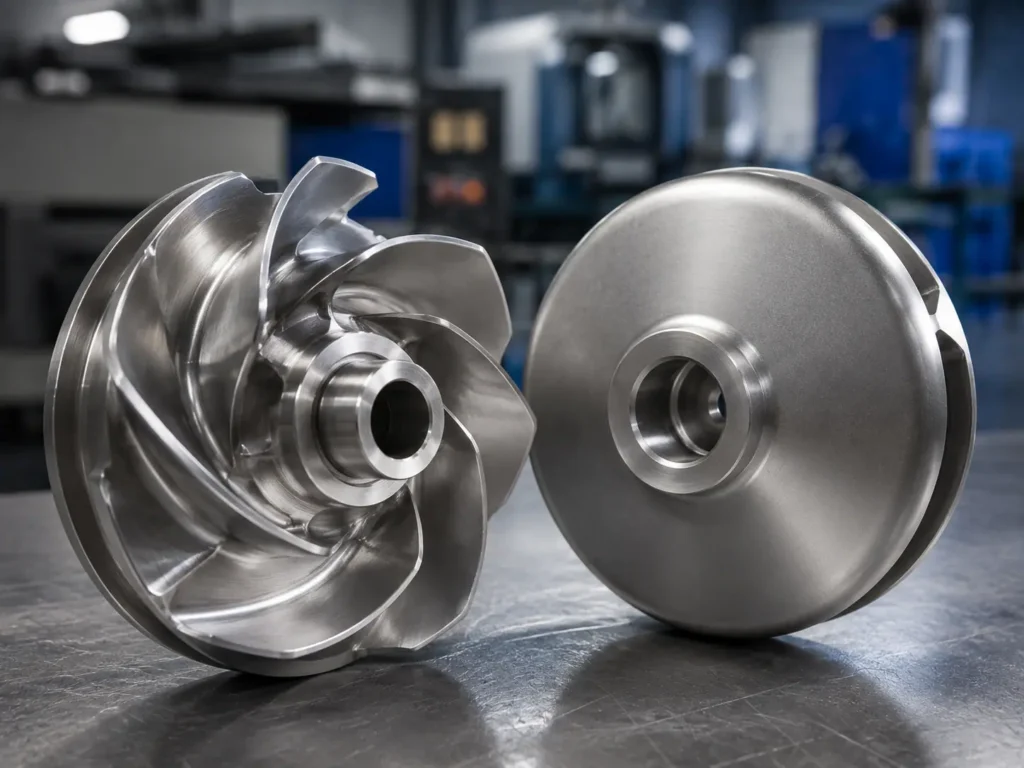
A radial flow impeller moves fluid mainly outward from the center of rotation. In process mixing, the term is often connected with radial-flow turbine impellers, Rushton-style turbines, dispersion duties, and tank applications where flow pattern, blade geometry, hub connection, material, and balance must be controlled before custom production.
Short answer: a radial flow impeller is worth reviewing as a separate manufacturing topic when the buyer has a mixer, agitator, turbine, or custom rotating part where the blade form pushes liquid outward rather than mainly up or down. Before quoting, buyers should confirm the drawing, blade type, blade count, diameter, hub and shaft connection, material, surface finish, operating speed, runout or balancing requirement, and process environment. Matson can manufacture radial-flow impeller hardware from drawings, 3D files, samples, and specifications, while final mixing performance and process design should stay with the mixer OEM or process engineering owner.
This article supports Matson’s mixer impeller manufacturer page. It is not another general axial-vs-radial article; it focuses on how buyers should prepare a radial flow impeller RFQ for manufacturing.
What Is a Radial Flow Impeller?
A radial flow impeller directs fluid outward from the center of rotation. In a tank, that often means liquid is pushed toward the vessel wall before circulating through the rest of the vessel. In a pump, radial flow language can describe centrifugal-style movement. In process mixing, it is often tied to turbine-style impellers.
For Matson’s content and RFQ workflow, the most useful angle is manufacturing: what does the part look like, how is it mounted, what material is required, how are blades attached, and what inspection is needed?
If the buyer only asks for “one radial flow impeller,” the description is still incomplete. A Rushton-style turbine, a flat-blade turbine, a custom disc turbine, and a pump-related radial part may all use radial-flow language, but their manufacturing details are different.
Radial Flow vs Axial Flow: Only the Useful Difference
The comparison matters, but it should stay short. Axial flow pushes fluid mainly along the shaft direction. Radial flow pushes fluid mainly outward from the center. Mixed flow combines both.
| Flow pattern | Typical equipment language | What changes in manufacturing review |
|---|---|---|
| Axial flow | Propeller, hydrofoil, axial pump, circulation impeller. | Blade pitch, swept diameter, hub, shaft connection, and blade-tip condition are central. |
| Radial flow | Radial-flow turbine, Rushton turbine, flat-blade turbine, selected pump or mixer parts. | Blade-to-hub connection, disc or hub structure, welds, blade thickness, diameter, runout, and balance need attention. |
| Mixed flow | Mixed-flow pump impeller, radial-axial blade geometry. | Blade angle, hub profile, casing relationship, inlet and outlet dimensions are more sensitive. |
For the broader comparison, use Matson’s axial flow impeller article. This radial-flow article stays focused on radial turbine and manufacturing details.
Where Radial Flow Impellers Usually Need Care
Radial flow impellers are often discussed in mixing applications where the equipment needs shear, dispersion, gas-liquid contact, or strong sideward flow. The exact process result belongs to the mixer OEM or process engineer, but the hardware still has to be manufactured correctly.
Common manufacturing-sensitive areas include:
- Flat blade or curved blade geometry
- Blade count and blade spacing
- Disc, hub, or center structure
- Weld quality or cast blade junctions
- Bore, keyway, clamp, flange, or coupling detail
- Blade thickness and reinforcement
- Diameter and tank clearance
- Surface finish, polishing, coating, or passivation
- Runout and balance at operating speed
This is where a real RFQ becomes more useful than a textbook definition. A buyer sourcing replacement hardware should show how the impeller mounts, what faces are worn, whether any blades are bent, and whether old welds or repairs are present.
Radial Flow Impeller Design: What Matson Needs From the Buyer
The phrase “radial flow impeller design” can mean different things. If the buyer is asking for process design, tank flow pattern, dispersion result, or scale-up calculation, that should stay with the equipment OEM or process engineering owner. If the buyer has a confirmed drawing or sample and needs manufacturing, Matson can review the part as hardware.
| RFQ item | Why it matters | What to send |
|---|---|---|
| Impeller type | Radial flow can mean Rushton turbine, flat-blade turbine, disc turbine, or custom geometry. | Drawing name, equipment type, photos, and whether the part is for mixing, pump, or custom equipment. |
| Blade geometry | Blade angle, width, thickness, and count affect fit, load, and manufacturability. | Blade count, blade dimensions, blade thickness, blade angle, and close-up photos. |
| Hub and shaft connection | Poor shaft fit can create wobble, vibration, or assembly failure. | Bore, keyway, set screw, clamp, flange, coupling, hub length, bolt pattern, and shaft size. |
| Manufacturing route | Fabrication, welding, casting, and CNC machining create different risks. | Weld detail, casting requirement, machined surfaces, heat treatment, and inspection points. |
| Material and surface finish | Chemicals, solids, cleaning, and corrosion change the suitable material and finish. | Material grade, pH, chloride, temperature, solids, viscosity, polish, coating, passivation, or certificate needs. |
| Runout and balancing | Large or faster turbine impellers can vibrate if mass or geometry is uneven. | Operating speed, diameter, acceptable runout, balancing grade, and report requirement. |
This is the section that prevents wasted back-and-forth. “Radial flow impeller, stainless steel, quote please” is not enough. The missing details are often the expensive details.
Rushton and Turbine-Style Manufacturing Notes
Rushton turbine impellers and similar radial-flow turbines can look straightforward, but they still need controlled manufacturing. The blades may be welded to a disc or hub, formed from plate, cast as one piece, or produced through a mixed fabrication and machining route.
For fabricated stainless parts, the welds, blade position, heat distortion, surface finish, and passivation requirement should be discussed before production. For cast parts, the buyer should confirm casting allowance, blade section thickness, machining surfaces, and inspection points. For machined hubs, the bore, keyway, flange, bolt pattern, or shaft connection must be treated as functional dimensions.
If the impeller runs in chemical processing, coatings, wastewater, or slurry-like conditions, material and weld cleanup become part of the service-life discussion. Do not judge the part only by diameter.
For the broader tank hardware checklist, see Matson’s tank agitator impeller article.
Material, Surface Finish and Documentation
Radial flow impellers used in process tanks often face chemical exposure, solids, cleaning cycles, deposits, abrasion, or corrosion. Material should come from the actual process condition and buyer specification.
304 stainless steel may be enough for mild water or general service. 316L stainless steel is often discussed when chemical exposure, cleaning, or corrosion matters more. Duplex stainless, carbon steel, alloy steel, coatings, or other grades may be reviewed when the process requires them.
Surface finish also matters. A rough weld, sharp edge, or uncleaned heat tint may be acceptable in one industrial tank and unacceptable in another. If the project requires polishing, passivation, coating, weld cleanup, Ra value, material certificate, dimensional report, or balance report, say that before quoting.
Matson’s impeller manufacturing work can include casting, CNC machining, surface treatment, dynamic balancing, dimensional inspection, and export packing when the requirements are defined.
What Buyers Should Send for a Quote
For a radial flow impeller project, send:
- Equipment type: mixer, agitator, process tank, pump, or custom machine
- Approved 2D drawing, 3D file, or physical sample
- Photos from top, bottom, side, hub, shaft connection, blade faces, welds, and worn areas
- Impeller type: Rushton turbine, flat-blade turbine, disc turbine, radial-flow mixer, or custom
- Outside diameter, blade count, blade width, blade thickness, and blade angle
- Bore, keyway, hub length, clamp, flange, bolt pattern, coupling, or shaft size
- Material grade, liquid chemistry, solids, viscosity, temperature, cleaning, and corrosion context
- Fabrication, welding, casting, CNC machining, polishing, coating, or passivation requirements
- Operating speed, balance grade, runout requirement, and report needs
- Quantity, batch schedule, packing, and documentation requirements
If the sample is bent, repaired, cracked, corroded, or worn, mark those areas clearly. A repaired blade or enlarged bore should not become the new production reference without confirmation.
Common Questions We Actually Get
What is a radial flow impeller?
A radial flow impeller moves fluid mainly outward from the center of rotation. In mixing equipment, it is often associated with turbine-style impellers such as radial-flow turbines or Rushton-style designs.
Is a radial flow impeller the same as an axial flow impeller?
No. A radial flow impeller pushes fluid mainly outward from the center. An axial flow impeller moves fluid mostly along the shaft direction. The difference affects blade shape, hub structure, tank flow pattern, and manufacturing checks.
Can Matson design the mixing performance?
Matson focuses on manufacturing the impeller hardware from drawings, samples, and specifications. Mixing performance, tank flow pattern, dispersion, and scale-up should be confirmed by the mixer OEM or process engineering owner.
What is important for a radial flow impeller RFQ?
Buyers should send the drawing, blade dimensions, hub and shaft connection, material, process condition, weld or casting route, surface finish, operating speed, runout, balancing, and inspection requirements.
Can a radial flow impeller be made from a sample?
Yes, but the sample should be checked carefully. Bent blades, worn hubs, repaired welds, corrosion, and enlarged bores can make sample-based copying risky without confirmed dimensions.
Send Us Your Drawing
Need a radial flow impeller manufactured from a drawing, 3D file, or sample? Send Matson the impeller type, blade and hub photos, shaft connection, material grade, process condition, operating speed, surface finish, balancing or runout requirement, quantity, and inspection needs through the contact page. We can review fabrication, casting, CNC machining, surface treatment, inspection, and documentation requirements before quoting.