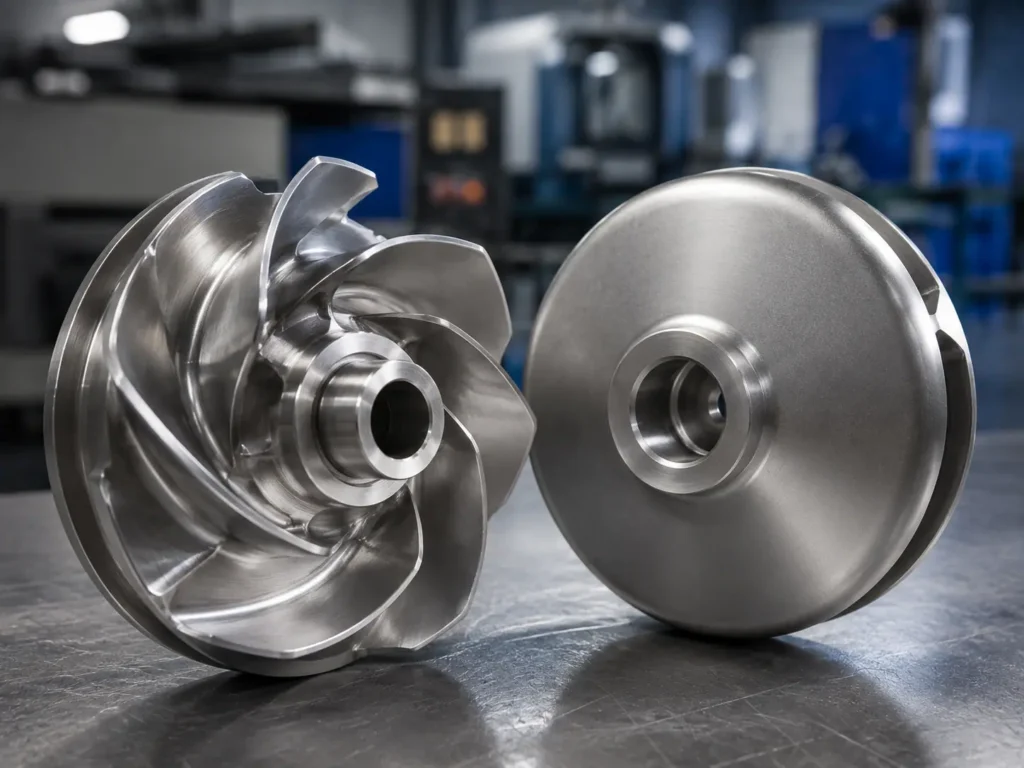
A shrouded impeller uses one or two side plates, called shrouds, to support the vanes and form a more controlled flow passage. In centrifugal pump projects, a shrouded impeller is often discussed together with closed impellers, double shrouded impellers, semi-shrouded designs, hub geometry, clearance surfaces, casting, CNC machining, and balancing.
Short answer: a shrouded impeller should be reviewed by structure, not by name alone. Buyers should confirm whether the impeller is single shrouded, double shrouded, semi-shrouded, or unshrouded; then check the hub, bore, vane passages, shroud thickness, wear-ring or clearance surfaces, material, pump speed, and balancing requirement before custom manufacturing.
Matson manufactures centrifugal pump impellers and other custom pump impellers from drawings, samples, and project specifications. This article focuses on shrouded impeller structure and manufacturing review, not on final hydraulic pump selection.
What Is a Shrouded Impeller?
A shrouded impeller has vanes connected to one or more side plates. These side plates are the shrouds. The shroud can support the vanes, help define the flow passage, and create important fit or clearance surfaces inside the pump.
In everyday pump language, many people call a double shrouded impeller a closed impeller. That is often reasonable, but it is still better to check the drawing. Some impellers have one shroud and one open side. Some have front and back shrouds. Some compressor or turbine-style parts use the word shrouded in a different way. The name is useful, but the geometry decides the manufacturing risk.
For buyers, the practical question is not “Is a shrouded impeller good?” The better question is: which shrouds exist, which surfaces fit the casing, which areas are machined, and which dimensions are critical?
Shrouded vs Unshrouded Impeller
The terms shrouded and unshrouded describe how the vanes are supported and enclosed. This affects inspection, casting, wear, clearance, and cleaning access.
| Impeller structure | Basic description | Manufacturing concern | Buyer should confirm |
|---|---|---|---|
| Double shrouded impeller | Vanes are enclosed between front and back shrouds. | Internal passage access, shroud thickness, wear-ring surfaces, and balance. | Both shroud dimensions, inlet eye, outlet width, casing relationship, and inspection points. |
| Single shrouded impeller | Vanes are supported by one shroud or backplate. | Open-side clearance, vane edge wear, and axial position. | Open-side clearance, wear plate or casing surface, hub height, and rotation direction. |
| Semi-shrouded impeller | Often used similarly to semi-open, with one supported side and one more exposed side. | Terminology confusion and clearance control. | Drawing section, photos from both sides, and which side faces the suction or casing. |
| Unshrouded impeller | Vanes are exposed without full side shrouds. | Vane stiffness, wear, balance, and clearance sensitivity. | Vane thickness, OD, material, speed, solids condition, and machining requirement. |
This comparison is not a universal selection rule. A pump OEM or engineering owner should confirm the final impeller type for the duty. Matson’s role is to manufacture to defined drawings, samples, materials, tolerances, inspection requirements, and balancing needs.
Hub and Shroud Are Not Small Details
The keyword group includes “hub and shroud of impeller” for a reason. These two areas often decide whether a replacement part actually fits the pump.
The hub connects the impeller to the shaft. It includes the bore, keyway, mounting face, hub height, sleeve relationship, taper, thread, or retaining detail. A small error here can shift the impeller inside the casing or create runout.
The shroud controls vane support and may also include wear-ring surfaces, seal-related surfaces, casing clearances, or front and back faces that affect axial fit. A worn shroud can make a sample look thinner or smaller than the original design. A repaired shroud can hide the original datum.
For a shrouded impeller RFQ, buyers should not only send OD and bore. Send photos and dimensions of the hub, front shroud, back shroud, inlet eye, outlet width, wear-ring areas, and damaged surfaces.
Closed Impeller, Shrouded Impeller and Centrifugal Pump Context
In centrifugal pump work, a shrouded impeller often overlaps with closed impeller terminology. A closed impeller normally has front and back shrouds around the vanes. It can suit cleaner liquids where controlled passages and clearances matter.
But the article you are reading has a narrower purpose. Matson already has a guide for closed impeller pump applications and another focused guide for closed impeller centrifugal pump fit and clearance review. Here, the focus is the shroud itself: how it is measured, worn, cast, machined, inspected, and balanced.
If a buyer says only “we need a shrouded impeller,” the manufacturer still needs the drawing or enough sample detail to understand the exact structure.
Shroud Wear, Clearance and Damage Review
Shrouds can show several types of damage. The pattern matters because it affects whether a sample can be copied safely.
| Shroud condition | Possible meaning | RFQ note |
|---|---|---|
| Rubbing marks on a shroud face | Possible axial misfit, bearing movement, casing contact, or wrong clearance. | Send casing relationship, hub height, mounting face, and worn-area photos. |
| Wear-ring surface loss | Clearance may have opened up, increasing leakage or reducing performance. | Confirm original wear-ring dimensions and mating-part condition. |
| Cracks near shroud and vane junction | Stress, casting defect, vibration, impact, or repeated overload may be involved. | Send speed, balance history, material grade, and close-up crack photos. |
| Corrosion on shroud surfaces | Material may not match liquid chemistry, temperature, chloride, or cleaning process. | Confirm liquid, pH, chloride, temperature, and material certificate needs. |
| Weld or grinding repair | The sample may no longer represent the original geometry. | Identify repaired areas and avoid copying them blindly. |
Shroud damage can also appear together with cavitation, abrasion, or imbalance. If damage is near the inlet eye or vane entry, Matson’s impeller eye article may help buyers check the inlet area more carefully.
Casting and CNC Machining Notes
Shrouded impellers can be more difficult to inspect and manufacture than open geometries because some vane passages are partially enclosed. Casting route, machining allowance, core or pattern quality, material flow, section thickness, and cleaning access all need review.
For custom manufacturing, the drawing should identify which surfaces are functional. Common functional areas include:
- Bore and shaft fit
- Hub height and mounting face
- Keyway, taper, thread, or retaining feature
- Front and back shroud faces
- Wear-ring or seal surfaces
- Inlet eye and outlet width
- Outside diameter or trim diameter
- Critical vane passage dimensions
- Runout and balancing requirements
Some shroud surfaces may remain as-cast if the drawing allows it. Other surfaces may require CNC finish machining. The quotation becomes much clearer when the buyer marks critical dimensions and inspection points before production.
Matson’s impeller manufacturing capabilities include casting, CNC machining, dimensional inspection, dynamic balancing, surface treatment, and export packing when project requirements are defined.
Shrouded vs Semi-Open: Do Not Mix the Terms
Some RFQs use “semi shrouded,” “single shrouded,” and “semi-open” almost interchangeably. That can create confusion.
A semi-open impeller normally has one shroud or backplate and one open vane side. A single shrouded impeller may describe a similar structure, but the exact meaning depends on the drawing and industry language. A double shrouded impeller is closer to a closed impeller.
For this reason, photos from both sides are useful. Mark the suction side, motor side, casing side, hub side, vane direction, and rotation direction if known. If the pump uses a wear plate or close axial clearance, include those mating-part dimensions.
For open-side clearance discussion, see Matson’s semi open impeller pump manufacturing notes.
What Buyers Should Send for RFQ
For a shrouded impeller project, send:
- Approved 2D drawing and 3D file if available
- Photos from front, back, side, bore, hub, inlet eye, outlet, and worn areas
- Whether the part is double shrouded, single shrouded, semi-shrouded, or unshrouded
- OD, inlet eye, outlet width, vane count, shroud thickness, and rotation direction
- Bore, hub height, mounting face, keyway, taper, thread, sleeve, or retaining details
- Wear-ring dimensions, casing clearance, axial clearance, and mating-part dimensions
- Material grade, liquid condition, solids, corrosion, temperature, and service history
- Casting route preference if specified, CNC machining requirements, and surface finish
- Pump speed, impeller mass, balancing grade, runout requirement, and report needs
- Quantity, batch schedule, packing, and document requirements
If the sample is worn, mark which areas are unreliable. A worn shroud, repaired hub, enlarged bore, or damaged wear-ring surface should not become the reference for a new batch without confirmation.
Common Questions We Actually Get
What is a shrouded impeller?
A shrouded impeller has vanes connected to one or more side plates called shrouds. In many centrifugal pump contexts, a double shrouded impeller is similar to a closed impeller.
What is the shroud of an impeller?
The shroud is the side plate that supports or encloses the vane passage. It may also form clearance, wear-ring, or casing-related surfaces that need careful manufacturing control.
What is the difference between shrouded and unshrouded impeller designs?
A shrouded design supports or encloses the vanes with side plates. An unshrouded design exposes the vanes more directly. The difference affects clearance, cleaning, inspection, casting, machining, wear, and balance.
Is a shrouded impeller the same as a closed impeller?
Often, but not always. A closed pump impeller usually has front and back shrouds, but buyers should still confirm the actual drawing, pump type, and casing relationship.
Can Matson manufacture a shrouded impeller from a sample?
Matson can review sample-based manufacturing, but worn shrouds, repaired hubs, damaged wear-ring surfaces, and unclear internal passages should be checked against drawings or reliable dimensions.
Send Us Your Drawing
Need a shrouded impeller manufactured from a drawing or sample? Send Matson the drawing, shroud and hub photos, critical dimensions, material grade, liquid condition, pump speed, balancing requirement, quantity, and inspection needs through the contact page. We can review casting, CNC machining, inspection, and balancing requirements before quoting.