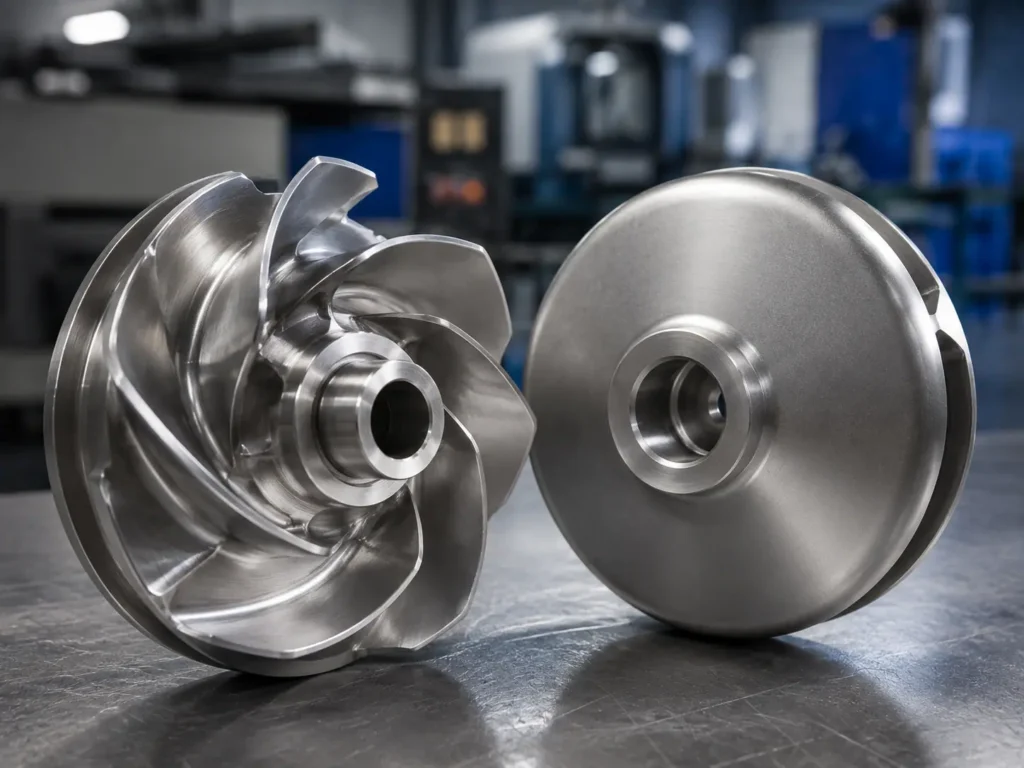
A vortex impeller sewage pump makes sense when wastewater contains solids, fibers, sludge, or debris that creates repeated clogging risk in tighter impeller passages. The vortex design is selected for solids-handling tolerance, not because it is automatically the most efficient pump design or the right answer for every sewage application.
Short answer: buyers should consider a vortex impeller sewage pump when keeping difficult solids away from narrow vane channels matters more than maximum clean-water efficiency. Before manufacturing, confirm the solids size, fiber condition, casing geometry, impeller position, pump speed, material, corrosion and abrasion risk, fit dimensions, and balancing requirement.
Matson manufactures custom vortex pump impellers from drawings, samples, and specifications. This article explains the sewage application decision. Buyers ready to source a custom part should use Matson’s dedicated vortex impeller pump landing page for product scope and RFQ details.
How a Vortex Sewage Pump Handles Solids
In a vortex pump design, the impeller is commonly positioned so that it creates a rotating flow inside the casing while reducing direct passage of larger solids through narrow vane channels. This can help wastewater, sludge, fibers, and soft solids move through the pump with less direct contact with the impeller.
The practical goal is clog resistance. A pump station that repeatedly stops because of rags, fibers, or irregular solids may value reliable passage more than the higher clean-water efficiency associated with other impeller geometries.
That does not mean solids never touch the impeller or that a vortex design cannot clog. The result still depends on casing geometry, solids size, fiber behavior, pump speed, liquid condition, and the approved hydraulic design.
When Vortex Solids-Handling Design Makes Sense
Use this table as a first decision check.
| Sewage condition | Vortex design direction | What buyers should confirm |
|---|---|---|
| Rags, wipes, fibers, or soft solids | Often worth reviewing when clogging is the main problem. | Maximum solids size, fiber length, blockage history, casing design, and current impeller type. |
| Sludge and variable wastewater | Can be practical where the liquid condition changes and passage matters. | Sludge consistency, solids concentration, settling behavior, pump duty, and wear history. |
| Wastewater with grit or sand | Needs abrasion review in addition to clogging review. | Particle hardness, grit load, material grade, wear zones, and service-life target. |
| Corrosive industrial effluent | Possible, but material compatibility becomes critical. | pH, chloride, chemicals, temperature, previous corrosion, and material specification. |
| Clean water with efficiency as the main target | Usually not the first design to choose. | Ask the pump OEM whether a closed or other clean-liquid design is more suitable. |
| Unknown replacement from a worn sample | Do not assume vortex geometry from appearance alone. | Original drawing, casing relationship, impeller position, rotation, bore, hub, and worn-area photos. |
When a Vortex Impeller Is Not Enough
A vortex impeller can reduce clogging risk, but it cannot correct every sewage pump problem.
If the pump is undersized, operating far from the intended duty, installed with poor suction conditions, or facing solids larger than the system was designed to pass, replacing the impeller alone may not solve the problem. The same applies when the casing, wear surfaces, shaft, bearings, or clearances are already damaged.
Abrasion also needs separate attention. A vortex flow path may reduce some direct solids contact, but grit and sand can still wear the impeller and casing. Corrosive wastewater can add pitting or erosion-corrosion. Buyers should send failure photos and operating context instead of describing every early failure as a clogging issue.
For broader sewage application review, see Matson’s sewage pump impeller article.
Vortex Compared With Open and Semi-Open Designs
Vortex is one wastewater direction, not the entire category.
Open impellers expose the vanes and make cleaning and visual inspection easier. They can suit dirty water and light solids, while clearance and vane wear remain important. Semi-open impellers provide one shroud and one open side, creating a compromise between hydraulic control and solids tolerance.
Vortex designs are often considered when the solids and fibers create stronger blockage risk. They may sacrifice some efficiency compared with designs that put more liquid directly through the impeller passages.
The detailed comparison belongs in Matson’s guide to sewage pump impeller types. For manufacturing, the approved type must still match the casing, shaft interface, speed, and drawing.
Casing Relationship and Fit Review
A vortex impeller cannot be treated as an isolated rotating part.
Its position relative to the casing and volute affects the intended flow pattern and solids passage. Bore, hub height, mounting face, backplate geometry, outside diameter, impeller offset, keyway, rotation direction, and clearance relationships should come from the approved drawing or pump assembly information.
For a sample-based project, photographs should show the impeller from the front, back, side, bore, hub, and vane areas. Also show how it sits inside the casing if possible. A worn sample may have lost outside diameter, vane edges, backplate thickness, or fit surfaces.
The factory can measure and manufacture a part. It should not guess the hydraulic position of a vortex impeller from a single photograph.
Material, Casting and Machining Notes
Sewage vortex impellers often face more than clogging.
Grit can cause abrasion. Chemicals and chloride can cause corrosion. Repeated solids impact can damage vane edges or transitions. Material selection should reflect the approved drawing, wastewater chemistry, solids, impact, wear history, and documentation requirement.
Stainless steel, duplex stainless, carbon steel, alloy steel, bronze, and other project-specified materials may be considered. When corrosion-resistant cast stainless steel is specified, ASTM A743/A743M or ASTM A744/A744M may appear in project requirements. The exact grade, testing, heat treatment, and certificates should be confirmed before quoting.
Manufacturing review should cover casting feasibility, machining allowance, bore and hub accuracy, mounting surfaces, backplate or vane geometry, inspection points, surface treatment, and balancing. Matson’s impeller manufacturing capabilities include casting, CNC machining, finishing, dimensional inspection, dynamic balancing, and export packing when requirements are defined.
Balancing and Uneven Wear
Solids-handling service can produce uneven wear. Even if a new impeller was balanced correctly, service damage can change its mass distribution and increase vibration.
Buyers should provide the pump speed, impeller mass, balancing requirement, and any vibration or bearing history. ISO 21940-11 is commonly used as a reference for rigid-rotor balancing terminology and grades when a project specification requires it. The correct grade should come from the buyer, pump OEM, or engineering owner.
Balancing does not fix wrong bore fit, runout, damaged mounting surfaces, incorrect casing position, or hydraulic problems. These items need separate inspection.
What Buyers Should Send for a Vortex Sewage Impeller Quote
Send:
- Approved 2D drawing and 3D model if available
- Physical sample and photos from the front, back, side, bore, hub, and worn areas
- Pump assembly or casing information showing the impeller relationship
- Sewage application: lift station, sludge, municipal sewage, treatment plant, or industrial effluent
- Maximum solids size, fiber condition, grit, sand, sludge consistency, and clogging history
- Wastewater chemistry, pH, chloride, temperature, and corrosion condition
- Pump speed, duty information, rotation direction, outside diameter, and impeller mass
- Bore, hub height, mounting face, keyway, backplate, offset, and critical clearances
- Material grade, certificate, testing, heat treatment, and surface-finish requirements
- Existing failure pattern: clogging, wear, corrosion, rubbing, cracking, or vibration
- Quantity, inspection report, balancing report, and export packing requirements
The phrase “vortex impeller sewage pump” is useful for finding the topic. It is not enough information for manufacturing. A reliable quote starts with the drawing, casing relationship, sewage condition, and failure history.
Common Questions We Actually Get
When should I use a vortex impeller sewage pump?
Use a vortex impeller sewage pump when solids, fibers, sludge, or debris create repeated clogging risk and the approved pump design prioritizes solids passage over maximum clean-water efficiency.
Is a vortex impeller sewage pump clog-proof?
No. A vortex design can reduce clogging risk, but solids size, fibers, casing geometry, pump duty, and system condition still decide actual performance.
What information should I send for a vortex sewage pump impeller quote?
Send the drawing or sample, casing relationship, solids and fiber details, material grade, pump speed, critical fit dimensions, failure photos, quantity, and balancing requirement.
Does a vortex impeller handle abrasive grit?
It can operate in wastewater containing grit, but abrasion still needs review. Particle hardness, grit load, material, wear pattern, and service-life target should be confirmed.
Can Matson decide whether my sewage pump should use a vortex impeller?
Matson can review manufacturing feasibility from drawings, samples, and specifications. Final hydraulic selection and pump design responsibility should remain with the pump OEM or engineering owner.
Send Us Your Drawing
Need a vortex sewage pump impeller manufactured from a drawing or sample? Send Matson the drawing, casing details, sewage condition, solids information, material grade, worn-part photos, pump speed, quantity, and balancing requirement through the contact page. We can review the material, casting, machining, inspection, and balancing route before quoting.