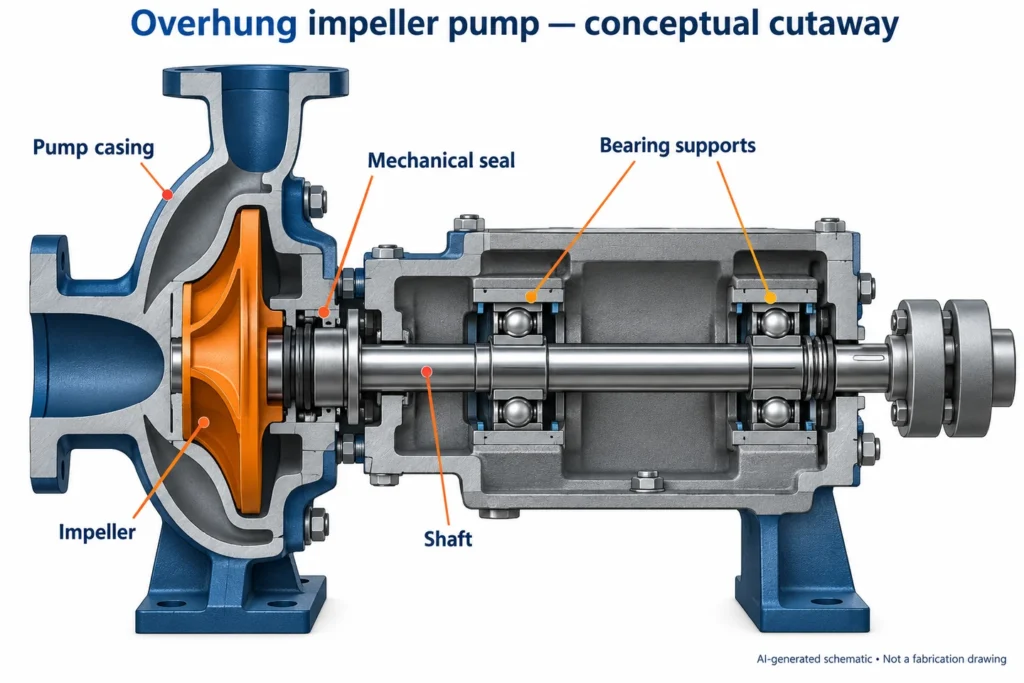
An overhung impeller pump is a centrifugal pump whose impeller sits beyond the shaft’s bearing supports, rather than between them. That layout matters when you specify a new impeller: the part must match the approved hydraulic geometry, mounting interface and running-clearance arrangement. A correct outside diameter alone does not establish interchangeability. Start with the pump assembly drawing, then separate the impeller’s manufacturing requirements from the complete pump’s operating and performance requirements.
What does “overhung” mean in a pump?
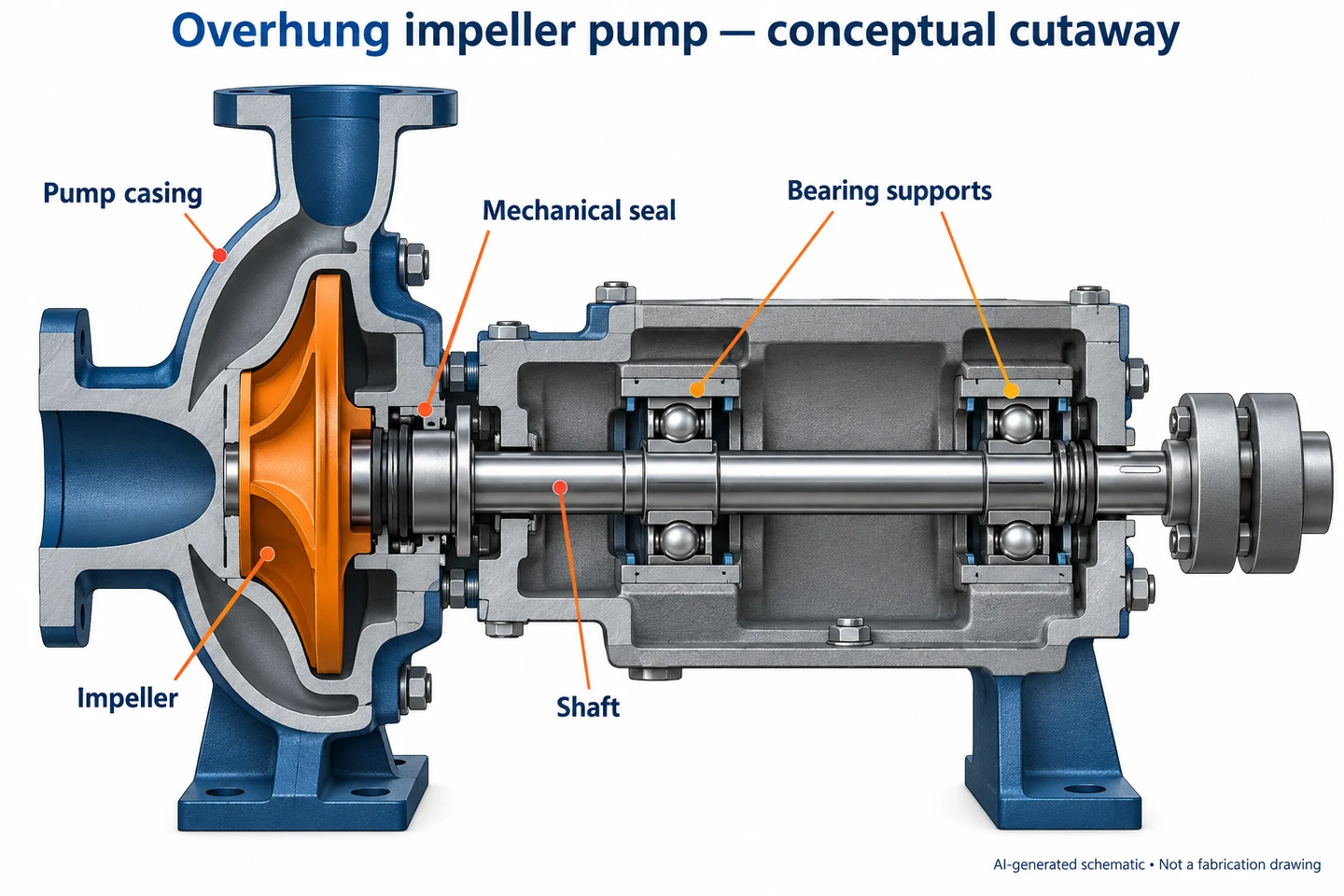
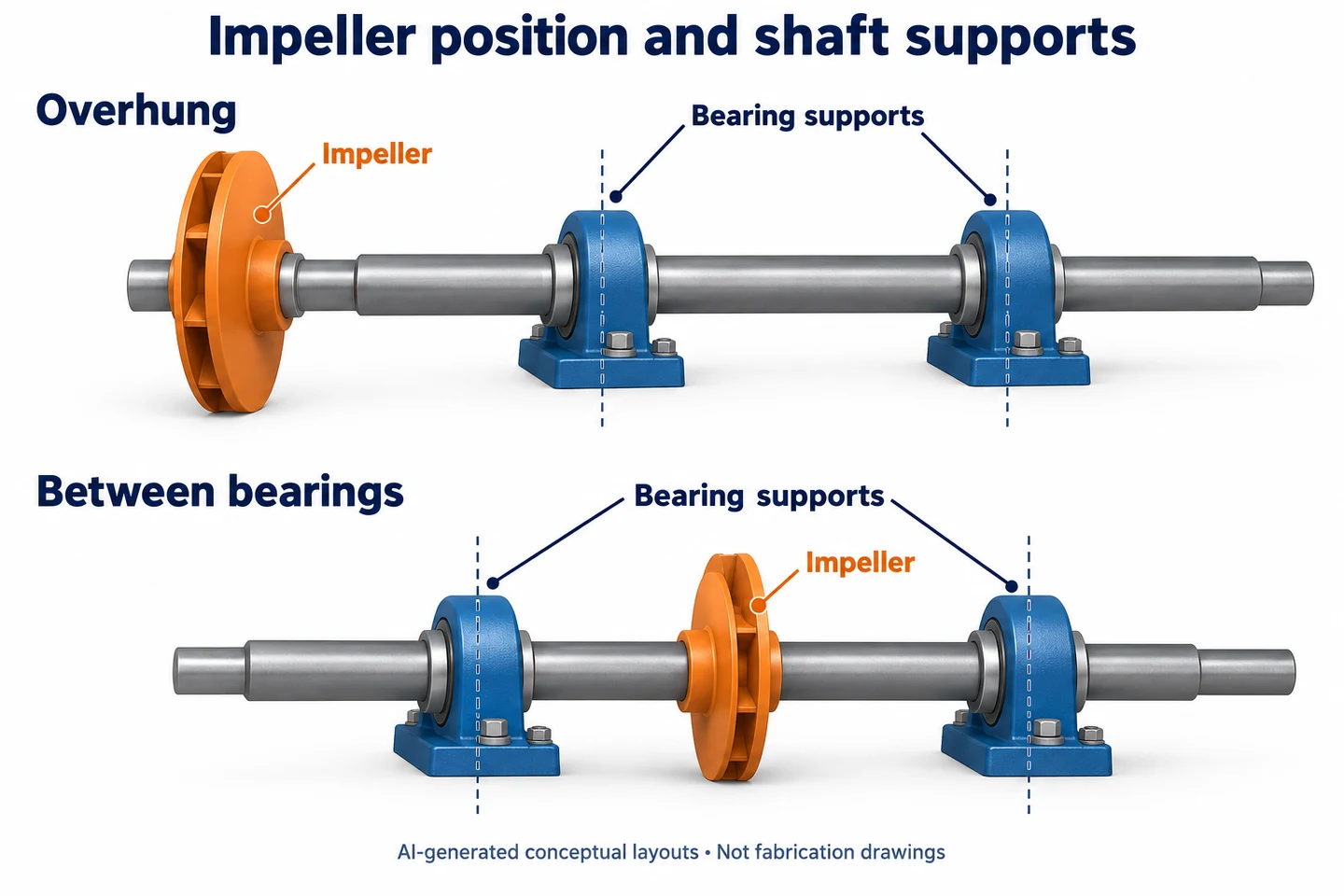
“Overhung” describes the position of the impeller relative to its shaft supports. It does not describe a particular blade shape, material or manufacturing process. In a common horizontal arrangement, the impeller projects into the pump casing while its bearing housing sits behind the wet end. The impeller is outside the span between the bearing support locations.
Importantly, an overhung pump does not necessarily have just one bearing. Both support locations can lie on the same side of the impeller. A between-bearings pump places its impeller or impellers within the supported span. This basic distinction is also described in PumpWorks’ explanation of OH and BB arrangements.
Is overhung the same as end suction?
No. End suction identifies an inlet arrangement; overhung identifies rotor support. A pump can be described using both terms, but they answer different questions. Likewise, “horizontal,” “vertical inline,” “close coupled” and “frame mounted” describe other aspects of installation or construction. Do not infer the complete assembly from one phrase on a purchase order.
For example, Sulzer describes its OH2 range as horizontal, centerline-mounted, single-stage, radially split and flexibly coupled. That is a specific combination, not a definition covering every overhung pump. If your specification refers to API 610, identify the applicable edition and configuration with the pump manufacturer; the word “overhung” alone does not establish compliance.
Is there a special “overhung impeller” shape?
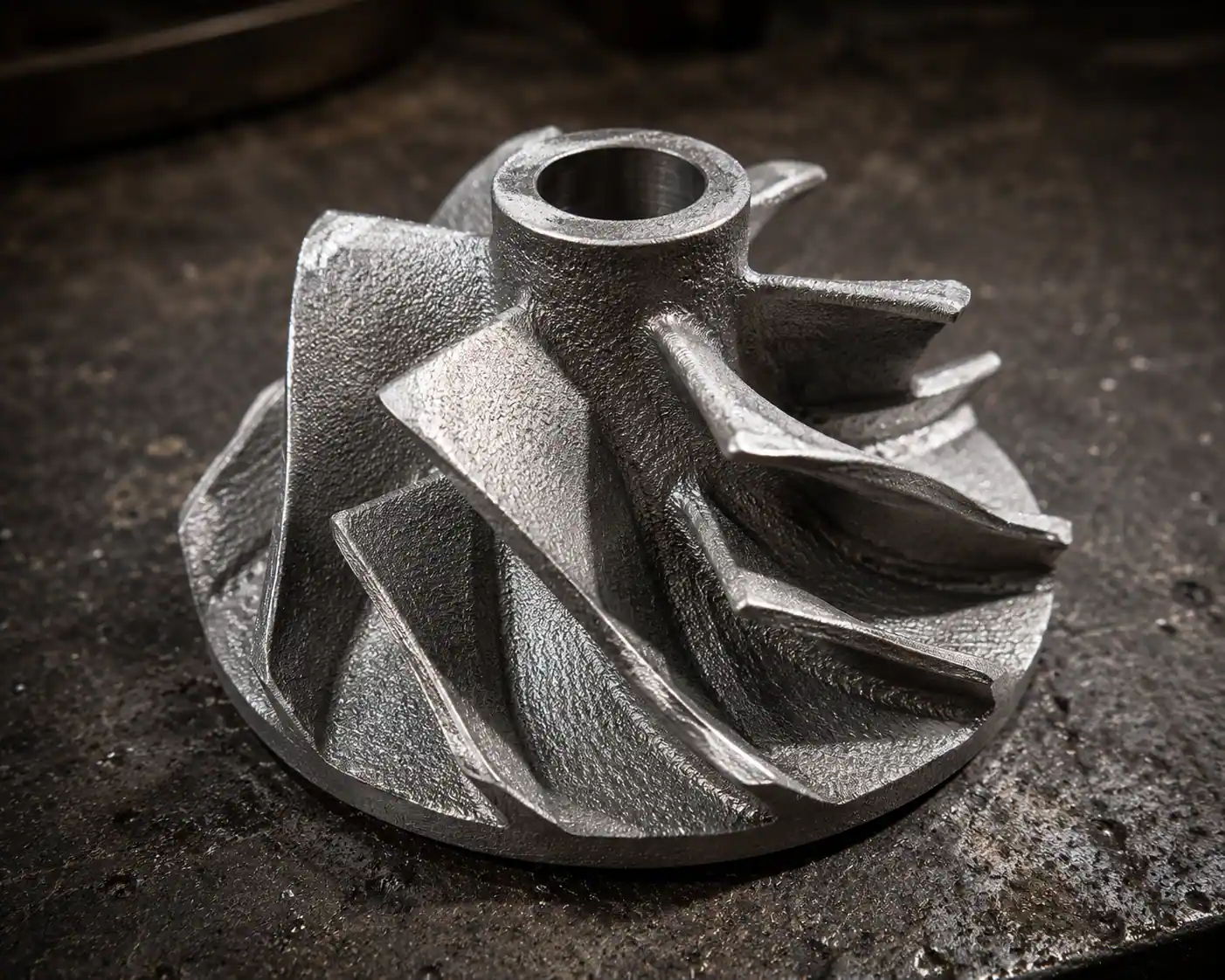
There is no single blade geometry that makes an impeller overhung. Closed, semi-open or open construction must be selected for the actual pump and service. The distinguishing feature is how the installed rotor is supported, not whether the impeller has a front shroud.
For a drawing-based order, treat “overhung pump application” as assembly context. You still need a controlled part drawing, material requirements and acceptance criteria. Matson’s custom pump impeller capabilities concern the component; they should not be read as a claim that Matson supplies or certifies the complete pumping system.
How an overhung impeller pump works
The overhung support arrangement does not replace the centrifugal pumping principle. Liquid enters the impeller inlet, the rotating passages transfer energy to the liquid, and the casing collects the discharge flow. The relationship among impeller geometry, casing, speed and liquid conditions establishes the pump’s hydraulic performance.
The shaft transmits drive torque to the impeller through the specified attachment. Depending on the design, that attachment may involve a keyed bore, a threaded connection or another engineered retention arrangement. The bearings support the rotor, while the seal arrangement controls leakage where applicable. Each interface has its own function; a successful dimensional inspection of one interface does not verify all the others.
For an impeller remake, follow this sequence:
- Identify the approved pump configuration and part revision.
- Establish the rotation direction using an explicit viewing reference.
- Match the hydraulic surfaces and the assembly interfaces.
- Inspect the manufactured part against the approved acceptance plan.
- Have the responsible pump organization verify assembled clearances and any required performance tests.
If the internal features are unfamiliar, the impeller cross-section guide explains the eye, vanes, shrouds and hub. This article uses those features to discuss assembly decisions; it is not a substitute for the pump’s sectional drawing.
Overhung vs between-bearings pumps: what the distinction changes
Compare the support arrangement first, then evaluate the actual pump design. Neither the label OH nor BB provides a universal pressure rating, speed limit, maximum impeller diameter or material requirement.
| Review question | Overhung arrangement | Between-bearings arrangement | What you should confirm |
|---|---|---|---|
| Where is the impeller? | Outside the bearing-supported span | Within the bearing-supported span | Sectional drawing and actual support locations |
| What component interfaces matter? | Hub, shaft attachment, axial location and adjacent wet-end features | Hub, shaft attachment and the applicable rotor assembly features | Controlled drawings, not assumptions from the configuration name |
| How should loading be reviewed? | Account for the projecting rotor and its complete support system | Account for the rotor within its support system | OEM load assessment, shaft design and bearing arrangement |
| Is the assembly compact? | Layout may suit compact wet-end arrangements | Package dimensions depend on the particular construction | Installed envelope and access requirements |
| Is maintenance access guaranteed? | Some designs permit wet-end withdrawal without disturbing piping | Access depends on casing and rotor construction | Maintenance drawing, lifting plan and withdrawal space |
| Can a different impeller be substituted? | Only through an approved interface and hydraulic review | The same approval principle applies | Authorized design revision and validation requirements |
| Which configuration is better? | Depends on duty and approved design | Depends on duty and approved design | Complete operating envelope rather than a generic ranking |
Avoid purchasing decisions based on statements such as “overhung pumps are always low pressure” or “between-bearings pumps always eliminate thrust.” Those statements omit the actual casing, rotor, thrust-control and operating details. Ask for the selected pump’s documented suitability, not a general claim about its family.
Applications and limits: when the assembly context matters
Overhung configurations appear in industrial pumping duties, but an application name is not enough to approve an impeller. Your review should identify the service conditions that the original design must accommodate.
Utility and circulation service
For a repeat order serving an established water or circulation system, the most useful starting point is the approved pump and impeller revision. Confirm whether the required part is the original diameter or an authorized trim. Also confirm whether the system duty has changed since the last purchase. A repeat part number can conceal a changed operating requirement.
Chemical transfer and process service
Record the actual liquid composition, temperature range and relevant exposure conditions. “Chemical service” does not specify a suitable alloy. If corrosion has prompted a material change, obtain approval for the new grade and any related processing requirements. Do not accept a visually similar casting as evidence of corrosion resistance or service compatibility.
Service involving solids or deposits
Establish the solids characteristics and the approved passage geometry. A proposed change to vane shape, passage width or shroud construction should be reviewed as a design change, not as a convenient manufacturing substitution. Specify which surfaces may be blended or repaired and which features must remain controlled. A casting cleanup decision must not quietly become a hydraulic redesign.
Variable operating conditions
Review minimum, normal and maximum duty, plus speed variation and foreseeable transients. The complete pump’s preferred and allowable operating regions belong in the equipment review. The Hydraulic Institute’s pump FAQs distinguish these operating-region concepts; there is no single percentage band that should be assigned to every pump in an impeller RFQ.
These checks establish responsibilities. The pump manufacturer or responsible engineer approves service suitability. The impeller manufacturer reviews whether the controlled component can be produced and inspected as specified. Neither task should be left implicit.
Why shaft loading belongs in the impeller review
Hydraulic loads act on the installed rotor, not on an isolated part drawing. Radial thrust acts perpendicular to the shaft, while axial thrust acts along it. The pump casing, impeller geometry and operating conditions all matter.
The Hydraulic Institute’s introduction to hydraulic loads explains that, for a single-volute casing, radial loading typically increases as operation moves away from the best efficiency point. Increased loading can contribute to shaft deflection, bearing problems, internal rubbing or vibration. This is a reason to check the actual operating envelope, not a basis for inventing a shaft-deflection limit for your pump.
For procurement, the practical consequence is change control. If you alter impeller diameter, passage geometry, mass distribution or an approved thrust-management feature, ask who evaluates the consequences for the complete assembly. Do not assume that a part which fits on the shaft is hydraulically or mechanically equivalent.
Keep balancing and hydraulic-load review separate
A specified balancing inspection addresses the component or rotor in the stated balancing setup. It does not independently confirm operating radial thrust, assembled shaft alignment, bearing condition or pump performance. Your RFQ should identify the balancing standard, acceptance requirement, configuration and reporting scope rather than merely requesting “well balanced.”
Similarly, visible vibration in a running pump does not prove that a newly supplied impeller is out of balance. Preserve the inspection records, assembly data and operating evidence so the responsible team can distinguish component nonconformance from other causes. This article is an order-review guide, not a field diagnostic procedure.
Impeller interfaces to confirm before manufacturing
Start with the surfaces that establish installation and location. A dimension list without datums, fits and inspection references can leave two suppliers producing different interpretations of the same part.
Bore, attachment and seating face
Confirm the bore or thread specification, torque-transmission feature, retention method and axial seating reference. Identify the shaft drawing used to approve the interface. “Fits the existing shaft” is not an inspection criterion unless the fit, reference part and acceptance method are documented.
Where a keyed connection is specified, clarify the keyway geometry and its positional relationship to the relevant datums. Where the attachment is threaded, clarify the thread specification and orientation. Do not infer tightening direction solely from an unlabeled photograph or an ambiguous rotation arrow.
Hydraulic geometry and trim status
Identify the eye, vane passages, outlet features, shrouds and approved finished diameter. State whether the supplied drawing represents the final trimmed part or a parent geometry requiring further approved machining. Include a revision-controlled trim instruction where applicable.
A dimensional remake of a worn sample needs an additional decision: which measured surfaces represent original design intent, and which reflect wear, deposits or earlier repair? Mark those uncertainties before quotation. Silent reconstruction is a poor substitute for a controlled engineering approval.
Running-clearance interfaces
Identify interfaces with the casing, wear rings, backplate and other adjacent parts, as applicable to that design. Distinguish the manufactured component dimensions from the assembled clearances. The latter also depend on the mating parts and the assembly condition.
Use the pump impeller dimensions checklist when collecting the drawing package. Here, the key question is which dimensions locate the part within the overhung assembly, and who approves the resulting assembly relationship.
Manufacturing and quality-control decision table
An inspection plan should tell you what evidence supports acceptance and what remains outside that evidence. Ask for the requirements before production, rather than trying to add them after a part has already been made.
| Item to review | Information to approve before production | Evidence to request | What that evidence does not prove |
|---|---|---|---|
| Material | Exact grade, governing specification and additional requirements | Agreed material documentation and traceability records | Compatibility with an unspecified liquid |
| Casting requirements | Controlled geometry, applicable quality criteria and machining allowance | Agreed casting inspection records; specified examinations where required | Every internal feature is acceptable without defined examination criteria |
| Machining | Drawing revision, datums, fits, geometric controls and controlled surfaces | Dimensional report against the agreed inspection plan | Correct assembled clearances without checking mating components |
| Attachment | Bore/thread, keyway where applicable, retention and seating references | Specified interface measurements and approved fit-check evidence | Complete rotor alignment or suitability of an undocumented shaft |
| Balancing | Applicable requirement, setup, correction rules and report scope | Agreed balancing report linked to the part | Acceptable pump vibration at every operating condition |
| Surface treatment | Approved process, masked areas and sequence relative to final inspection | Specified process and final inspection records | Unqualified resistance to all corrosion or erosion conditions |
| Traceability | Identification method and required document linkage | Part identification connected to the approved records | Certification of the whole pump |
Agree on the process sequence
The drawing and inspection plan should explain which requirements apply before and after each relevant operation. If a treatment or repair could affect a controlled feature, identify the subsequent inspection needed to release it. Avoid a generic sequence that assumes every alloy, casting and finish requires the same processing.
Also distinguish quotation feasibility from confirmed acceptance. A supplier can review the proposed route, but any deviation from a controlled requirement needs authorization. Matson’s manufacturing overview provides the business context for drawing-based casting, machining and inspection discussions; project-specific requirements still need confirmation.
Define what happens when information is missing
An unresolved interface should trigger a drawing question, not an unrecorded shop-floor assumption. A missing acceptance criterion should trigger agreement on the criterion, not an invented universal tolerance. Ask the supplier to list open technical points alongside the quotation so purchasing can see what is firm and what remains conditional.
What to include in an overhung pump impeller RFQ
Make the RFQ usable for both quotation and technical review. The strongest package separates the controlled part definition from the operating background and from the requested supplier deliverables.
| RFQ section | Include | Decision it supports |
|---|---|---|
| Controlled part definition | Part number, revision, drawing/3D data and permitted reference samples | What the supplier is authorized to make |
| Assembly references | Pump sectional drawing, relevant shaft and mating-part information | How the impeller is mounted and located |
| Hydraulic background | Approved duty, speed, rotation reference and trim status | Whether the supplied part definition matches the intended configuration |
| Service conditions | Liquid description, temperature range and solids/corrosion context | Which material or process questions need engineering approval |
| Material and process requirements | Grade, specifications, treatments and approved deviations | What the manufacturing quotation includes |
| Inspection and acceptance | Dimensional controls, balancing scope, examinations and required documents | How component conformity is established |
| Commercial requirements | Quantity, delivery expectations, packing and identification | Comparable quotation scope |
| Responsibility boundaries | Who approves reconstruction, deviations, assembly and performance validation | Which decisions remain with the equipment owner or OEM |
Before you release the purchase order
Resolve three questions explicitly: What is the approved part? How will it be accepted? Who verifies the assembled pump? If any answer is missing, treat the order as technically incomplete even when the commercial quotation looks finished.
For a new component source, agree whether a first-article review is required and what it includes. If a sample is supplied, record whether it is a dimensional reference, a worn-condition reference or an approved master. If the order includes reconstruction, identify the approval gate before production. Keep every accepted deviation connected to the drawing revision and order records.
After the impeller arrives
Check identification and documentation against the order before assembly. Have the responsible team verify the mounting, retention and relevant clearances using the approved procedures. Where the project requires a pump performance test, specify the test scope, conditions and acceptance criteria separately from component inspection.
This separation keeps a material certificate from being mistaken for a performance guarantee, or a successful shaft fit from being mistaken for an approved hydraulic change. It also makes a repeat order easier: the next quotation can refer to a stable, documented definition instead of rediscovering the same uncertainties.
Frequently asked questions
Does an overhung impeller pump have only one bearing?
No. Overhung describes the impeller’s position outside the shaft’s supported span, not the number of bearings. A common arrangement has two bearing support locations on the same side of the impeller. Use the assembly drawing to identify the actual supports, bearing functions and shaft geometry. Do not specify a component from a simplified sketch alone.
Can a closed impeller be used in an overhung pump?
Yes, if it is part of the approved pump design. Closed, semi-open and open describe impeller construction; overhung describes rotor support. They are different classifications. When ordering, confirm the required shrouds, hydraulic passages, mounting features and mating interfaces against the controlled drawing. Changing construction is a design decision, not an automatic replacement option for the same support layout.
Is every end-suction pump an overhung pump?
Do not use the inlet description as proof of the support arrangement. End suction describes how liquid enters the pump, whereas overhung describes the impeller’s location relative to shaft supports. Check the sectional drawing for the specific equipment. The same purchase description should also identify the required part revision and assembly references rather than relying on a broad pump-family label.
Can I order an impeller using only its outside diameter?
No. Outside diameter does not define the mounting, axial position, hydraulic passages or interfaces with adjacent components. Supply the controlled drawing and applicable shaft or assembly information. Clarify whether the diameter is an approved finished trim. If only a sample is available, document wear and reconstruction uncertainties and agree who approves the proposed definition before manufacture.
Does a balancing report confirm acceptable pump operation?
Not by itself. A balancing report applies to the specified part or rotor and the agreed test configuration. It does not verify hydraulic loading, assembled alignment, running clearances or performance throughout the operating range. Request the balancing requirement and report scope in the RFQ, then assign assembly checks and any required pump testing to the responsible organization separately.
Can a worn impeller be used as the manufacturing master?
It can provide reference information, but wear may have changed dimensions and surfaces that must be reconstructed. Record the sample’s condition and distinguish measured geometry from the proposed design target. Seek original drawings or approved mating-part information where available. Establish an engineering approval gate for uncertain features; a copied worn surface is not automatically an acceptable replacement requirement.
Should I change from overhung to between-bearings construction?
That is a complete pump selection question, not an impeller sourcing decision. The responsible pump engineer should review duty, operating range, rotor design, installation and project requirements. Neither configuration name establishes suitability on its own. If your immediate task is a repeat impeller order, retain the approved assembly definition unless a formally reviewed equipment change has been authorized.
What should I send Matson for a quotation?
Send the impeller drawing and revision, material specification, quantity, relevant assembly references and required inspection records. Add approved duty, speed, rotation reference and trim information where they help explain the application. Identify any sample-based reconstruction or unresolved interface questions. Matson can then review the component manufacturing scope, with complete-pump suitability and performance approval remaining with the responsible equipment organization.
Final Thoughts
An overhung arrangement tells you where the impeller sits, not everything needed to manufacture or approve it. Keep the controlled geometry, shaft attachment, material requirements and inspection evidence together, and assign complete-pump validation separately. For a drawing-based impeller order, that separation turns a broad pump description into a usable manufacturing package. Matson’s role is to review the custom component scope against the requirements you provide.
Ready to review a new or repeat impeller order? Send Matson your drawing and RFQ requirements with the part revision, material, quantity and required inspection documents. Highlight any uncertain sample features or proposed changes so they can be addressed before quotation and production approval.