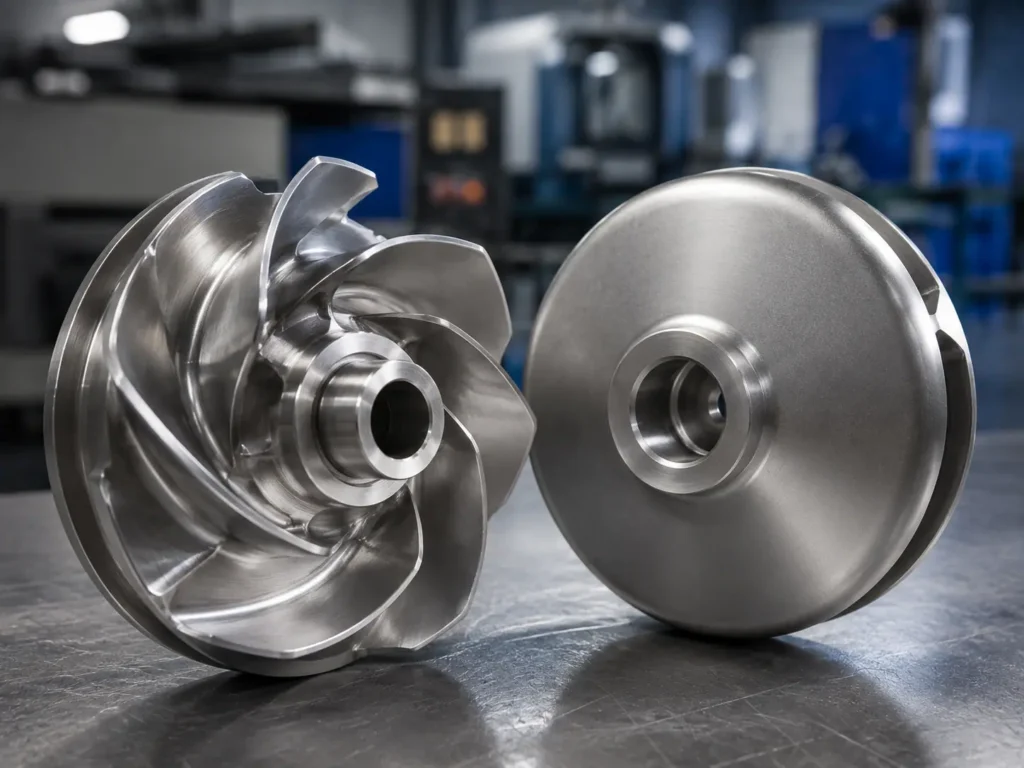
A material certificate for custom impellers should match the specified metal, product form and inspection requirements, with a clear link to the material supplied. If your order calls for EN 10204 documentation, state the certificate type before quotation. Types 2.2, 3.1 and 3.2 provide different inspection evidence and validation arrangements; none selects the alloy for you or replaces acceptance of the finished impeller’s dimensions, balance and operating suitability.
Choose the document requirement before buying the material
“Material certificate required” leaves several purchasing decisions unresolved. Does the order need a declaration, specific inspection results, or additional independent validation? Does that requirement cover the casting, the incoming bar, or each metal component in a fabricated wheel? Who must review the documents before material enters production?
These questions affect the material source, inspection schedule and quotation. If you need witnessing during production, the relevant people must be involved while those activities are still available to witness. Adding a certificate label at shipment cannot recreate an earlier inspection.
For custom pump impellers, start with the approved drawing and material specification. Record the required certificate type alongside the casting or wrought product form and delivery condition. Do not leave the documentation requirement in a separate email that the material purchaser may never see.
EN 10204 types at a glance
EN 10204 describes inspection documents for metallic products. Its number identifies a document framework, not an alloy specification. You still need the applicable material standard, grade and order requirements. The British Stainless Steel Association’s certificate guide explains this distinction and the certificate categories summarized below.
| Document type | Evidence and validation | Purchasing decision |
|---|---|---|
| 2.1 declaration | Manufacturer declares compliance with the order, without test results. | Do the approved requirements permit a declaration alone? |
| 2.2 test report | Compliance statement with results of non-specific inspection. | Do not assume these are results for the supplied test unit. |
| 3.1 inspection certificate | Specific inspection results, validated by the manufacturer’s authorized inspection representative independent of manufacturing. | Confirm the required test unit, results and authorized validation. |
| 3.2 inspection certificate | Specific inspection results with manufacturer inspection validation and purchaser-authorized or officially designated inspection representation. | Agree the inspection parties and activities before production. |
The table is a purchasing overview. The controlled standard and contract govern the exact requirement. Do not treat a higher certificate number as proof of a better alloy or better pump performance.
When does 3.1 fit, and when does 3.2 need planning?
Where the purchase specification requires specific material inspection evidence without an additional purchaser or designated inspector, a 3.1 requirement may fit. Confirm it with the engineering or quality owner. A manufacturer’s inspection representative being independent of manufacturing is not the same as an outside organization certifying the product.
For an order specifying 3.2, agree who will participate, the scope covered and when their involvement is required. LRQA’s EN 10204 Type 3.2 guidance describes independent inspection and witnessing activities. The practical procurement consequence is early coordination: material availability alone does not establish that the requested certification route is available.
Ask the supplier to separate the material price from any additional inspection, witnessing, testing and document costs. Require a proposed schedule identifying the activities that cannot proceed without the agreed review or attendance. This lets you compare quotations on the same scope instead of comparing one price with inspection included against another that excludes it.
Do not automatically demand 3.2 for every impeller. Equally, do not substitute 3.1 where the order requires 3.2. The choice belongs to the project requirements, and any proposed alternative needs documented acceptance before purchasing proceeds.
Define what the certificate covers
A cast impeller needs evidence for its casting material
Clarify the foundry product, heat or test unit, governing casting specification and required delivery condition. A certificate for metal charged into a furnace does not, by itself, establish the properties of the resulting impeller casting. Melting, alloy adjustment, casting and subsequent treatment create a production route that needs its own applicable evidence.
Ask how the reported tests represent the supplied castings under the governing specification. Do not assume that every result came from cutting a specimen out of each finished impeller. The test unit and specimen arrangement should be defined by the applicable requirements, with a documented connection to the delivered material.
Machining from stock requires the original material link
For an impeller machined from bar, billet, plate or forging, identify the parent product and certificate reference. Cutting and machining must preserve the connection between that material and the finished part. Where later processing changes the required material condition, establish which additional records demonstrate compliance after that processing.
The order should distinguish a material certificate from a finished-part inspection report. A valid stock certificate does not prove bore size, vane geometry, runout or dynamic balance. Those are separate acceptance activities in the impeller manufacturing process.
Fabricated wheels can require several certificates
A welded fan or mixer impeller can contain a plate back disc, formed blades and a separately machined hub. These components need not originate from one heat or even one product form. Define which items require certificates and how the component list references them. Include filler or purchased hardware evidence where the approved specification calls for it.
One cover sheet stating the assembly grade should not hide the separate material sources. Request a simple component-to-certificate index when the assembly contains multiple certified items. Detailed shop-floor identity transfer belongs in the impeller traceability requirements plan.
Put four separate requirements into the RFQ
First, state the material: exact grade, product standard, product form and delivery condition. A broad family name such as stainless steel or bronze does not provide an acceptance specification. Any proposed equivalent should go through the buyer’s engineering approval process.
Second, state the document type and its coverage. Identify the parts or components covered, required certificate language and format, and whether original producer documents must accompany a supplier’s summary. Agree who issues and validates the relevant documentation.
Third, state the actual inspection and test requirements. A certificate designation does not replace the product specification’s test list. If the order needs additional chemistry, mechanical properties, impact testing or other evidence, name the requirement and acceptance basis rather than expecting the supplier to infer it.
Fourth, state the submission and release timing. Request an example report format during quotation if it helps confirm the fields, but distinguish that example from the actual production certificate. Agree when the real documents must be submitted and who resolves discrepancies before dispatch.
Three certificate problems to resolve before shipment
The certificate describes a different product form. A report for plate should not be used to establish compliance of a cast impeller simply because the alloy family sounds similar. Check the actual procurement specification and production route. Ask the supplier for the correct evidence or an explicitly proposed deviation for engineering review.
The supplier forwards an unreadable or incomplete copy. Request the complete document, including references, reported results and validation. Where authenticity is uncertain, use a trusted contact route to the issuing organization. Do not approve altered grades, substituted identifiers or unexplained edits on a supplier-created copy. The BSSA guidance on misuse of material test certificates highlights the need to check certificate validity and supporting information.
The requested inspection was not arranged. Stop treating the issue as a formatting task. Ask the responsible inspection parties what evidence remains available and whether an acceptable route exists under the contract. A missing witness activity cannot be resolved merely by stamping an existing report. Any alternative must be reviewed before the order is released.
How Matson can review the documentation scope
Matson manufactures custom metal impellers from drawings or samples and can review material documentation requirements with the proposed manufacturing route. Send the drawing revision, material grade, quantity, product form, required certificate type and inspection scope together. Where independent inspection is required, identify the nominated organization and project conditions early.
Certificate availability, additional testing and inspection arrangements need confirmation for the specific order. This is particularly relevant when comparing a casting route with machining from certified stock, or when a fabricated assembly combines several material sources. A clear documentation scope helps determine what the quotation must include and which approvals are needed before production.
Questions about material certificates for custom impellers
Does EN 10204 specify the metal grade for my impeller?
No. It addresses inspection document types; the grade and applicable product specification must be defined separately. Your RFQ should identify whether the part is cast, machined from wrought stock or fabricated, and state the required delivery condition. A certificate reference without those inputs leaves the supplier unable to determine exactly which material requirements the order must satisfy.
Does a 3.1 certificate mean an outside inspector tested every impeller?
No. That interpretation confuses validation responsibility with independent outside inspection and individual testing. Ask the supplier to identify the applicable inspection arrangement, the test unit represented by the results and the relationship to the delivered parts. Whether every impeller requires additional checks comes from the approved inspection plan and product specification, not from that assumption about the certificate label.
Can I request 3.2 after the impellers are already finished?
Raise the requirement immediately, but do not assume it can be added retrospectively. The inspection parties need to assess available records, identification and any activities that were not witnessed. Ask for a documented feasibility review before agreeing to extra testing or shipment. If the original requirement cannot be met, the buyer must decide whether a proposed alternative is acceptable.
Is PMI enough when the required material certificate is missing?
PMI supplies a different kind of evidence. It can help check alloy chemistry within the selected method’s capabilities, but does not recreate the original certificate, inspection validation or production history. Treat missing required documentation as an unresolved order requirement. Ask the quality owner to evaluate the evidence and any proposed disposition; do not automatically substitute an alloy reading for the agreed document.
What should I send when requesting a material certificate for custom impellers?
Send the controlled drawing, exact material and product specification, manufacturing route, quantity and required condition. Add the certificate type, covered components, required tests, traceability level, inspection-party details and document submission deadline. If your customer has a certificate template or purchasing clause, include it at quotation so the supplier can identify gaps and confirm feasibility before material is ordered.
Final Thoughts
Choose the material certificate requirement when you define the impeller order. Keep the alloy specification, document type, test scope and inspection responsibilities explicit, then confirm that the proposed production route can deliver the required evidence. Matson can review these inputs alongside your drawing and quantity so the quotation reflects both the custom impeller and its agreed documentation, with unresolved requirements addressed before production begins.
Send Matson your drawing and material certificate requirements for a project-specific manufacturing and RFQ review.