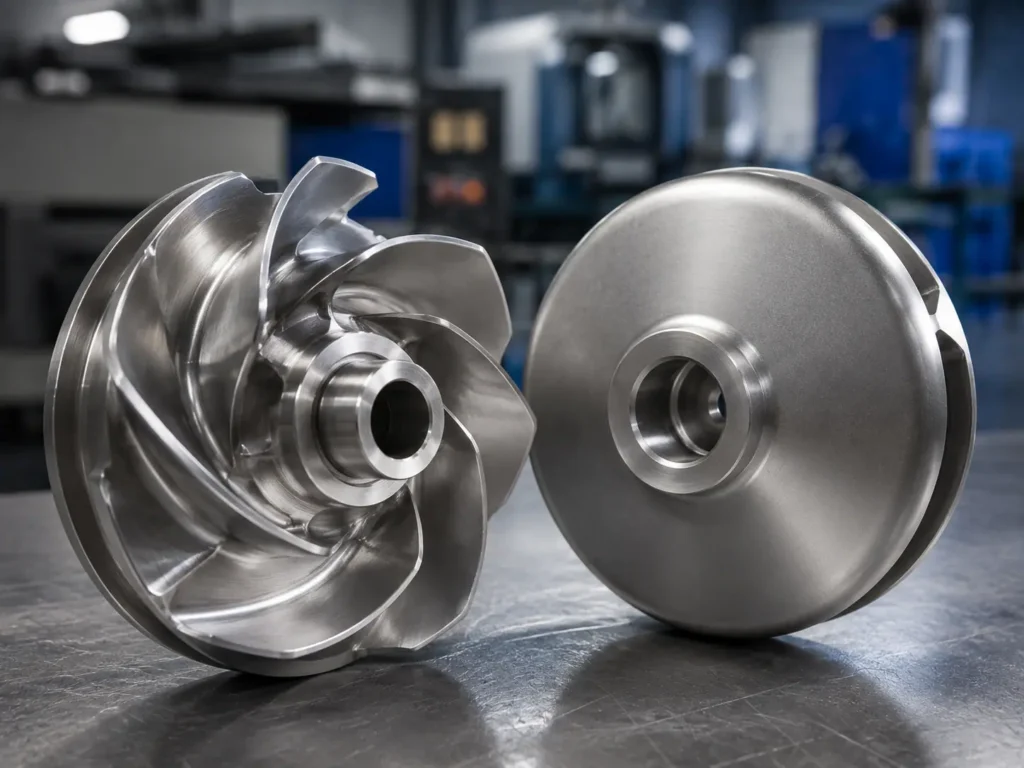
Impeller welding requirements should define the approved joint or repair location, base and filler materials, welding procedure qualification, personnel qualification, heat-input controls, dimensional checks, nondestructive examination, acceptance criteria, and rebalancing. A drawing note that says only “weld as required” is not enough for an OEM rotating component.
Short answer: welding changes more than the joint. It can distort the bore-to-blade relationship, alter material condition, introduce local discontinuities, affect coatings and machined surfaces, and change mass distribution. Buyers should therefore approve the welding route before production and state what must be inspected after welding, machining, heat treatment, and balancing.
Matson manufactures custom industrial impellers from drawings, 3D files, physical samples, and buyer specifications. For a fabricated or weld-repaired impeller RFQ, Matson can review the drawing, material, interfaces, machining, inspection, and balancing requirements. Welding availability and qualified procedure coverage must still be confirmed for the specific material, joint, and project standard.
When Does an Impeller Need Welding Controls?
Welding requirements can apply to fabricated fan wheels, blower impellers, mixer and agitator impellers, welded hubs or blades, attachment features, build-up work, and approved repair welding on castings. These are not interchangeable situations.
A production fillet weld joining a blade to a backplate has different risks from a repair weld used to remove a casting discontinuity. A stainless mixer impeller exposed to chemical service has different filler-metal and surface-treatment concerns from a carbon-steel fan wheel. A hub repair close to a machined bore has greater distortion risk than a noncritical attachment outside the rotating geometry.
The buyer should first classify the weld:
- production joint on a fabricated assembly
- attachment weld for a hub, blade, stiffener, or balance-related feature
- build-up weld followed by machining
- casting repair weld
- field repair that must be rejected or separately approved
Do not allow these categories to share one vague acceptance note.
Impeller Welding Decision Table
| Control item | Why it matters on an impeller | What the RFQ should state |
|---|---|---|
| Approved weld location | Joint position affects load path, distortion, machining access, corrosion exposure, and balance. | Joint symbol, side, length, size, contour, prohibited zones, and drawing revision. |
| Base and filler material | Wrong pairing can change strength, corrosion behavior, cracking risk, or heat-treatment response. | Exact base grades, material condition, filler classification, and substitution approval route. |
| Procedure qualification | A qualified range must cover the process, material group, thickness, joint, and production conditions. | Required WPS and supporting qualification record, governing standard, and edition. |
| Personnel qualification | Welder or operator qualification must match the process and applicable range. | Required qualification standard, process, material and validity records. |
| Heat and distortion control | Preheat, interpass temperature, sequence, restraint, and post-weld treatment can move critical geometry. | Temperature limits, sequence, fixture plan, heat-treatment requirement, and reinspection stage. |
| Weld examination | Visual inspection alone may not address surface or internal discontinuities required by the project. | VT, PT, MT, UT or RT method where applicable, coverage, timing, acceptance criteria, and reports. |
| Final rotating-part checks | A sound weld does not prove correct runout, dimensions, or mass distribution. | Datum setup, dimensional report, runout limit, balance requirement, correction limits, and final records. |
WPS, Qualification Records, and Welder Approval
A Welding Procedure Specification describes how the joint will be made. Its supporting qualification record demonstrates the tested range behind that procedure. The buyer should not assume that possession of one WPS qualifies every alloy, thickness, joint form, position, filler, or heat-treatment condition.
ISO 15614-1:2017 covers procedure qualification by welding procedure tests for arc and gas welding of steels and arc welding of nickel and nickel alloys; its scope includes production, repair, and build-up welding. ISO 9606-1:2012 covers qualification testing of welders for fusion welding of steels. ASTM A488/A488M-24 is specifically relevant when a project specification calls for qualification of procedures and personnel for fabrication or repair welding of steel castings.
These references are examples, not a universal requirement for every impeller. The equipment OEM or engineering owner must state the governing code, edition, material specification, and any additional project rules.
Distortion Can Make a Good Welded Part Unusable
Impellers are rotating components with linked geometry. Welding heat can pull a backplate, change blade spacing, move the hub, alter bore alignment, or create face and radial runout. The risk rises with uneven weld distribution, thin sections, dissimilar thicknesses, poor restraint, excessive heat input, or repair close to a machined feature.
A practical manufacturing plan should identify:
- which surfaces remain as-fabricated and which will be finish machined
- the datum used before and after welding
- welding sequence and balanced placement around the circumference
- fixture and restraint strategy
- when stress relief or other heat treatment is required
- which dimensions must be rechecked after heat treatment
- when the bore, hub, mounting face, outside diameter, and runout are inspected
- whether balancing occurs before or after coating and final attachments
The dedicated impeller heat treatment requirements guide owns the material-condition and thermal-cycle review. This article owns the welding control plan and the dimensional consequences of that plan.
Inspection Must Match the Weld Risk
Visual testing is the starting point, not an automatic complete inspection plan. ISO 17637:2016 specifies visual testing of fusion-welded joints in metallic materials and can also apply before welding. Other methods may be required when the drawing, material specification, weld location, service risk, or governing code calls for surface or volumetric examination.
The RFQ should state the method, extent, timing, acceptance criteria, examiner qualification, and report format. “NDT required” is incomplete. Penetrant testing, magnetic particle testing, ultrasonic testing, and radiographic testing do not have the same material limitations or defect-detection purpose.
Inspection timing also matters. A repair area may need examination after defect removal, after welding, after heat treatment, and after final machining. If a weld is hidden by a shroud, hub, coating, or later assembly step, the hold point must occur before access is lost.
Matson’s impeller manufacturing page describes the wider casting, CNC machining, surface treatment, dimensional inspection, and balancing route. Welding and NDT requirements should be added to the project-specific quality plan rather than assumed from that general process description.
Product-Specific Application Boundaries
Fabricated fan and blower impellers often require close control of blade-to-backplate joints, inlet geometry, hub alignment, weld sequence, distortion, runout, and dynamic balance. The fan OEM remains responsible for the approved aerodynamic geometry, speed, duty, and acceptance criteria.
Welded mixer and agitator impellers may add corrosion, cleanability, surface-finish, shaft-connection, tank-clearance, and chemical-service requirements. The process engineer or mixer OEM must approve the blade geometry and process duty.
Repair welding on a cast pump impeller needs separate authorization. The buyer should identify whether repair is permitted, which zones are prohibited, how the excavation is documented, which procedure applies, what heat treatment follows, and which examinations are repeated. Matson should not be positioned as approving hydraulic redesign or accepting an undocumented field repair.
What OEM Buyers Should Send
Send the following before quotation:
- controlled 2D drawing and 3D file, with welding symbols and revision status
- impeller type, service, operating speed, material, quantity, and assembly condition
- base-material grade and condition for every welded component
- filler-metal requirement or approved selection responsibility
- joint preparation, weld size, length, contour, finish, and prohibited repair zones
- required WPS, qualification record, welder or operator qualifications, standard, and edition
- preheat, interpass, heat-input, sequence, restraint, and post-weld heat-treatment requirements
- required VT, PT, MT, UT or RT scope, acceptance criteria, hold points, and reports
- critical dimensions, datum structure, runout, surface finish, and post-weld machining requirements
- balancing grade or residual-unbalance requirement, speed, balance condition, and report requirement
- coating, passivation, pickling, cleaning, marking, traceability, and final documentation
If the old sample contains a repair, mark it. A ground, filled, welded, coated, or heat-affected surface is evidence of part history, not automatic approval to reproduce the same repair.
Common Questions We Actually Get
What should impeller welding requirements include?
They should include weld location and geometry, materials, qualified procedure, qualified personnel, heat controls, inspection method and acceptance criteria, dimensional reinspection, machining, heat treatment, and balancing.
Is visual inspection enough for an impeller weld?
Not always. Visual testing is fundamental, but the drawing, material, service risk, joint location, and governing specification may require surface or volumetric examination.
Does a qualified WPS cover every impeller material and thickness?
No. The qualified range depends on the governing standard and variables such as process, material group, thickness, joint form, filler, position, and heat-treatment condition.
Should an impeller be balanced again after welding?
The buyer should normally require balance review after welding, final machining, repair, coating, or attachment changes that can alter mass distribution. The exact acceptance requirement must come from the equipment specification.
Can Matson approve a repair weld on a failed impeller?
Matson can review manufacturing information and project requirements, but repair permission, prohibited zones, engineering acceptance, and service suitability must be approved by the pump, fan, mixer, or equipment owner responsible for the design.
CTA
Need an OEM review for a fabricated or weld-repaired impeller? Send the controlled drawing, material grades, weld map, applicable standards, WPS and qualification requirements, inspection plan, critical dimensions, runout, balance requirement, quantity, and service conditions through the contact page. Matson can review the manufacturing and RFQ scope before quotation.