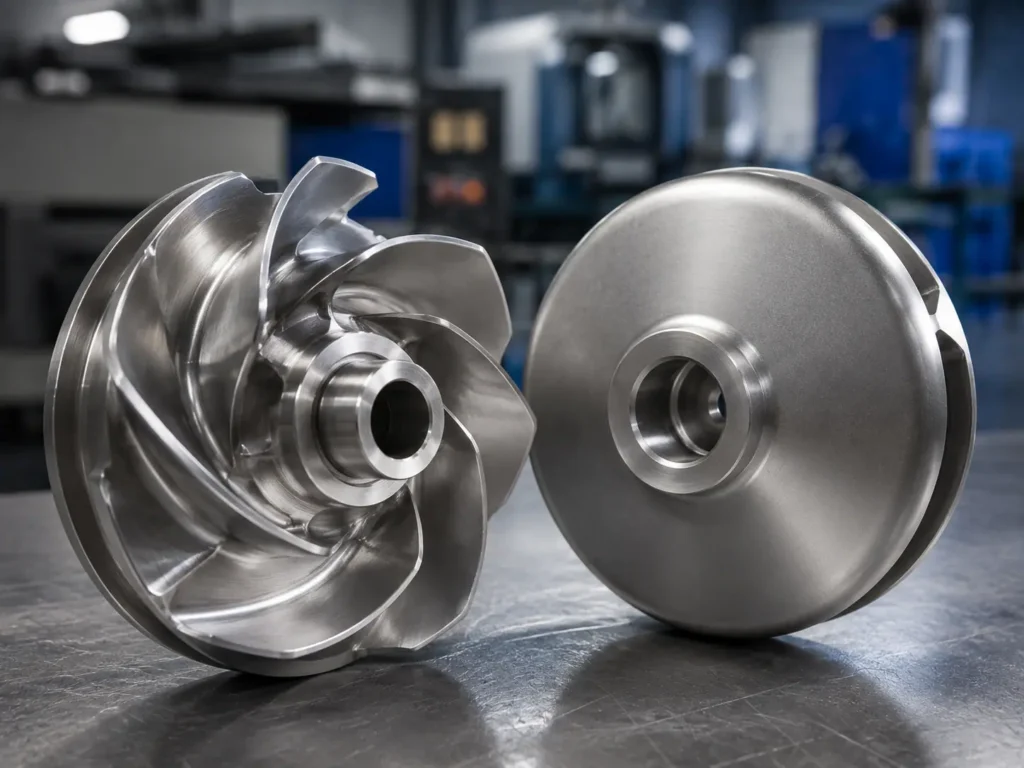
Impeller drawing revision control is the process of making sure quotation, tooling, casting or fabrication, CNC machining, inspection, balancing, marking, and shipment all use the same approved design baseline. A revision letter on the PDF is not enough. The supplier must also control the matching 3D model, specifications, approved deviations, programs, fixtures, inspection plan, and work already in progress.
Short answer: every impeller order should identify one released part number, drawing number, revision, model version, and effective date or order point. When a change is issued, the buyer and manufacturer should assess its effect, approve the disposition of existing material and parts, update every dependent production document, remove obsolete versions from use, and verify the first affected output before normal production continues.
Matson manufactures custom industrial impellers from buyer drawings, 3D files, samples, and specifications. The buyer remains responsible for releasing the design requirement and approving engineering changes. Matson can review how a released change affects the selected casting, fabrication, machining, surface-treatment, inspection, balancing, and packing route before quotation or production.
What the Controlled Impeller Baseline Includes
The controlled baseline is the complete set of information required to make and accept the part. It can include:
- buyer part number and equipment or assembly reference
- 2D drawing number, revision, release status, and issue date
- 3D model identifier, file revision, and model-based-definition notes where applicable
- material specification, grade, condition, and approved alternatives
- dimensional tolerances, datums, surface finish, coating, and marking requirements
- applicable customer, industry, inspection, balancing, and packaging specifications
- approved deviation, concession, clarification, or engineering-change record
- first-article or sample approval status
- manufacturing traveler, pattern or tooling revision, CNC program, fixture, and inspection plan
If one of these items changes while the others remain uncontrolled, the part can be manufactured to a mixed baseline. A new drawing with an old CNC program is not controlled production. Neither is a current model paired with an obsolete inspection report template.
Drawing Revision Control Decision Table
Use this table to identify what a revision change must reach. It is not a universal document list; the actual scope follows the project and process route.
| Controlled item | What must identify the version | Typical risk if it is not updated | Release check |
|---|---|---|---|
| 2D drawing | Drawing number, revision, approval status, issue date, sheets, and referenced specifications. | Wrong dimensions, tolerances, notes, or material requirement. | Confirm one released copy and document precedence. |
| 3D model | Part number, file name, revision or version, coordinate system, units, and linked drawing. | Vane or shroud geometry conflicts with the 2D drawing. | Record the exact file and resolve every known conflict. |
| Pattern, tooling, and fixture | Tool ID, revision, affected features, maintenance or modification record. | New geometry is requested while old tooling still controls the blank or setup. | Verify modification, replacement, or approved continued use. |
| CNC program and setup | Program number, revision, model source, datum, tool list, and machine setup. | Bore, hub, mounting face, keyway, OD, or profile follows an obsolete definition. | Independent program and setup review before release. |
| Inspection plan | Ballooned drawing, characteristic list, datum, method, sampling, and acceptance revision. | Production changes but inspection continues checking old features or limits. | Match every characteristic to the released baseline. |
| Work order and traveler | Part, revision, quantity, material, route, operation status, and deviation references. | Work in progress cannot be separated by revision. | Identify the revision at order release and each transfer point. |
| Final records and marking | Part or batch identity, drawing revision, report references, and release status. | A conforming report is assigned to a different revision or shipment. | Reconcile part, reports, packing list, and buyer order. |
Decide Whether the 2D Drawing or 3D Model Governs
Complex impeller vanes, blades, shrouds, and passages are often defined by a 3D model, while the 2D drawing carries dimensions, tolerances, datums, material, finish, balancing, and inspection notes. Both can be necessary, but the purchase documents should state which source controls geometry and what happens when they conflict.
Do not assume the newest file name is the approved file. A model named final-new-v3.step may have no formal relationship to drawing revision C. Use a controlled identifier, release status, and transmittal record. If the buyer sends a replacement file after quotation, the supplier should not silently overwrite the original and continue.
For model-based definition, clarify whether the model includes only nominal geometry or also product manufacturing information, tolerances, annotations, and datums. If the 2D drawing remains the authority for non-geometric requirements, say so explicitly.
The impeller manufacturing route should be reviewed against the released baseline. A change that looks small on screen can affect draft, shrinkage compensation, machining stock, tool access, fixture location, inspection access, runout, or mass distribution.
A Good Revision Identifier Is More Than a Filename
The controlled record should answer:
- Who created and approved the change?
- Which part numbers, assemblies, sheets, models, and specifications are affected?
- What changed and why?
- When does the revision become effective?
- Which orders, serial numbers, lots, or dates use the new revision?
- What happens to raw material, castings, fabricated assemblies, machined parts, finished inventory, and field stock?
- Which tools, programs, inspection plans, reports, labels, and packing documents must change?
A revision cloud or change note helps reviewers locate a change, but it does not replace impact assessment. Likewise, an email saying “please use the attached drawing” is weak control if the attachment lacks approval status or the purchase order still names the earlier revision.
Review the Change Before Releasing It
The buyer and supplier should assess more than dimensions. For an impeller, a proposed change can affect:
- mating shaft, sleeve, key, taper, nut, flange, or hub interface
- casing, wear ring, wear plate, inlet, outlet, axial, or radial clearance
- vane count, angle, thickness, profile, leading edge, trailing edge, or passage
- casting fill, feeding, shrinkage, core, pattern, and machining allowance
- weld joint, fixture, sequence, distortion, heat treatment, and NDT
- machining datum, tool reach, remaining wall thickness, and surface finish
- coating, passivation, polishing, masking, and marking areas
- part mass, center of gravity, runout, balance condition, and correction zones
- inspection method, instrument access, report format, and sampling
- packaging support, blade-edge protection, and shipping identification
The review result can be accept, reject, request clarification, quote a cost or lead-time change, require new tooling, or propose a controlled alternative. Production should not use the new requirement until the authorized parties have released it.
Control Work in Progress and Existing Inventory
An engineering change creates a physical segregation problem. The manufacturer should identify how many parts exist at each stage: raw stock, casting, fabricated blank, heat treatment, rough machining, finish machining, coating, balancing, inspection, packing, or shipment.
Each group needs a disposition. Options may include:
- continue to the old revision for an identified order
- rework to the new revision under an approved instruction
- inspect and submit for concession
- use only for a named application or service quantity
- scrap or return the affected material
- hold until the buyer decides
Do not mix old- and new-revision parts in one unlabeled container. If both revisions remain valid for different equipment, packing labels and reports must make the distinction visible.
Rework feasibility must be checked rather than assumed. Increasing a diameter may be impossible after machining; moving a bore datum can invalidate earlier features; reducing vane thickness can alter balance and strength; welding or material addition may require separate approval, heat treatment, NDT, machining, and rebalancing.
Push the Revision Into Every Production Control
Releasing a drawing is only the first step. The change must reach the people and systems that make or inspect the impeller.
For a cast route, review the pattern, core box, shrinkage assumptions, machining allowance, gating or feeding decisions, inspection zones, and casting identification. For a fabricated wheel, review blade templates, forming, joint details, fixture, weld map, sequence, and distortion controls. For CNC machining, update the source model, program, setup sheet, datum, offsets, fixture, in-process checks, and final inspection plan.
External processors also need the correct baseline. Heat-treatment, NDT, passivation, coating, balancing, and third-party inspection purchase orders should identify the affected part and revision when the requirement changes their work.
Obsolete paper copies and locally saved files must be removed from normal use or clearly marked as superseded. Keeping an old drawing for historical evidence is different from leaving it available at the machine as an apparent production instruction.
Revision Control and Traceability Are Different
Revision control defines which design baseline is authorized. Traceability records which material, process route, inspection results, and physical part were produced against that baseline.
The two controls connect, but one does not replace the other. A perfectly controlled revision can still lose material heat identity. A fully traceable part can still be wrong if it was deliberately produced to an obsolete revision. The impeller traceability requirements guide owns the part-to-material, process, report, marking, and shipment identity chain.
For every released batch, the traveler, inspection report, balancing record, final marking where required, and packing list should identify enough information to connect the output to the approved revision.
Decide When Reinspection or a New First Article Is Required
Not every spelling correction requires a new first article. A geometry, material, datum, process, tooling, supplier, inspection, or balance-related change may require partial or complete requalification.
Use risk and affected characteristics. A bore-tolerance change may require new machining and fit inspection without repeating unrelated material tests. A vane-profile change can affect casting or fabrication, dimensional verification, clearance, mass distribution, and equipment performance, making a broader first-article review appropriate.
The custom impeller first article inspection guide owns ballooned-characteristic review, material evidence, dimensional results, runout, balancing, deviation status, approval, and reapproval triggers. Revision control determines which baseline that first article must demonstrate.
The approval record should say whether the new revision is:
- approved for prototype or fit check only
- conditionally approved for a limited quantity
- approved for a named order or equipment application
- approved for normal repeat production
- rejected or returned for correction
“Sample looks good” does not define the production authorization.
Buyer and Supplier Responsibilities
The buyer or design authority should release clear, internally approved requirements and identify approval authority. It should communicate superseded revisions, resolve 2D/3D conflicts, approve design-affecting deviations, and decide how changes apply to open orders and existing stock.
The manufacturer should review the change for manufacturability, cost, lead time, tooling, quality, and production impact; identify questions before release; update dependent controls; prevent unintended use of obsolete information; and provide the agreed revision evidence with the shipment.
Neither side should rely on memory. If a phone call changes the requirement, convert it into an approved record before production. If the factory proposes a manufacturing improvement, it should not change design-controlled geometry, material, or acceptance requirements without buyer authorization.
ISO 10007:2017 provides general configuration-management guidance across the product life cycle, including configuration identification, change control, status accounting, and audit concepts. ISO 9001:2015 provides the broader quality-management context for documented information and controlled production changes. Neither standard defines the specific drawing hierarchy, first-article trigger, or work-in-progress disposition for one impeller order; the contract must do that.
What Buyers Should Confirm Before the RFQ
Send or define:
- buyer part number, equipment or assembly reference, and purchase-order line
- released 2D drawing number, revision, sheets, issue date, and approval status
- exact 3D file identifier, version, units, coordinate system, and relationship to the drawing
- precedence among drawing, model, specifications, purchase order, and approved deviations
- material, tolerances, datums, finish, coating, balancing, marking, inspection, and packing requirements
- effective point for the revision: order, lot, serial number, date, or other controlled break
- disposition rules for material, tooling, work in progress, finished stock, and shipped parts
- required supplier impact review, quotation update, lead-time approval, and change acknowledgment
- first-article, partial reinspection, trial assembly, balancing, or requalification triggers
- required revision fields in travelers, certificates, inspection reports, labels, and packing lists
- document retention, access, language, file format, and approval authority
These details let suppliers quote the actual change work. A revised PDF can create pattern modification, new programming, fixture changes, additional inspection, obsolete inventory, and reapproval cost that is not visible from the changed dimension alone.
Common Questions We Actually Get
What is impeller drawing revision control?
It is the controlled process for identifying the approved drawing and model baseline, reviewing changes, updating dependent manufacturing and inspection information, preventing use of obsolete versions, and verifying affected output.
Can the 3D model override the 2D drawing?
Only when the purchase documents or design authority define that precedence. Many projects use the model for nominal complex geometry and the drawing for tolerances, material, datums, finish, inspection, and notes. Conflicts must be resolved before production.
Does every impeller revision require a new first article?
No. The decision depends on affected fit, function, material, process, tooling, inspection, balance, and application risk. The approval record should define whether reinspection is partial or complete.
What happens to work in progress after a drawing change?
It should be identified, segregated, assessed, and assigned an approved disposition such as continue to the old revision, rework, concession, restricted use, hold, or scrap. Do not mix revisions without clear identity.
Can Matson manufacture to a revised impeller drawing?
For suitable custom projects, Matson can review the revised drawing or model against casting, fabrication, CNC machining, inspection, balancing, surface treatment, packing, cost, and lead-time requirements. The buyer should release the approved revision and disposition open work before implementation.
CTA
Need a revised impeller drawing reviewed before production? Send the released drawing and model, change description, affected orders, material, quantity, tooling status, work-in-progress disposition, inspection and balancing requirements, first-article trigger, and approval contacts through the contact page. Matson can review the manufacturing impact before quotation or change release.