Pump impeller types are easy to list and hard to choose. In industrial pumps, the common types are closed, open, semi-open, vortex, mixed-flow, and slurry pump impellers. The real choice starts with the liquid, solids, pump speed, casing, material, and maintenance reality.
Short answer: clean liquid points toward a closed impeller. Dirty liquid, fibers, sludge, or abrasive particles push the discussion toward open, semi-open, vortex, or slurry designs.
Matson manufactures custom pump impellers from drawings, 3D files, samples, and project specifications. This article looks at pump impeller types from an RFQ review and manufacturing angle. If you already have a drawing or sample, compare the design with the actual working condition before asking a pump impeller manufacturer for a quote.
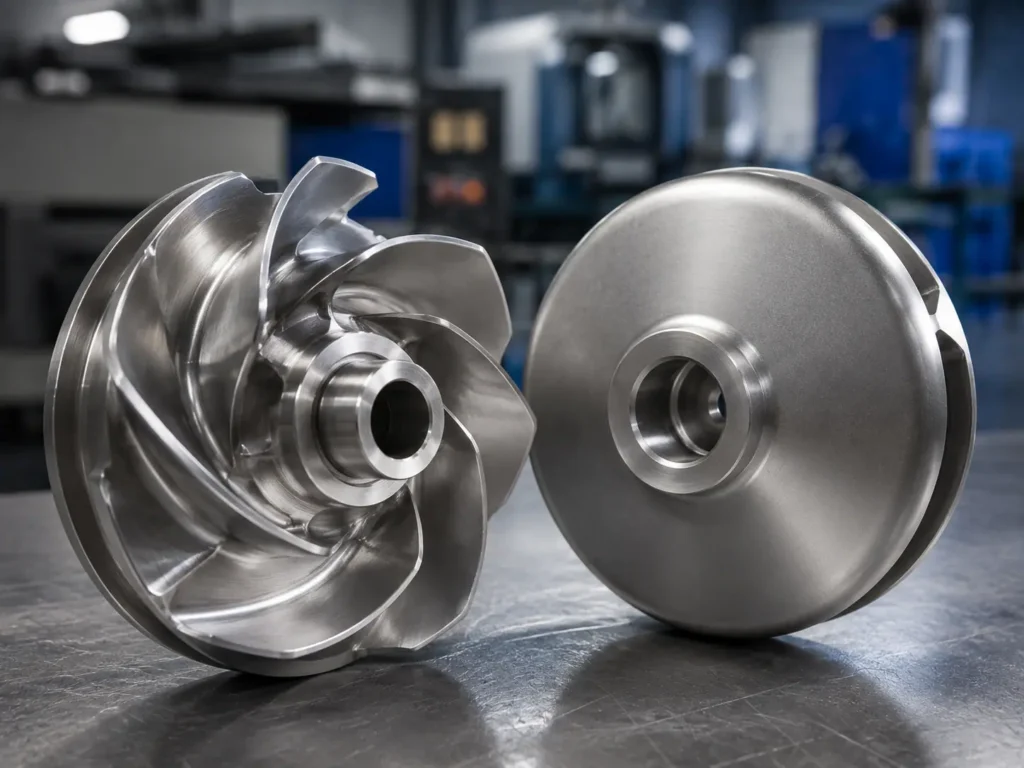
Quick Comparison of Pump Impeller Types
Use this table as a first filter, not a final answer. A drawing that looks correct on screen still has to fit the casing, shaft, fluid, speed, and service life target.
| Pump impeller type | Common use | Why buyers choose it | What to check before quoting |
|---|---|---|---|
| Closed pump impeller | Clean water, process liquid, many centrifugal pumps | Efficiency and controlled flow | Clearance, bore accuracy, balance, clean-fluid condition |
| Open pump impeller | Liquids with light suspended solids | Easier cleaning and access | Vane wear, efficiency loss, mounting face, balance |
| Semi-open impeller | Wastewater, chemical and process pumps | A practical middle choice | One-side clearance, corrosion, solids content |
| Vortex pump impeller | Sewage, sludge and clog-risk service | Lower clogging risk | Solids size, casing match, flow loss, material |
| Mixed-flow impeller | Higher-flow pump applications | Radial plus axial flow behavior | Blade shape, hub profile, original hydraulic design |
| Slurry pump impeller | Mining, tailings, abrasive slurry and heavy sludge | Wear resistance | Hardness, section thickness, service life, balance |
What We Check Before Talking About Type
The impeller name is not enough. I want to know the liquid first. Then solids. Then speed. Then whether the buyer is copying an existing pump or trying to improve a failing part.
Photos help, but they also trick people. A photo shows the shape. It does not show a worn bore, a 0.8 mm clearance problem, or a material mistake.
A simple RFQ example: a buyer gives only “OD 320 mm” and asks for a closed impeller quote. That sounds specific, but it is not enough. If the bore is 5 mm off, or the hub height is wrong, the impeller does not fit the pump. If the liquid carries fine abrasive sand, the “efficient” closed design becomes the wrong conversation.
Most engineering textbooks are right about closed impellers being efficient. In real customer pump work, that advice is only half the story. Solids content and maintenance conditions eat the other half.
Closed Pump Impellers
A closed pump impeller has vanes between front and back shrouds. It belongs in clean or relatively clean liquid service.
The attraction is efficiency. The flow path is controlled. The pump runs cleaner hydraulically.
The catch is clearance. Closed impellers are less forgiving. Bore accuracy, hub dimensions, sealing surfaces, vane passages, and balance all matter. Send the drawing, not just the outside diameter.
Put a closed impeller into fibrous sludge and it clogs faster. Put it into abrasive service and the wear pattern gets ugly. We have seen enough of this pattern to be careful with “closed is better” claims.
Open Pump Impellers
An open pump impeller has exposed vanes. You can see the working surfaces. Cleaning and inspection are easier.
That does not make it a rough part. A bad vane profile, wrong mounting face, loose bore control, or poor balance still creates vibration and poor pump performance.
Open impellers make sense when the liquid is not perfectly clean and the pump needs easier access. The price you pay is efficiency. Sometimes that price is worth paying.
Semi-Open Impellers
A semi-open impeller has one shroud and one open side. In many industrial pump projects, this is the compromise buyers end up with after the first round of discussion.
It gives more structure than a fully open design and handles some solids better than a closed design. Wastewater, chemical processing, and general process pumps use this layout for that reason.
For production, I look at clearance first. Then material. Then how much machining remains after casting. Corrosive liquid changes the material discussion quickly: 304, 316, duplex stainless, bronze, or another alloy.
Vortex Pump Impellers
A vortex pump impeller is for clog-risk service. It sacrifices some clean-water efficiency to keep difficult liquid moving.
That is the point. Sewage, sludge, and wastewater do not behave like clean water in a test chart. For an industrial water pump impeller or wastewater pump project, the question is often not “highest efficiency.” It is “will this keep running without blocking every week?”
Before quoting a vortex impeller, send solids size, approximate solids content, liquid chemistry, pump speed, and casing information. Wastewater often brings corrosion and abrasion together. Treating material as a small detail is how the project gets expensive later.
Mixed-Flow Impellers
Mixed-flow impellers combine radial and axial flow behavior. They appear in higher-flow pump applications with moderate head.
I would not judge this type from a name or photo. Blade shape, hub profile, diameter, casing relationship, and original hydraulic design all matter. If the pump already works, copy the proven geometry carefully.
For mixed-flow impellers, the drawing or sample is the starting point. Geometry, material, tolerance, and quantity decide the manufacturing route.
Slurry Pump Impellers
Slurry kills impellers. Not slowly.
A stainless impeller that survives years in clean water can be destroyed fast in mineral slurry. The surface finish is not the main issue. Section thickness, alloy choice, hardness, casting quality, and balance decide whether the part has a chance.
For a slurry pump impeller project, send the slurry condition, particle size, expected service life, and photos of the worn part. A worn sample is useful, but do not assume it still shows original dimensions. Measure what matters before copying it.
Choosing the Right Impeller Type
I would not choose a pump impeller type from a keyword list. Start with the working condition, then check whether the drawing supports that choice.
| Question to ask | Why it matters |
|---|---|
| Is the liquid clean or dirty? | Clean liquid points toward closed designs. Dirty liquid pushes the discussion toward open, semi-open, vortex, or slurry impellers. |
| Are there solids, fibers, or abrasive particles? | Solids change clogging risk, vane wear, passage shape, and material selection. |
| Is corrosion part of the job? | Chemical liquid, seawater, and wastewater move the material discussion toward stainless steel, duplex stainless, bronze, or other alloys. |
| How fast does the pump run? | Speed changes the balancing and vibration risk. |
| Is this copied from a drawing or a worn sample? | A worn sample hides original dimensions. Photos plus key measurements reduce mistakes. |
| What documents are needed? | OEM buyers often ask for material certificates, dimensional reports, and balancing data. |
If the current pump runs well, manufacture to the drawing or confirmed sample. If the current impeller fails early, do not only reorder the same part. Check material, thickness, balance, solids, and corrosion before the next batch.
Manufacturing Notes
Pump impeller manufacturing uses different routes: investment casting, sand casting, CNC machining, surface finishing, inspection, and dynamic balancing.
A small stainless impeller with detailed geometry often fits investment casting plus finish machining. A larger cast impeller often needs sand casting and extra machining allowance. A high-speed part needs tighter balancing control. There is no single route that fits every impeller.
For more detail on casting, CNC machining, surface treatment, and balancing, see Matson’s impeller manufacturing capability page.
What to Send for an RFQ
For a faster and cleaner quote, send:
- 2D drawing, 3D file, or physical sample
- Material grade or operating liquid
- Outside diameter, bore size, hub height, and key mounting dimensions
- Pump type and application
- Quantity and expected batch schedule
- Surface finish requirement
- Balancing requirement
- Inspection or documentation requirement
- Photos of the current part, especially if the sample is worn
Matson manufactures to customer drawings and samples rather than selling off-the-shelf retail replacement parts. If you need help checking the manufacturing route, send the project details through the contact page.
Common Questions We Actually Get
What are the main pump impeller types?
The main industrial pump impeller types are closed, open, semi-open, vortex, mixed-flow, and slurry pump impellers. The right choice starts with the liquid, solids, pump design, material, and speed.
Which pump impeller type is best for wastewater?
Wastewater pumps often use semi-open, vortex, or other solids-handling impeller designs. Solids size, clogging risk, corrosion, and abrasion decide the final choice.
Are closed pump impellers more efficient?
Yes, in clean-fluid centrifugal pump service. In dirty liquid, that efficiency advantage can disappear behind clogging, wear, and maintenance problems.
Can Matson manufacture pump impellers from a drawing?
Yes. Matson manufactures custom pump impellers from 2D drawings, 3D files, physical samples, or detailed dimensional specifications.
Does every pump impeller need dynamic balancing?
No. Balancing is driven by pump speed, diameter, application, drawing requirement, and buyer documentation needs.
CTA
Need help choosing a manufacturing route for a pump impeller project? Send Matson your drawing, sample photos, material grade, quantity, and application environment. We can review the part and suggest a practical route for casting, machining, finishing, inspection, and balancing.