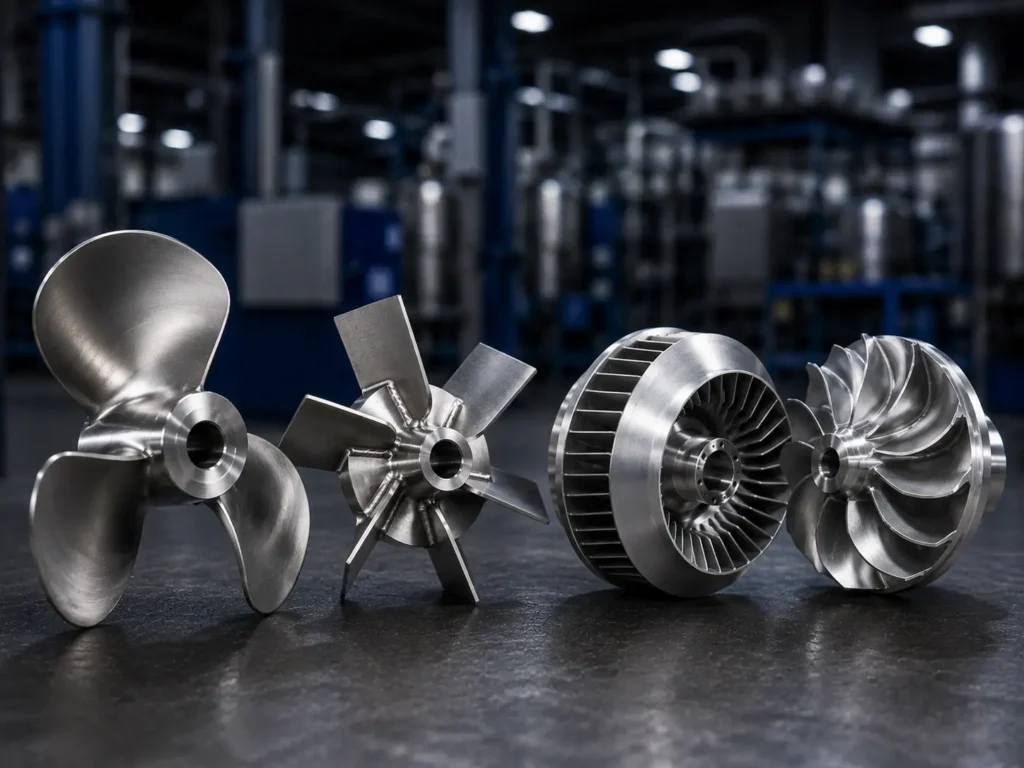
A mixing impeller for solids suspension is suitable only when it meets the specified suspension target under the required operating conditions. Keeping particles off the tank floor does not automatically produce uniform solids concentration throughout the vessel. Before selecting or ordering an impeller, define the required distribution, particle properties, liquid conditions, fill range and restart duty. Then qualify the arrangement and release the approved geometry for manufacture rather than buying from a blade-type label alone.
Off-bottom suspension and uniform distribution are different requirements
Off-bottom suspension concerns whether particles remain persistently settled on the vessel floor under a defined observation method. A just-suspended condition is often described using a just-suspended speed, Njs. That condition does not establish that samples from the upper and lower parts of the tank have the same solids concentration.
Uniform suspension needs a separate, measurable definition. Specify the permitted concentration variation, sampling positions, time after startup and operating conditions. Do not assume that the word “uniform” means exactly identical concentration everywhere, or allow each supplier to invent its own interpretation.
ProQuip’s process-specification guidance distinguishes suspension objectives and asks buyers to explain the required process result and how it is measured. Its equipment guarantees belong to ProQuip; they are not Matson guarantees. The useful sourcing principle is to define acceptance before asking for a recommendation.
| Required result | What to define | What it does not prove |
|---|---|---|
| No persistent settled bed during operation | Observation or measurement method, relevant floor regions and operating condition | Uniform concentration at all vessel heights |
| Specified solids distribution | Sampling locations, concentration basis, permitted variation and stabilization time | Acceptable restart after a long shutdown |
| Reliable delivery to an outlet | Outlet location, withdrawal rate and acceptable delivered solids concentration | That the rest of the tank meets the same concentration criterion |
| Restart from a settled condition | Permitted shutdown duration, bed condition, startup procedure and equipment limits | That steady-running qualification covers the restart load |
These distinctions matter in mineral slurries, chemical process vessels, wastewater mixing and other industrial duties. The correct endpoint depends on the process. Keeping an abrasive slurry moving before transfer is a different acceptance task from supplying a consistent solids concentration to a downstream reaction or dosing step.
Characterize the particles before comparing impellers
Particle size distribution, not just an average
A single average particle size can conceal a coarse fraction that behaves differently from the rest of the material. Provide the measured distribution and the method used to obtain it. Record particle shape, density and any relevant tendency to agglomerate, break or adhere.
If the feed varies between batches, describe the expected range and the conditions used for qualification. An acceptance test based on a convenient fine sample should not be presented as covering a coarser production feed without evidence. Identify whether particles dissolve, react or change size during the process; suspension and dissolution are not interchangeable objectives.
Concentration needs a stated basis
State whether solids concentration is mass fraction, volume fraction or another defined quantity. Include units and sampling conditions. Two RFQs both saying “20% solids” are not necessarily describing equivalent slurries.
For an established process, retain the approved concentration range and any restrictions during filling, addition or withdrawal. For a new process, ask the process owner to define the design cases. The component manufacturer should not silently choose the easiest concentration and treat it as the entire duty.
Liquid properties can change during the batch
Provide liquid density, viscosity behavior and temperature range. Where the mixture is non-Newtonian, a single viscosity value may not adequately describe the operating condition. Include the relevant measurement basis and any approved rheological model rather than treating all slurries like water.
If the process includes gas addition, foam, crystallization or fragile solids, identify those constraints separately. A suspension test does not automatically qualify gas dispersion or acceptable product integrity. Define which result governs selection and which additional results must remain acceptable.
The tank arrangement is part of the suspension problem
Impeller diameter, blade geometry, elevation, liquid height, bottom contour and internals need to be reviewed together. Baffles, coils, dip pipes and outlets can affect both circulation and access. An arrangement drawing is more useful than tank capacity alone.
For bottom clearance, identify the measurement reference. Clearance measured from an impeller center plane is different from the closest physical blade-to-floor gap. A dished or sloped bottom also needs a defined reference surface. Do not copy a nominal clearance while changing blade pitch or profile without checking the resulting occupied envelope.
The impeller-to-tank diameter ratio guide explains D/T and its limits. This article does not repeat that sizing discussion. For suspension, the key question is whether the selected arrangement meets the specified solids endpoint across the required fill and feed conditions.
In a tall tank, enlarging the lowest impeller is not automatically a solution to poor upper-vessel distribution. The equipment designer may need to evaluate impeller number, placement or other arrangement changes. Keep that engineering decision separate from a purchase instruction for a larger component.
Which impeller family should you evaluate?
Axial-flow designs are common candidates for selected suspension duties because bulk circulation is important. However, “axial flow” does not identify an exact profile or validate a particular slurry application. Particle properties, geometry, operating conditions and the acceptance target still govern the review.
The primary Lightnin guide to fluid mixing discusses suspension as a flow-oriented application. That general framework is not a universal ranking of all impellers and is not evidence that a particular Matson component has achieved a process result.
| Candidate or proposed change | Useful question | Limitation to confirm |
|---|---|---|
| Hydrofoil-style impeller | Does the exact approved geometry provide the required suspension and distribution? | A family name does not establish coefficients or process performance |
| Pitched-blade turbine | Are blade angle, pumping direction and installed geometry appropriate to the duty? | Do not assume equivalence to another turbine merely from diameter and blade count |
| Radial-flow candidate | What evidence supports it for this suspension task and other process requirements? | Local agitation is not proof of adequate floor coverage or full-height distribution |
| Multiple-impeller arrangement | Which regions or process endpoints require the added stages? | Spacing, shaft loading and installed interactions need equipment-engineering approval |
| Higher speed or larger diameter | Does the change improve the defined endpoint within approved equipment limits? | Power, load, clearance and product-quality consequences require separate review |
Our hydrofoil impeller guide covers that geometry family and its manufacturing features. This suspension article owns the application acceptance and sourcing logic, not a claim that hydrofoils always outperform other designs.
Do not turn Njs into a universal speed recommendation
Just-suspended speed is meaningful only with its definition, observation method and applicable material and geometry conditions. A correlation needs its original variable definitions, units and limits. A coefficient copied from a different blade design or vessel should not be presented as a production setting.
Ask who supplies and approves the calculation or test basis. Record which particle distribution, loading, fluid properties, bottom geometry and impeller position were represented. Do not use a numerical result to hide missing inputs.
Likewise, increasing speed until the surface looks active is not a qualification method. The process could show strong visible movement while retaining deposits in unobserved regions or failing an upper-vessel concentration criterion. Approved equipment limits and product-quality constraints apply throughout any operating review.
Matson supplies suitable custom components to approved requirements. The process owner or mixer OEM must validate the mixing arrangement and operating window. The article does not provide a universal rpm, suspension coefficient, motor selection or shaft-loading approval.
Restart from a settled bed is a separate case
A mixer that maintains an already suspended slurry has not necessarily demonstrated that it can restart after solids settle. Record the permitted shutdown duration, settling behavior and any potential bed consolidation. Define the state of the vessel before the approved restart procedure begins.
The equipment owner must evaluate the startup sequence and mechanical demands. Do not recommend simply increasing torque or speed without that review. If the process requires emptying, flushing or another controlled intervention before restart, include it in the agreed operating basis rather than leaving it outside the RFQ assumptions.
For procurement, distinguish normal operation, temporary interruption and the worst approved restart case. If a proposed supplier test covers only steady suspension, describe that limitation explicitly. A new impeller purchase is not authorization to operate an existing system outside its approved limits.
Write an acceptance test another team can repeat
Define the endpoint first, then specify how evidence is collected. For distribution, identify sampling heights, radial locations, collection times and concentration measurement methods. Include the outlet if the downstream process depends on its delivered solids content.
Sampling must be representative and follow site safety procedures. A sample drawn after unintended settling in a line may not represent the vessel at the intended moment. Ask the process team to document how such bias is controlled. A single conveniently located sample should not stand in for a full distribution requirement.
Keep test inputs traceable: actual particle sample, liquid properties, fill level, geometry revision, speed and duration. Record acceptance limits before reviewing results. If a pilot test is used, document the scale-up basis and the differences that remain unverified.
Do not confuse a CFD image, a coefficient table or a visual tank demonstration with a validated process guarantee. Those tools can inform engineering when their assumptions are appropriate. They do not replace the agreed evidence for the specific duty.
Preserve the qualified geometry through manufacturing
Once the process design is approved, convert it into a controlled component specification. Record finished diameter, blade count, profile, pitch, orientation, thickness where specified, hub relationship, shaft connection and relevant dimensional requirements. Define which changes require OEM approval.
A worn sample can assist the discussion but may no longer preserve the accepted shape. Identify erosion, repaired edges, distortion and material loss. Use an authoritative drawing, model or approved reference where available, and document reconstructed dimensions before production.
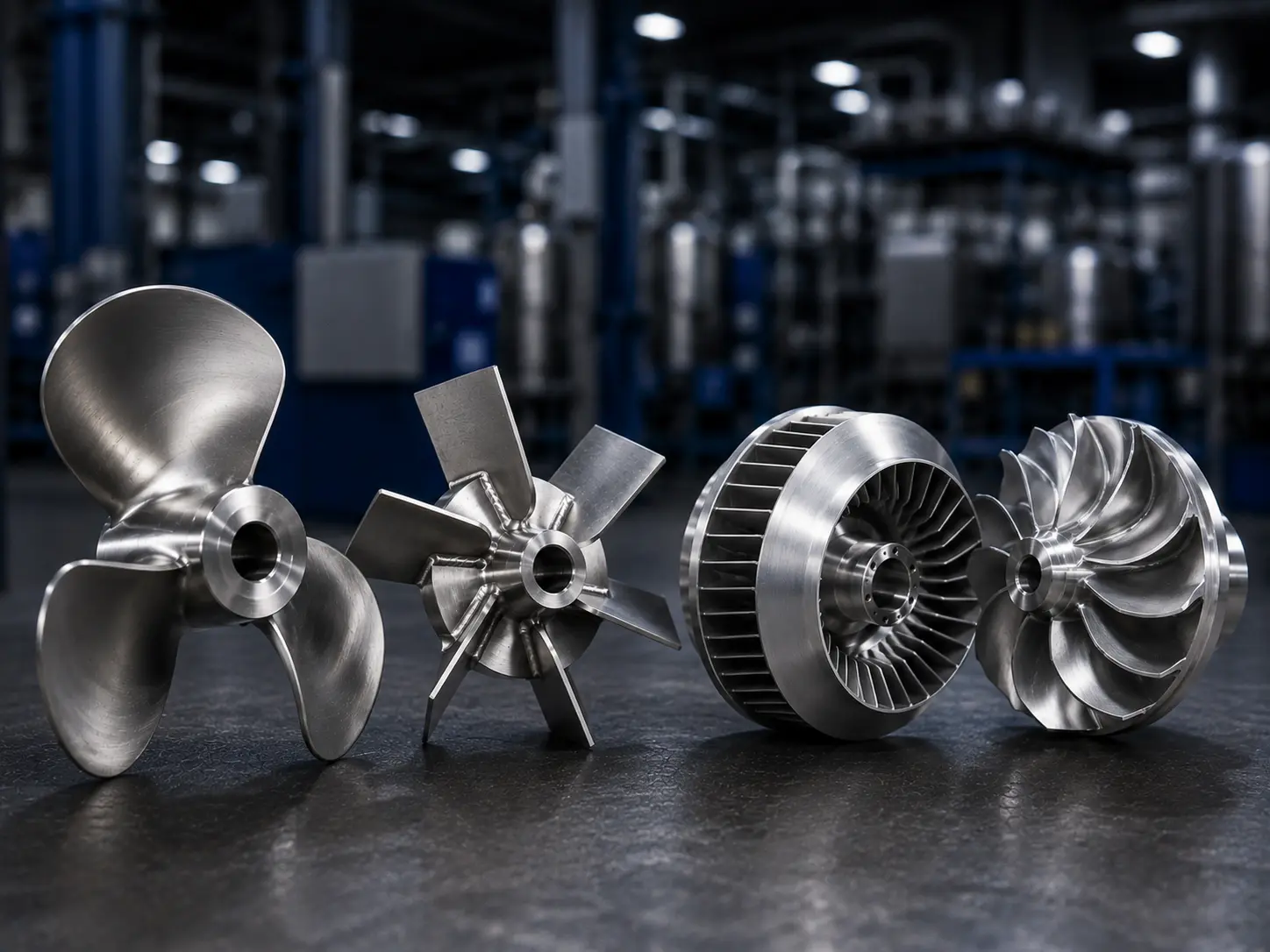
Matson’s impeller manufacturing capabilities support review of suitable drawing-based production routes, machining, finishing, balancing and inspection requirements. Material and surface requirements need approval against the fluid, solids, temperature and cleanliness conditions, not merely the word “slurry.”
The inspection plan should identify the drawing characteristics, datum references and report requirements. For fabricated components, agree joining and inspection scope. For cast and machined components, separate starting-condition acceptance from finished-interface inspection. A balance report, where required, does not establish suspension performance or correct blade geometry by itself.
What to send before requesting a quotation
| RFQ input | What to provide | Why it matters |
|---|---|---|
| Suspension endpoint | Off-bottom, concentration distribution, outlet delivery or another defined result | Prevents different suppliers quoting against different definitions |
| Particle and liquid data | Size distribution, densities, concentration basis, rheology and temperature range | Defines the conditions behind the approved selection |
| Installed arrangement | Tank drawing, levels, bottom shape, baffles, internals and impeller positions | Identifies geometry and interface constraints |
| Operating cases | Normal duty, interruptions, restart condition and approved equipment limits | Separates steady suspension from settled-bed recovery |
| Released component design | Revision-matched drawing/model, material, shaft connection and controlled blade geometry | Makes the qualified component reproducible |
| Acceptance and quantity | Inspection records, surface/balance requirements, sample and batch quantities | Makes quotations and delivered evidence comparable |
For suitable custom mixer and agitator impellers, Matson can review approved geometry and manufacturing requirements before quotation. If the process endpoint or operating window remains unresolved, label it as an open engineering item. A component quote should not be treated as qualification of a complete mixer or a guarantee of uniform suspension.
Questions to settle before ordering
Is off-bottom suspension enough for uniform solids distribution?
Not necessarily. Avoiding a persistent settled bed describes a different endpoint from maintaining an agreed concentration profile throughout the tank. Define both requirements if the process needs both. Specify sampling locations, timing and allowable variation for the distribution test. Visible motion or a clear floor does not establish that material withdrawn from every height or outlet has the required solids content.
What does Njs mean when selecting a suspension impeller?
Njs denotes a just-suspended speed under a defined criterion and operating arrangement. Its value needs an applicable correlation or test basis, with documented particles, liquid properties and geometry. It is not a universal motor setting or proof of uniform distribution. Ask the process owner to approve the method and operating window before a calculated speed becomes part of the equipment specification.
Can a hydrofoil always replace a pitched-blade turbine?
No. Compare the exact geometries against the same suspension endpoint, material properties and installed conditions. A hydrofoil family label alone does not establish equivalent process performance, shaft interfaces or mechanical loads. Any change should follow the OEM’s approval and qualification process. Manufacturing should reproduce the released geometry rather than substitute a visually similar impeller on the assumption that the two families are interchangeable.
Why is the particle size distribution important?
An average size can conceal a coarse fraction or agglomerates that behave differently from the majority of the feed. Supply the distribution, measurement basis, density and relevant shape or breakage information. Qualify the expected production range rather than a convenient sample alone. If particles dissolve or change during mixing, describe that evolution so the acceptance test represents the intended process condition.
Does higher speed always solve settled solids?
No. Higher speed does not remove the need to review bottom geometry, impeller position, internals and the defined process endpoint. It also changes equipment loading and potentially product-quality conditions. Any operating change must stay within the approved mechanical and process envelope. Investigate the cause of the observed deposits and validate the proposed change instead of using visible surface activity as the acceptance criterion.
Should shutdown and restart be included in the specification?
Yes, when the process requires recovery after settling. State the permitted interruption duration, expected bed condition and approved restart procedure. Maintaining a slurry already in motion does not demonstrate safe recovery of a consolidated bed. The equipment owner must approve startup loads and operating restrictions. Identify any necessary flushing or other intervention explicitly rather than assuming the impeller alone covers every restart situation.
Can the same D/T ratio guarantee suspension after scale-up?
No. Matching impeller diameter to tank diameter preserves one geometric ratio, not every operating or process condition. Liquid height, internals, particles, rheology and the chosen scale-up criterion still need review. Document which test evidence supports the larger arrangement and what remains unverified. Release a complete mechanical drawing for the production component rather than scaling every dimension by an informal copying rule.
What does a manufacturing inspection report prove?
It demonstrates the reported component characteristics against the agreed inspection requirements. Material records, dimensional measurements and balance results address different acceptance items. None alone proves the suspension endpoint in an installed tank. Keep component conformance separate from process qualification, and retain both sets of evidence where required. For repeat orders, control geometry revisions and approval responsibilities so the manufactured baseline remains traceable.
Final Thoughts
Keeping solids off the floor is useful only when it matches the process requirement. Define distribution, operating range and restart conditions before qualifying an impeller, then preserve the approved geometry through manufacturing. Matson can review suitable custom mixer components from released drawings and specifications. Send your drawing and RFQ with particle data, tank arrangement, material, quantity and inspection requirements so the quotation addresses a controlled component rather than an assumed process result.