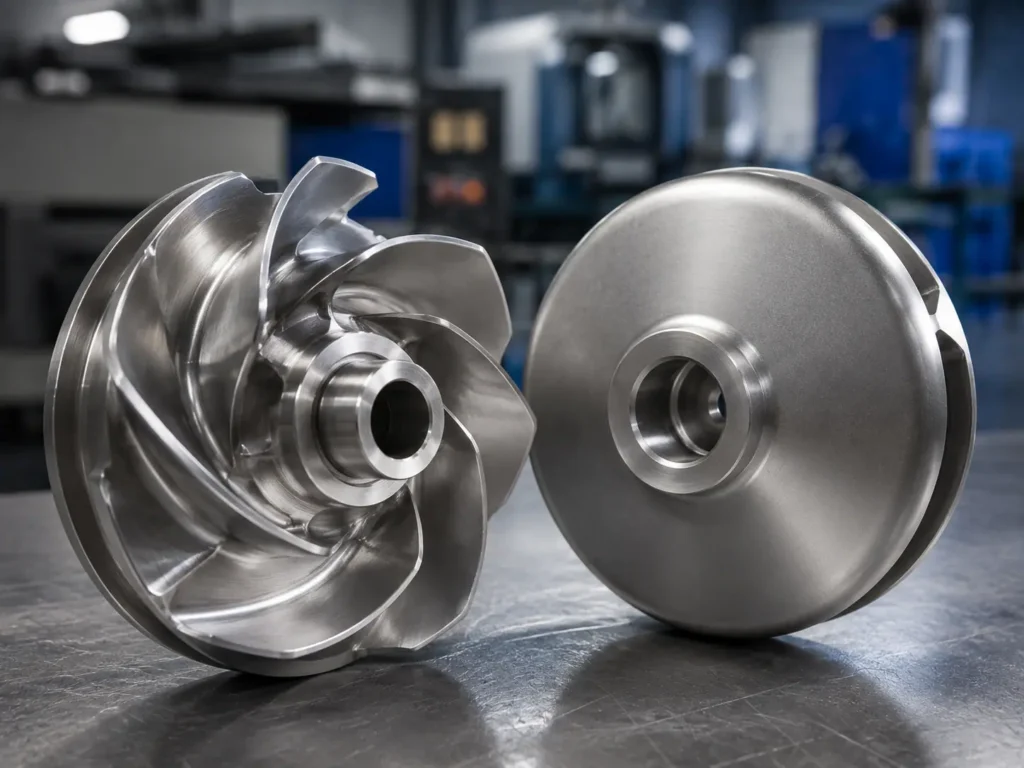
A vaned disc impeller is a mixer or agitator impeller built around a central disc with multiple vanes or blades attached around it. Many vaned-disc designs generate mainly radial flow and are used where strong local shear, gas dispersion, liquid blending, or solids-related mixing is required. The exact process result depends on blade form, disc diameter, vane dimensions, speed, tank geometry, baffles, fluid properties, and the approved mixer design.
For custom manufacturing, “vaned disc impeller” is not a complete specification. Buyers should provide the controlled drawing or 3D model, disc and blade geometry, shaft connection, material, weld requirements, surface finish, runout, balancing criteria, operating speed, quantity, and inspection plan. Matson can review manufacturing feasibility from drawings, files, or samples, while process sizing and mixing-performance approval remain with the mixer OEM or responsible engineer.
[Image placeholder: Add a real fabrication and inspection image of a stainless steel vaned disc impeller showing the central disc, radial blades, hub, bore, welds, blade spacing, and runout inspection setup. Alt text: “Vaned disc impeller geometry and manufacturing inspection”]
Main Parts of a Vaned Disc Impeller
The central disc divides or redirects flow near the impeller and provides a structure for the vanes. The blades create the working flow pattern. The hub or shaft connection transfers torque. Each part affects manufacturability, runout, balance, and service life.
| Feature | What the drawing should define | Manufacturing risk |
|---|---|---|
| Central disc | Diameter, thickness, flatness, center location, material, and edge condition. | Cutting heat, welding distortion, uneven thickness, or incorrect shaft-axis relationship. |
| Vanes or blades | Count, height, length, thickness, angle, profile, orientation, and spacing. | Uneven placement, profile variation, edge distortion, and unequal mass distribution. |
| Hub | Outside diameter, height, bore, keyway, spline, thread, mounting face, and fillet. | Poor shaft fit, incorrect axial position, runout, or weak disc-to-hub connection. |
| Welds or joints | Joint type, weld size, continuity, permitted process, finish, and inspection. | Distortion, incomplete fusion, cracks, excessive grinding, or inconsistent mass. |
| Finished assembly | OD, axial envelope, runout, balance, surface treatment, and marking. | Interference with tank hardware, vibration, poor fit, or surface contamination. |
The drawing should also define the direction of rotation when blade orientation is not symmetrical. “Clockwise” must include the viewing side.
Is a Vaned Disc Impeller the Same as a Rushton Turbine?
A Rushton turbine is a well-known type of disc turbine with flat vertical blades arranged around a central disc. It is one example within the broader vaned-disc family. Not every vaned disc impeller is a standard Rushton turbine.
Differences may include:
- Number of blades
- Flat, curved, concave, pitched, or otherwise profiled vanes
- Blade height, width, thickness, and radial position
- Disc diameter and thickness
- Openings, cutouts, or reinforced sections
- Hub and shaft connection
- One-piece, welded, bolted, or removable construction
- Surface finish and hygienic requirements
- Gas-dispersion or solids-handling features
Do not replace a buyer’s approved geometry with a generic six-blade disc turbine because the overall diameter looks similar. Process performance, torque, power, gas handling, and mechanical loads can change.
Radial Flow and Process Performance Need Engineering Ownership
Many vaned-disc impellers discharge flow outward from the shaft region and are described as radial-flow impellers. This can create strong circulation zones and local shear, particularly in a baffled tank. Gas dispersion duties may use the blade and disc arrangement to break and redistribute gas near the impeller.
That description is useful, but it is not a performance guarantee. Actual results depend on:
- Impeller diameter and rotational speed
- Blade geometry and disc-to-blade proportions
- Tank diameter and liquid height
- Impeller elevation and number of impellers
- Baffles, coils, draft tubes, and internal obstructions
- Liquid viscosity and density
- Gas flow rate and sparger arrangement
- Solids concentration, settling behavior, and particle properties
- Motor, gearbox, shaft, and mechanical design limits
Matson should manufacture to an approved mixer design rather than claim one universal power number, blend time, gas-dispersion rate, or solids-suspension result. The radial flow impeller guide explains the broader radial-flow category and its manufacturing checks.
Dimensions Buyers Should Send
A basic request such as “600 mm disc impeller, stainless steel” is not enough for production. Include:
- Finished impeller outside diameter
- Central disc diameter, thickness, flatness, and edge requirements
- Blade count, height, length, thickness, profile, and angle
- Blade radial position and spacing
- Overall axial height or blade envelope
- Hub diameter, height, bore, keyway, mounting face, and shaft fit
- Disc-to-hub and blade-to-disc joint details
- Weld size, length, location, sequence requirement, and permitted finishing
- Rotation direction and viewing convention
- Face and radial runout limits
- Static or dynamic balancing requirement
- Material grade and permitted equivalents
- Surface roughness, polishing, passivation, coating, or cleanliness requirement
- Operating speed, temperature, liquid, gas, solids, and corrosion exposure
- Quantity, inspection records, marking, and packing requirements
If a 3D model controls the blade geometry, the 2D drawing should still identify datums, critical dimensions, tolerances, material, weld symbols, finish, runout, balance, and inspection requirements.
Fabrication, Casting, or Machining Route
Many large vaned disc impellers are fabricated from cut plate, formed blades, a machined hub, and controlled welding. Other designs may use casting, direct machining, bolted components, or mixed routes. The approved route depends on geometry, size, material, quantity, mechanical load, cleanliness, and buyer requirements.
| Manufacturing route | Potential fit | Buyer checks |
|---|---|---|
| Plate fabrication and welding | Large disc-and-blade assemblies with accessible joints and approved welded construction. | Material certificates, cutting accuracy, fixtures, weld procedure, distortion control, finish, runout, and balance. |
| Casting plus machining | Integrated geometry, repeated quantities, or designs already approved for casting. | Casting method, allowance, defects, vane consistency, material control, machined interfaces, and inspection. |
| Direct CNC machining | Selected smaller or high-precision geometries where material removal and access are practical. | Stock form, datum strategy, tool access, surface finish, dimensional inspection, and cost. |
| Bolted or removable blades | Designs requiring assembly, transport, maintenance, or replaceable components. | Fasteners, locking, fits, joint faces, assembly sequence, torque, and balance after assembly. |
The manufacturing route should not be changed solely to reduce price. A change from cast to fabricated—or from welded to machined—can alter stiffness, mass, edge form, corrosion behavior, surface finish, and validation requirements. Obtain engineering approval before changing the process.
Matson’s impeller manufacturing capabilities include casting, CNC machining, selected fabrication, surface treatment, dimensional inspection, dynamic balancing, and export packing for suitable projects.
Welding Distortion Is a Dimensional Problem
Adding blades around a disc introduces heat unevenly. Without a controlled fixture and weld sequence, the disc can dish, the hub can move off-axis, blades can lean, and the final assembly can exceed runout or balance limits.
Useful controls include:
- Verified blade and disc materials before assembly
- Cutting and forming inspection before welding
- A fixture referenced to the shaft axis or approved datum
- Blade position and tack-weld inspection
- Balanced weld sequence
- Interpass and heat-input controls when specified
- Disc flatness and hub position checks during fabrication
- Final weld inspection before excessive grinding hides the joint
- Post-weld machining only where approved
- Runout and balance verification after final finishing
Cosmetic grinding is not the same as weld acceptance. If hygienic or high-finish service requires blended welds, the drawing should state the required profile, roughness, inspection, and passivation or electropolishing steps.
Material and Surface Finish Must Match the Duty
Stainless steel is common for corrosion resistance and cleanability, but the exact grade should come from the process owner. Duplex stainless, carbon steel, alloy steel, coated materials, or other choices may fit different duties.
Material review should consider liquid chemistry, temperature, chlorides, solids, cleaning agents, contamination limits, weldability, distortion, stress, and required documentation. An unapproved material substitution can change corrosion resistance, strength, fabrication behavior, and surface-treatment results.
For food, pharmaceutical, or high-cleanliness duties, the buyer may require specific surface roughness, weld blending, crevice control, passivation, electropolishing, and inspection records. Matson should claim these only when they are agreed and feasible for the project.
Runout and Balancing Are Separate Requirements
A vaned disc impeller can be dimensionally off-axis even if a balancing machine reduces residual unbalance. It can also meet runout limits while still having unequal blade mass or weld distribution. Inspect geometry and balance separately.
The buyer should define:
- Face runout of the disc
- Radial runout at the impeller OD or specified diameter
- Hub or bore concentricity
- Blade-position tolerance
- Balance standard or project-specific acceptance requirement
- Balance grade when applicable
- Operating speed and assembly condition
- Whether keys, fasteners, shaft hardware, or removable blades are included during balancing
- Permitted correction areas and methods
- Required report format
Do not assume one balance grade fits every mixer. The mixer OEM or engineering owner should define the mechanical acceptance criteria.
Sample-Based Reproduction Needs Caution
A used vaned disc impeller may have bent blades, worn edges, disc distortion, repaired welds, enlarged bore, corrosion, or previous balance correction. A scan or measurement captures the current sample, not necessarily the original design.
Photograph both sides, mark damaged areas, measure the shaft and mating parts, and identify which geometry comes from the sample versus an approved drawing or engineering decision. If several blades differ, do not average them without approval. The variation may be wear, distortion, poor prior manufacture, or intentional geometry.
Common Questions Buyers Ask
What is a vaned disc impeller?
It is a mixer or agitator impeller with multiple blades mounted around a central disc. Many designs generate radial flow and are used for blending, shear, gas dispersion, or solids-related duties.
Is a vaned disc impeller always a Rushton turbine?
No. A Rushton turbine is one familiar flat-blade disc-turbine design. Vaned disc impellers can use different blade counts, profiles, angles, disc proportions, hubs, and construction methods.
Can Matson design the mixing performance?
Matson can review manufacturing feasibility from approved drawings, models, samples, materials, and specifications. Process sizing, power, flow, gas dispersion, blend time, and mixing-performance approval should remain with the mixer OEM or process engineer.
Does a welded vaned disc impeller need balancing?
Many rotating mixer assemblies require a defined balance and runout check, especially at higher speed or with large welded structures. The buyer should specify the applicable acceptance criteria and assembly condition.
Can a vaned disc impeller be manufactured from a sample?
It can be reviewed, but worn blades, bent sections, repaired welds, disc distortion, bore wear, and balance corrections must be identified. Critical geometry should be confirmed before production.
Need a vaned disc impeller manufactured from a drawing, model, or sample? Send Matson the disc and blade geometry, hub and shaft connection, material, weld and finish requirements, operating speed, process condition, runout, balancing, quantity, inspection, and document requirements through the custom mixer impeller quote page.