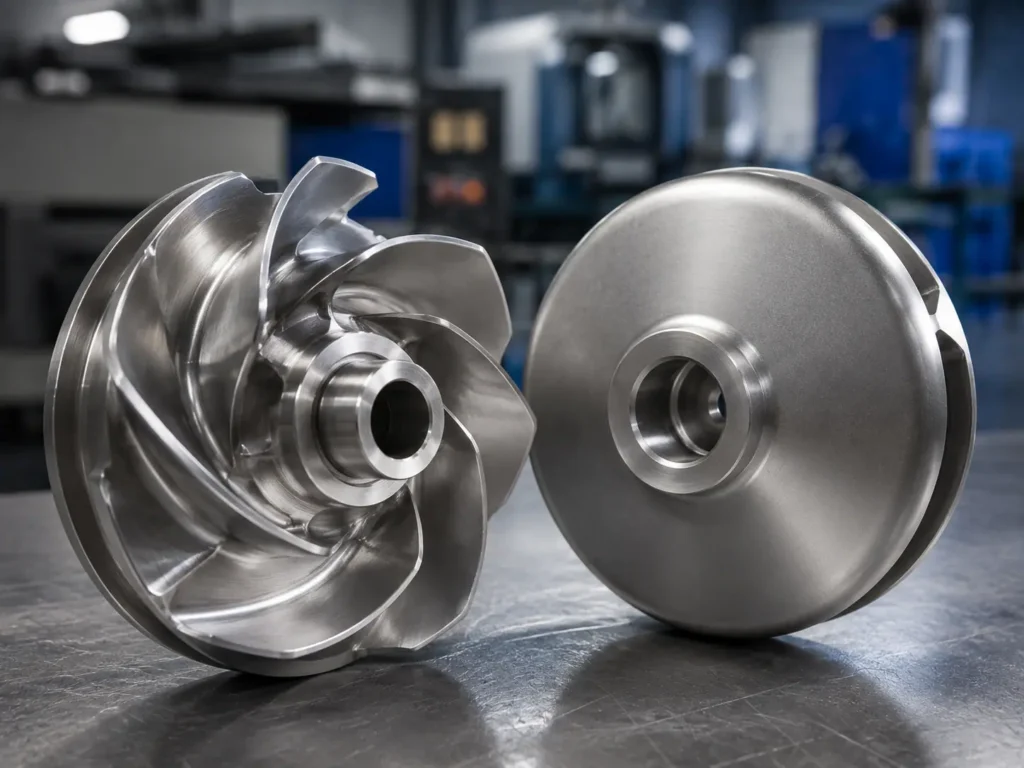
Choosing a custom impeller manufacturer in China is not only a price decision. For OEM pump, fan, blower, mixer, agitator, compressor, and industrial equipment projects, the safer choice is a manufacturer that can review drawings or samples, confirm the process route, control critical dimensions, provide material and inspection documents, and support repeatable export supply.
Short answer: buyers should choose a custom impeller manufacturer in China by checking product fit, drawing review ability, sample reproduction risk, casting and CNC machining capability, material certificate options, dynamic balancing, inspection reporting, batch consistency, and communication before RFQ approval. A low quote is not useful if the bore, hub, vane geometry, shaft fit, material, or balance requirement is not controlled.
Matson manufactures custom impellers for industrial OEM buyers, distributors, and equipment builders. Projects can include pump impellers, fan and blower impellers, mixer and agitator impellers, selected compressor impellers, and non-standard industrial impellers made from drawings, samples, or project specifications.
[Image placeholder: Add a real factory image showing custom impeller drawings, a physical sample, calipers, CNC-machined surfaces, and several finished pump or mixer impellers. Alt text: “Custom impeller manufacturer in China reviewing drawings samples and machined impellers”]
Start With the Project Type
The first filter is simple: does the manufacturer understand your type of impeller?
A custom pump impeller is not the same sourcing problem as a welded fan wheel or a tank agitator impeller. A pump buyer may care about casing clearance, wear-ring surfaces, suction eye condition, corrosion, abrasion, and dynamic balancing. A fan or blower buyer may care about blade shape, weld strength, hub fit, RPM, vibration, and balance correction. A mixer buyer may care about shaft connection, blade angle, surface finish, tank environment, and material compatibility.
For broad custom projects, Matson’s custom industrial impeller page is the main reference. If the project is pump-specific, start with the custom pump impeller page. If it is for a recurring OEM or distributor program, the supplier should also be able to discuss batch control and OEM impeller supply.
Custom Manufacturer vs Supplier
Some buyers search for “custom impeller supplier China” or “impeller supplier vs manufacturer.” The wording matters.
| Type | What it usually means | Best fit | Buyer risk |
|---|---|---|---|
| Trading supplier | A company that sources from one or more factories. | Simple purchasing, standard components, or when the buyer needs sourcing help. | Less direct control over drawing review, process route, inspection, and production feedback. |
| Custom manufacturer | A factory or manufacturing partner that reviews drawings, samples, materials, machining, balance, and inspection. | Custom pump, fan, blower, mixer, agitator, compressor, and OEM equipment impellers. | Still needs careful RFQ data; the manufacturer cannot guess missing dimensions or application conditions. |
| OEM supply partner | A manufacturer that can support repeat batches, documents, packing, revision control, and export communication. | Distributors, equipment builders, recurring production, and long-term part programs. | Prototype approval and batch consistency must be managed before scaling orders. |
A trading supplier is not always bad. For custom impellers, however, direct manufacturing review is important because small details can decide whether the part fits and runs correctly.
What the Manufacturer Should Ask Before Quoting
A serious custom impeller manufacturer should not quote only from one photo and a diameter.
For drawing-based projects, the factory should ask for 2D drawings, 3D files, material grade, quantity, revision number, tolerances, surface finish, balance requirement, and inspection documents. For sample-based projects, it should ask which areas are worn, previously welded, corroded, or broken, and which surfaces still represent the original design.
At minimum, expect questions about:
- Outside diameter, bore, hub height, shaft fit, keyway, mounting face, bolt pattern, and critical clearances
- Vane count, vane profile, inlet and outlet geometry, shroud structure, or blade angle
- Material grade, working fluid or gas, solids content, temperature, corrosion, abrasion, and speed
- Casting, fabrication, CNC machining, polishing, coating, passivation, or surface treatment needs
- Dynamic balancing, dimensional report, material certificate, photos, packing, and export documents
- Prototype quantity, first batch quantity, annual volume, and repeat-order expectations
If a supplier does not ask these questions, the price may look fast but the project risk is higher.
Process Route: Casting, CNC Machining, Fabrication, and Balancing
Custom impeller manufacturing often uses more than one process.
Investment casting may fit smaller or more complex stainless steel, bronze, or alloy impellers. Sand casting may fit some larger or heavier cast parts. Fabrication and welding may fit selected fan, blower, or mixer structures. CNC machining is often needed after casting or fabrication for bore, hub, mounting face, keyway, wear-ring surface, shaft connection, or other functional dimensions.
Balancing should not be treated as a final afterthought. If the impeller is large, fast, heavy, or used in vibration-sensitive rotating equipment, the buyer should confirm balancing before production. For manufacturing-route details, Matson’s impeller manufacturing page explains casting, CNC machining, surface treatment, dynamic balancing, inspection, and export packing.
OEM Buyers Should Check Repeatability
One sample is not the same as a supply program.
For OEM pump, fan, blower, mixer, or industrial equipment projects, buyers should check whether the manufacturer can keep the same drawing revision, material grade, machining datum, inspection point, balance requirement, and packing method across repeat orders. This matters more than a small price difference.
Useful questions:
- Can the manufacturer keep drawings and revisions clear?
- Can the same critical dimensions be inspected every batch?
- Can material certificates or balance reports be provided when requested?
- Can first-article approval or sample confirmation be handled before batch production?
- Can the factory pack impellers safely for export so machined surfaces and blades are protected?
For export buyers, communication is part of capability. A factory that understands drawings but does not clarify documents, packing, shipping, or revision changes can still create delay.
Buyer Checklist Before Choosing a Supplier
Use this checklist before approving a China custom impeller supplier.
| Check item | What to confirm | Why it matters |
|---|---|---|
| Product fit | Pump, fan, blower, mixer, agitator, compressor, slurry, chemical, marine, HVAC, or OEM equipment context. | The supplier must understand the part category before choosing a process route. |
| Drawing or sample quality | Complete drawing, usable sample, clear photos, damaged-area notes, revision control, and critical dimensions. | Missing data creates quote errors and fit problems. |
| Material confirmation | Stainless steel, duplex stainless, bronze, carbon steel, alloy steel, aluminum, high-chrome alloy, or other specified grade. | Material affects casting, corrosion, wear, machining, certificate, and cost. |
| Critical machining | Bore, hub, keyway, mounting face, wear-ring surface, shaft connection, OD, and inspection datum. | These surfaces often decide assembly fit and running stability. |
| Balancing | Whether dynamic balancing is required, what report is needed, and when balancing should be done. | Balance affects vibration, bearing load, and OEM acceptance. |
| Documentation | Material certificate, dimensional report, balancing report, photos, packing list, and export documents. | Documents must be planned before production if they are required. |
| Repeat supply | Prototype, first batch, annual volume, revision control, packing, and re-order process. | OEM projects need consistency, not only one successful sample. |
When Matson Is a Good Fit
Matson is a good fit when the buyer needs drawing-based or sample-based custom impeller manufacturing rather than catalog retail parts.
Good-fit projects include:
- Pump impellers for industrial water, wastewater, chemical, marine, mining, and OEM pump projects
- Fan and blower impellers for HVAC, process air, ventilation, dust collection, and industrial equipment
- Mixer and agitator impellers for chemical processing, wastewater treatment, food and beverage equipment, and tank systems
- Custom industrial impellers that need casting, CNC machining, surface treatment, dynamic balancing, inspection, and export packing
- Prototype, pilot-run, recurring batch, distributor, and OEM supply projects
Matson is based in Shijiazhuang, Hebei, China, and the current site positioning is a China-based custom impeller manufacturer for industrial OEM buyers, distributors, and equipment builders. Final feasibility still depends on the drawing, sample condition, material, tolerance, balance requirement, quantity, and application environment.
Common Questions Buyers Ask
How do I choose a custom impeller manufacturer in China?
Check whether the manufacturer understands your impeller type, can review drawings or samples, can choose a suitable process route, can machine critical dimensions, can provide balancing or inspection documents, and can support export communication.
Is a custom impeller supplier the same as a manufacturer?
Not always. A supplier may trade or source parts, while a manufacturer should be able to review the drawing, process route, material, machining, inspection, and production risks directly. For custom OEM projects, direct manufacturing capability is usually more important.
What should I send before asking for a quote?
Send a 2D drawing or 3D file, sample photos, material grade, key dimensions, quantity, application, operating conditions, surface finish, tolerance, balancing requirement, inspection document needs, and shipping destination.
Can a manufacturer make an impeller from a worn sample?
Yes, but a worn sample needs careful review. The buyer should identify damaged surfaces, send measurements, confirm original fit dimensions, and avoid assuming every worn area represents the original design.
Can Matson support OEM impeller projects?
Yes. Matson can review custom impeller projects from drawings, samples, material requirements, quantities, and application conditions. For a specific project, send drawings, sample photos, material grade, quantity, and documentation needs through the custom impeller quote form.