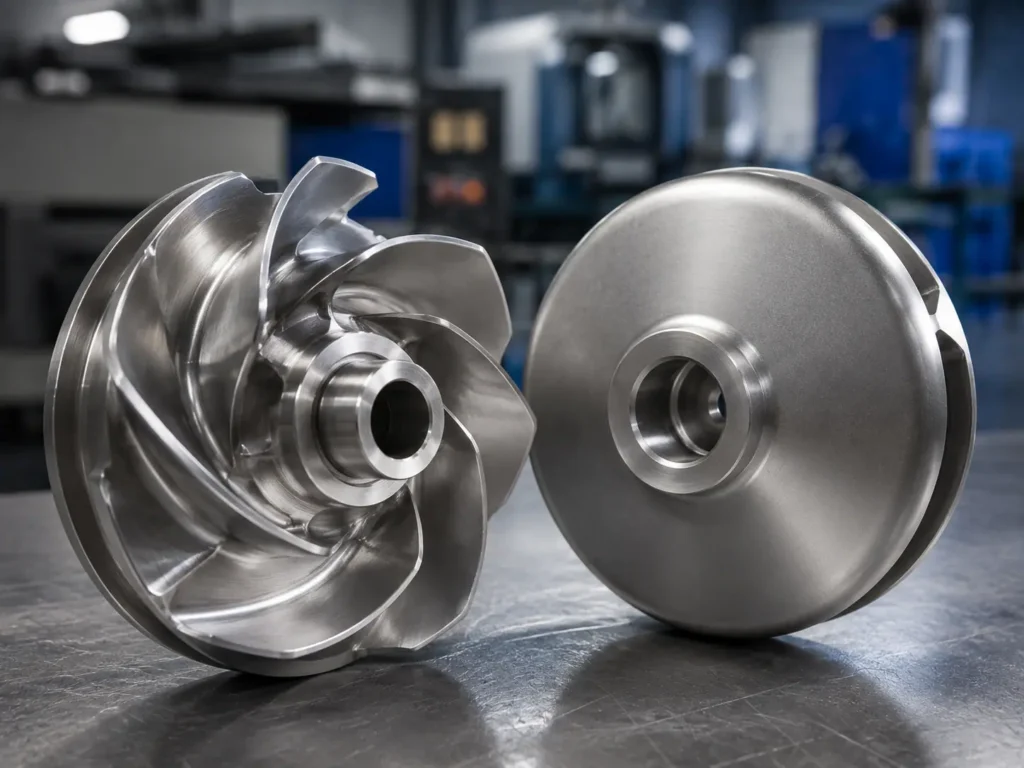
Buyers searching for an impeller manufacturer in China are usually not looking for a random list of company names. They are trying to reduce sourcing risk. A stronger way to compare Chinese impeller manufacturers is to check whether the supplier can match the impeller type, material, casting or machining route, balancing requirement, inspection documents, and export communication needed for the project.
Short answer: the best impeller manufacturer in China for a custom project is not always the largest factory or the lowest quote. For pump, fan, blower, mixer, agitator, compressor, and OEM equipment impellers, buyers should compare process capability, drawing review, sample reproduction experience, material control, dynamic balancing, inspection reports, and whether the supplier understands B2B export requirements.
Matson is a China-based custom impeller manufacturer for industrial OEM buyers, distributors, and equipment builders. The company manufactures drawing-based and sample-based impellers for pumps, fans, blowers, compressors, mixers, agitators, and non-standard industrial equipment.
[Image placeholder: Add a real factory image showing several custom pump, fan, blower, and mixer impellers with drawings or inspection tools on a workshop table. Alt text: “Custom impeller manufacturer in China comparing pump fan blower and mixer impellers”]
Why a Fake Top 10 List Is Not Very Useful
Many sourcing articles use titles like “top impeller manufacturers in China” and then list companies without showing how they were evaluated. That format looks convenient, but it does not help a buyer who has a real drawing, a worn sample, a balance requirement, or a material certificate request.
For custom impellers, the comparison should start with the part. A closed pump impeller, a stainless steel mixer impeller, a backward-curved blower wheel, and a high-chrome slurry pump impeller may all be called “impellers,” but they do not require the same manufacturing route.
The practical question is not only “Who makes impellers in China?” It is:
- Can the supplier understand this drawing or sample?
- Can they choose a suitable casting, machining, or fabrication route?
- Can they control the bore, hub, keyway, vane geometry, mounting face, and balance?
- Can they provide the documents needed for import, inspection, or OEM approval?
- Can they communicate clearly before money and time are committed?
That is why this guide uses a buyer evaluation framework instead of pretending to rank factories from the outside.
Manufacturer Comparison Checklist
Use this table when comparing impeller manufacturers in China. It works for pump impellers, fan wheels, blower impellers, mixer impellers, and many drawing-based industrial parts.
| Evaluation point | What to check | Why it matters |
|---|---|---|
| Impeller category fit | Pump, fan, blower, compressor, mixer, agitator, slurry, wastewater, marine, HVAC, or custom industrial equipment. | A supplier that understands the category can ask better RFQ questions and avoid treating every impeller as the same part. |
| Drawing or sample review | 2D drawing, 3D file, photos, worn sample condition, critical dimensions, revision control, and missing data. | Custom impellers often fail because the bore, hub, clearance, vane profile, or mounting face was not reviewed before quote. |
| Manufacturing route | Investment casting, sand casting, CNC machining, fabrication, welding, surface treatment, or combined process route. | The wrong route can increase cost, create dimensional risk, or make the part difficult to inspect and balance. |
| Material control | Stainless steel, duplex stainless, bronze, carbon steel, alloy steel, high-chrome alloy, aluminum, or heat-resistant steel. | Material choice affects corrosion resistance, abrasion resistance, casting quality, machining, price, and certificate requirements. |
| Dynamic balancing | Whether balancing is available, when it is needed, and what report or grade the buyer expects. | Impellers are rotating parts. Poor balance can create vibration, bearing load, noise, and early failure. |
| Inspection documents | Dimensional report, material certificate, balancing report, photos, packing list, and export documents. | OEM buyers and distributors often need records before approving a supplier or repeating batch orders. |
| Export experience | Communication, packing, shipping terms, document handling, and response speed. | A capable local factory still needs export discipline if the buyer is outside China. |
Compare by Impeller Type, Not Just by Price
A very low quote can be tempting. It can also hide a mismatch between the supplier and the part.
For a pump impeller manufacturer, buyers should confirm the pump type, liquid, solids content, corrosion condition, finished outside diameter, bore, hub height, keyway, wear-ring or casing clearance surfaces, material, and balancing requirement. A pump impeller quote based only on outside diameter is not enough.
For fan and blower projects, the buyer should check whether the supplier has experience with fan and blower impellers, backward-curved or forward-curved blades, radial blade wheels, airfoil fan impellers, hub fit, weld control, and balancing. A supplier that mainly makes pump castings may not be the right fit for a fabricated blower wheel unless they can show the right process route.
For mixer and agitator projects, the buyer should confirm shaft connection, blade style, tank environment, material, surface finish, weld quality, runout, and whether the impeller is a propeller, pitched-blade turbine, hydrofoil, anchor, paddle, or dispersion design. Matson’s mixer impeller manufacturer page is the better landing page for that product-line intent.
For recurring OEM or distributor supply, the buyer should also check batch consistency, packing, repeat-order communication, and whether the manufacturer can support repeatable OEM production rather than only one-off sample jobs.
Casting, CNC Machining, and Fabrication Capability
Many custom impellers are not made by one process only.
A cast pump impeller may still need CNC machining on the bore, hub, mounting face, wear-ring surfaces, keyway, or outside diameter. A welded fan wheel may need fixture control, hub machining, and balance correction. A mixer impeller may need formed blades, welded supports, machined shaft connection, polishing, or passivation.
When comparing Chinese impeller suppliers, ask how the factory will make the part:
- Is investment casting or sand casting suitable?
- Which surfaces will be CNC machined after casting or fabrication?
- Does the supplier understand where machining allowance is needed?
- Can the factory inspect the critical dimensions before shipment?
- Does the balance requirement need to be planned before surface treatment or packing?
Matson’s impeller manufacturing capability covers casting, CNC machining, surface treatment, dynamic balancing, inspection, and export packing for custom industrial impeller projects.
Material Certificates and Inspection Are Not Small Details
For many industrial buyers, “stainless steel” is not enough information. A chemical process pump may need 316L. A seawater pump may need bronze, duplex stainless, or another corrosion-resistant grade confirmed by the buyer’s environment. A mining slurry impeller may need high-chrome or wear-resistant alloy. A fan wheel in a hot process-air system may need a heat-resistant steel.
Before choosing an impeller supplier in China, ask what documentation can be provided:
- Material certificate or chemical composition report when requested
- Dimensional inspection report for critical surfaces
- Dynamic balancing report if balance is part of the order
- Photos before packing
- Surface finish or treatment confirmation
- Export packing and shipping documents
Do not add documentation requirements after production if they are important. Some reports must be planned before or during manufacturing.
Drawing-Based and Sample-Based Projects Need Different Review
A complete drawing is usually the cleanest starting point. It gives the manufacturer geometry, material, dimensions, tolerances, revision control, and inspection points.
A physical sample can also be useful, especially when the original drawing is missing. But a sample is not automatically reliable. The part may be worn, corroded, welded, trimmed, broken, or distorted. A bore may be enlarged. Vane edges may be damaged. A hub face may no longer show the original height.
For custom sourcing, it is often worth preparing a better RFQ before asking for the lowest quote. A complete RFQ helps the manufacturer check the drawing, sample condition, material, dimensions, balance requirement, and inspection documents before giving a serious price.
At minimum, send:
- 2D drawing or 3D file if available
- Photos from front, back, side, bore, hub, keyway, vane, and damaged areas
- Material grade or working environment
- Quantity and expected repeat order plan
- Speed, balance, surface finish, and inspection requirements
- Application: pump, fan, blower, mixer, compressor, slurry, chemical, marine, HVAC, or OEM equipment
When Matson May Fit the Shortlist
Matson is a practical shortlist option when the buyer needs a custom impeller made from drawings, samples, or project specifications rather than an off-the-shelf retail replacement.
Good-fit projects include:
- Custom pump impellers for industrial water, wastewater, chemical, marine, mining, and OEM pump applications
- Fan and blower impellers for HVAC, process air, dust collection, ventilation, and industrial equipment
- Mixer and agitator impellers for tanks, chemical processing, wastewater treatment, and industrial mixing equipment
- Drawing-based or sample-based impellers that need casting, CNC machining, surface treatment, dynamic balancing, inspection, and export packing
- OEM, pilot-run, recurring batch, and distributor supply projects
Matson should be positioned carefully. It is not a consumer parts store, and a final quote still depends on the drawing, material, tolerance, balance requirement, quantity, and application.
Questions to Ask Before Choosing a China Impeller Supplier
Before sending payment or approving a sample, ask these questions:
| Buyer question | Good supplier response | Warning sign |
|---|---|---|
| Can you review this drawing or sample before quoting? | The supplier asks about material, dimensions, worn areas, balance, quantity, and application. | The supplier quotes immediately from one photo. |
| Which process route do you suggest? | The supplier explains casting, machining, fabrication, or mixed-route options. | The supplier says every impeller is made the same way. |
| Which dimensions are critical? | The supplier checks bore, hub, keyway, mounting face, OD, clearance, and vane geometry. | The supplier only asks for outside diameter. |
| Can you provide material and inspection documents? | The supplier confirms what can be documented before production starts. | The supplier treats certificates and reports as an afterthought. |
| Can you support repeat orders? | The supplier discusses drawings, revision control, batch quantity, packing, and export communication. | The supplier only talks about one sample price. |
Common Questions Buyers Ask
What is the best impeller manufacturer in China?
The best supplier depends on the impeller type, material, manufacturing route, balance requirement, inspection documents, and export needs. A buyer should compare real capability instead of trusting a generic ranking list.
Can a China impeller supplier make parts from samples?
Yes, many custom manufacturers can review physical samples, but worn samples need caution. Buyers should identify damaged areas, send measured dimensions, and confirm critical fit surfaces before production.
Should I choose casting or CNC machining for a custom impeller?
It depends on the geometry, material, tolerance, quantity, and functional surfaces. Many impellers use casting or fabrication first, then CNC machining for the bore, hub, mounting face, wear surfaces, or other critical dimensions.
Do custom impellers need dynamic balancing?
Many rotating impellers need dynamic balancing, especially when they are large, fast, heavy, or used in vibration-sensitive equipment. The balancing requirement should be discussed before production.
What should I send to Matson for an impeller quote?
Send a drawing or sample photos, material grade, key dimensions, quantity, application, surface finish, tolerance, balancing requirement, inspection document needs, and shipping destination. You can also contact Matson for a custom impeller quote with your drawing or sample details.